
Trading platform & site functionality
At first glance, zhoutiphex.com is a crypto-themed landing site that nudges visitors to register for an account. The layout relies on a mass-market theme (“deepblue/lave”) with prominent buttons and orange icons touting features like “buy/sell bitcoins,” “strong security,” and “world coverage.” The presence of a blockchain.info ticker and a bitcoin.com widget feels designed to evoke legitimacy through familiar brands without establishing any relationship or authorization. A live chat widget (JivoChat) is embedded to steer conversations, sometimes a hallmark of boiler-room style outreach where agents quickly push visitors toward deposits.
Under the hood, the site includes Google Translate elements and media pulled from assets.mixkit.co, plus a YouTube embed used to pad the page with video content. A reference to a TradingView timeline-like script is made through a local path that mirrors an external endpoint—an integration pattern that looks like a superficial port rather than an authentic, documented partnership. None of this translates into real, auditable functionality: there is no visible order book, no authenticated trading dashboard preview, and no clear evidence of custody arrangements or liquidity venues.
The copy is vague and heavy on crypto buzzwords, giving no specifics on spreads, fees, slippage handling, or execution quality—basic criteria for assessing a trading or exchange platform. There is no listing of available trading pairs, market depth indicators, or proof-of-reserves statements. Prospective clients cannot see the mechanics of how deposits are safeguarded nor how withdrawals are processed, timed, or prioritized. Key operational disclosures are missing, which under normal due diligence would be a stop sign.
Crucially, the site title (“Zhoutiphex Incorporations”) and the call-to-action (“Register to get your own personalized account”) sound like a generic account-gathering funnel rather than a mature exchange or brokerage. This minimalism—combined with third-party widgets, ambiguous branding, and the absence of professionally drafted legal pages—suggests marketing veneer over any real infrastructure. While many modern platforms use CDNs and off-the-shelf components, legitimate firms still surface transparent compliance, fees, and corporate details. Zhoutiphex offers none of that.
License & regulatory status
We found no credible evidence that Zhoutiphex is authorized by any major market regulator. A licensed entity soliciting crypto or trading activity would typically appear in databases maintained by the UK Financial Conduct Authority (FCA), Germany’s BaFin, Italy’s CONSOB, Australia’s ASIC, Switzerland’s FINMA, or, for U.S. derivatives, the CFTC and the NFA. Our review found no matches for this operator under those registers. The site itself does not display any license number, nor does it reference a supervised entity responsible for client funds.
It bears repeating: unregulated is not a trivial label. If a platform takes deposits and purports to run an exchange or investment service, lack of authorization is a direct risk to depositors and a likely violation of local laws where solicitation occurs. Even in permissive crypto jurisdictions, serious platforms communicate their compliance posture, identify responsible legal entities, and provide documentation on custody and AML/KYC processes. Zhoutiphex does none of this, and that silence speaks volumes.
We also looked for regulator warnings but could not independently verify public notices specifically naming Zhoutiphex. Absence of a warning is not a clean bill of health—many fraudulent domains operate briefly and below the radar, rotating branding to avoid explicit blacklisting. The stronger sign is what is missing: there is no license claim to verify, no audited financials, no custody arrangements named, and no disclosures about where client assets would be held.
Given the site’s design choices and solicitation of crypto, users should assume they have zero statutory protections. In the EU and UK, retail clients enjoy stringent guardrails when dealing with regulated firms—negative balance protection, segregation of client funds, and complaint avenues including the Financial Ombudsman Service (FOS) in the UK. None of these backstops apply here. If Zhoutiphex vanishes, customers are left with little more than a domain that can be repointed overnight.
User feedback
We did not find credible, established third-party review histories for Zhoutiphex on respected consumer-complaint platforms. That lack of footprint is itself instructive: reputable financial platforms tend to accumulate traceable feedback, press mentions, or industry scrutiny. Fraudulent websites often have minimal public history, spin up quickly, and disappear before patterns of complaints can coalesce in mainstream databases.
While we cannot cite verified individual complaints specific to Zhoutiphex, the hallmarks of similar operations are well documented. Victims commonly report sudden withdrawal blockages once an account shows a profit, followed by demands for additional deposits (“release fees,” “tax clearances,” or unexpected “KYC upgrades”) before funds can supposedly be released. Other recurring themes include aggressive “account managers” who pressure clients to top up balances, and unresponsive support once clients resist depositing more.
Another common tactic in this segment is the “surprise KYC after deposit” move. Clients are encouraged to deposit first to “activate” or “verify” an account, and only when a withdrawal is attempted does the platform insist on new documents or payments. The objective is not compliance—but leverage: to stall withdrawals and trap funds indefinitely. The combination of template aesthetics, absence of formal documentation, and emphasis on crypto is fully compatible with that playbook.
In short, the ecosystem of complaints around similarly structured sites is consistent and grim: ghosted support, moving goalposts for verification, arbitrary fees, and accusations of “market volatility” conveniently wiping out balances. Without licensing, without a real-world company presence, and without visible accountability, users who send funds may find themselves with no recourse the moment they ask for their money back.
Deposits & withdrawals
The site’s integrations suggest a strong push toward cryptocurrency deposits, with references to bitcoin.com widgets and blockchain.info ticker data. We could not locate clear statements about accepted payment methods such as cards or bank wires, nor any contractual terms covering processing times, fees, or the right to withhold withdrawals. That omission is critical: legitimate platforms carefully disclose their onboarding and offboarding rails.
Crypto transfers are final and irreversible by design. That is precisely why poor actors prefer them: once the funds move to an address under their control, there is no intermediary to dispute the transfer. Without transparent withdrawal policies, clients have no way to anticipate turnaround times, limits, or due diligence requirements—making it alarmingly easy for the operator to stall indefinitely behind vague “compliance checks.”
We also did not find credible evidence of an audited custody solution or a third-party wallet management policy. Authentic exchanges publish at least some technical or procedural detail about hot/cold storage splits, signing policies, and contingency measures. Zhoutiphex offers none of that, depriving users of any basis to trust that deposits—if sent—are safeguarded in a controlled environment.
Why unregulated brokers are risky
Entrusting capital to an unregulated platform removes the protections that retail clients justifiably expect. There is no prudential oversight to ensure client assets are segregated from operating accounts, no capital adequacy rules, no requirements to handle complaints within fixed timelines, and no formal escalation path if the operator goes dark. When something breaks, you are on your own.
In the event of a dispute, regulated platforms must generally cooperate with ombudsman or regulator-led resolution processes; unregulated sites do not. They can deny, delay, or deflect without consequence, all while continuing to solicit new deposits. Even if you gather evidence, the cross-border nature of such schemes and the use of anonymity tools make enforcement slow and uncertain.
Finally, the risk is asymmetric. If you send funds and the platform behaves, you can withdraw—perhaps—until the operator changes its stance. If the platform is bad-faith from day one, every deposit works against you. The only reliable defense is not to send money in the first place, especially when the website provides no license, no legal identity, and no operational transparency.
How to get help if you’ve been scammed
If you already deposited with zhoutiphex.com, act quickly. First, document everything: screenshots of the dashboard, chat transcripts, emails, wallet addresses, and transaction hashes. If you paid by card or bank transfer, contact your issuer immediately and request a chargeback or recall citing suspected fraud. For crypto transfers, provide the transaction IDs and the destination addresses so your bank or a forensic team can trace flows if needed.
Report the incident to your national authority. UK residents should file with Action Fraud; EU residents can notify their national police and consumer protection agency; U.S. victims should file at IC3.gov and notify their state regulator if applicable. If the platform contacted you across borders, mention that in your report—it can elevate the case priority and trigger information-sharing between agencies.
For hands-on guidance, you can contact us at reportscammedfunds.pro. Our publication specializes in evidence preservation, regulator reporting, and strategic recovery steps, including countering common follow-on frauds such as “recovery scams” that target victims a second time. Do not engage with unsolicited “asset recovery” pitches that demand upfront fees—these are almost always fraudulent. Use reputable channels, coordinate with your bank, and let us help you structure your case with the strongest possible evidentiary trail.
Conclusion
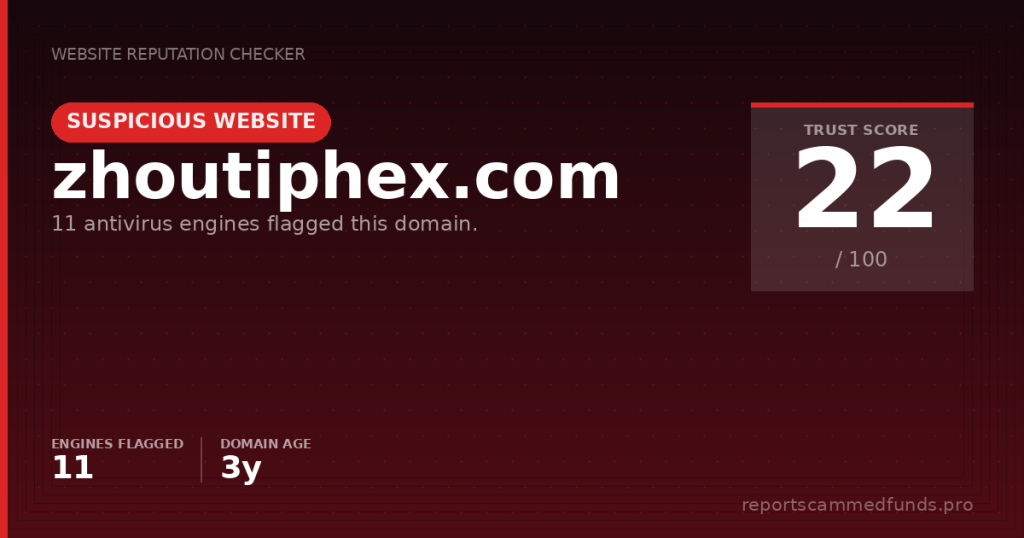
Zhoutiphex Incorporations fails every basic credibility test: no license, no legal identity, no disclosures about custody or withdrawals, and a template-heavy interface that leans on third-party widgets to simulate substance. Multiple engines flag the domain as malicious, and the operational opaqueness is consistent with high-risk, short-lived scam sites.
There is no scenario in which depositing funds here is prudent. If you are evaluating crypto venues, restrict yourself to platforms with clear regulatory status, long-standing public track records, auditable disclosures, and verifiable corporate footprints. Anything less is gambling with counterparties you cannot identify, let alone hold accountable.
Our recommendation is unequivocal: do not register, do not deposit, and do not provide documents to zhoutiphex.com. If you have already engaged, follow the recovery steps detailed above and reach out to reportscammedfunds.pro for case assistance.