
Trading platform & site functionality
YI Miner presents itself as a cloud-mining platform for major cryptocurrencies, featuring a glossy landing page that highlights BTC, ETH, DOGE, and LTC. The site employs a standard front-end stack—Bootstrap styling from a public CDN, a live chat widget via JivoSite, and Cloudflare services for email obfuscation and performance telemetry. Rather than a full investment prospectus, the site is built as a marketing funnel with prominent imagery of mining gear, a 'plans' section, and generic benefit statements. We did not find granular technical details: no data center addresses, no mining pool IDs, no machine fleet lists (e.g., S19 XP quantities), and no power contracts. That lack of operational specificity is material, because legitimate miners typically publish at least some proof-of-work footprint to build trust.
On the client side, the page sets a basic PHP session cookie and loads a handful of images and icons that depict asset logos and steps to get started. There is no downloadable client software, and the experience appears to revolve around a web dashboard the user would reach only after creating an account and depositing funds. Cloudflare’s browser insights scripts are present, which is commonplace but does not validate the business model. We observed no whitepaper, audited financial statements, or attestation from a recognized accounting firm—resources reputable mining operations often commission to demonstrate solvency and capacity.
From a user-experience standpoint, the design borrows heavily from mainstream landing-page patterns: hero slider banners, icon rows for supported coins, a 'how it works' section, and a FAQs block. However, the copy is thin on quantifiable metrics: it does not disclose specific hashrates per plan, data about uptime guarantees, maintenance fee schedules, or realistic payout volatility. There is also no transparent fee table for electricity, repair, or pool fees, all of which determine real-world profitability for miners. Without those numbers, users are asked to accept future 'profit' on faith—an especially dangerous premise in crypto mining where margins are razor-thin and highly cyclical.
The live chat widget may create a veneer of responsiveness, but in similar operations it is often a sales channel rather than a service line with recourse. We saw no corporate identifiers on the footer—no company registration number, no incorporated entity name, and no registered office address—which makes it difficult to perform routine due diligence. The absence of third-party review badges (e.g., SOC 2 for data centers, ISO certifications, or miner-pool partnerships verifiable on-chain) compounds the trust deficit. In net, the site functions like a marketing wrapper for deposits without the technical controls, transparency, or performance data expected from a real mining business.
License & regulatory status
If a platform invites the public to put capital at risk for the promise of returns, it enters a regulatory perimeter in many jurisdictions. Mining-as-a-service may look different from a brokerage account, yet it can still constitute an investment contract—bringing it under securities or consumer-investment rules depending on the country. We found no claim of authorization from the UK Financial Conduct Authority (FCA), Germany’s BaFin, Italy’s CONSOB, Australia’s ASIC, the US CFTC/SEC, or any other major supervisor. Equally important, the site does not list the legal entity operating the service, which would be the minimum required to verify licensing assertions.
We searched public registers where possible and did not find an obvious match for 'YI Miner' as a supervised investment firm. That said, we could not independently verify every jurisdictional registry, and this is not a substitute for legal advice. The burden to prove authorization lies with the operator; when none is provided, prudence dictates that consumers assume it is unregulated. This is especially true in crypto mining, where numerous Ponzi-style contracts have operated under similar branding, only to disappear when withdrawals exceed new inflows.
Regulators across the EU, UK, and North America have repeatedly warned consumers about cloud-mining pitches that guarantee returns or make passive-income claims without independent audits. The FCA and ESMA routinely remind investors that cryptoassets are high risk and largely unprotected, and that unregulated operators can vanish overnight with customer funds. In the US, both the SEC and the CFTC have pursued promoters of fraudulent digital-asset schemes masquerading as mining opportunities. While YI Miner is not named in a specific public warning we could locate, its lack of licensing and absence of verifiable disclosures align uncomfortably with patterns regulators describe in enforcement bulletins.
User feedback
We did not find a credible volume of independent, third-party user reviews from reputable consumer-protection portals that would substantiate successful long-term payouts. In the absence of trustworthy testimonies, paid testimonials and on-site 'success stories' should be treated as marketing content rather than evidence. Too often, clone sites and recycled templates populate short-lived domains, generate an initial flurry of glowing comments on low-moderation platforms, and then go dark after deposits slow.
Across the broader category of unregulated mining sites, the complaint themes recur with striking regularity: withdrawals are 'pending' indefinitely, payout thresholds are suddenly raised after users reach them, surprise 'maintenance' or 'verification' fees appear after profits accrue, and support becomes evasive. Another frequent pattern is the 'account review hold' following a withdrawal request, where users are asked for yet more deposits to 'unlock' funds. These are textbook post-deposit friction tactics designed to stretch time and extract additional payments.
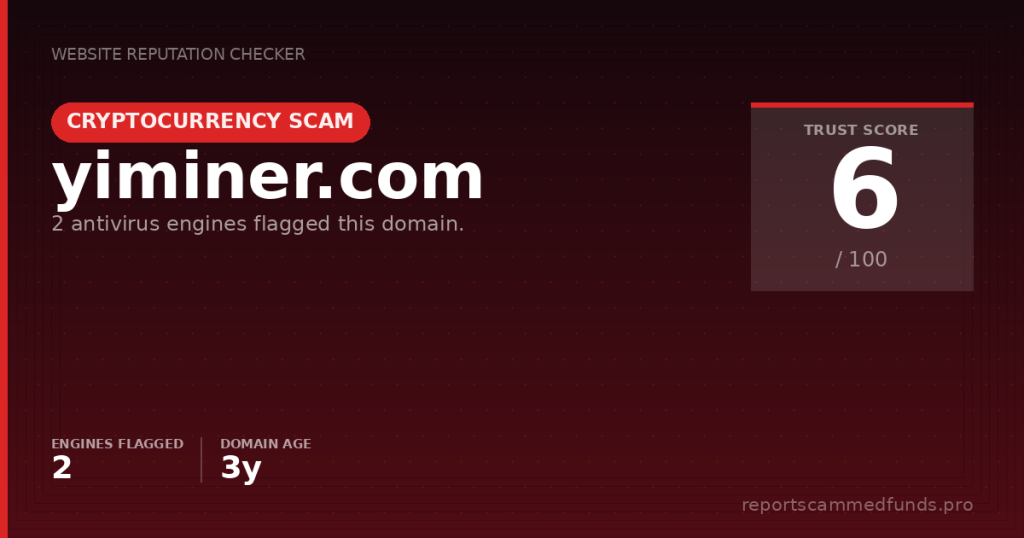
Given YI Miner’s limited transparency and the risk tags assigned by independent scanners, readers should assume that their experience could mirror those negative patterns. In such scenarios, even if an initial small payout is processed to build confidence, larger withdrawals are often delayed or denied. The absence of a verifiable corporate entity makes any dispute or chargeback more complex, especially when deposits are in cryptocurrency.
Deposits & withdrawals
The branding and iconography suggest support for popular cryptoassets—BTC, ETH, USDT, LTC, DOGE, SOL, XRP, TRX, and others—but the site does not present a clear, enforceable schedule of fees, payout minimums, or withdrawal timelines in an audited document. Without those basic parameters, customers cannot model expected cash flows or weigh maintenance and electricity charges against theoretical income. In legitimate mining contracts, the operator usually discloses the hashrate per purchased unit, the pool used, block reward assumptions, and exact fee deductions.
Users should be cautious about any platform where deposit addresses are provided before a formal contract, and where there is no cross-checkable billing entity on invoices. Crypto transfers are generally irreversible; once coins are sent to a destination, they cannot be clawed back like a card chargeback. Some unregulated operations will also pressure users to convert fiat to stablecoins on third-party exchanges and then send those funds onward—this makes the money flow harder to recover and pushes liability to the user.
If you have already deposited with YI Miner and your withdrawal is stalled or subject to new, unexpected fees, consider that a critical red flag. Do not send further 'unlock' or 'tax' payments; legitimate firms do not require a second deposit to release your first. Document all communications, transaction hashes, and timestamps now, as that evidence will be important if you pursue recovery options with your bank or report to authorities.
Why unregulated brokers are risky
Placing funds with an unregulated crypto operator means you do not benefit from investor protection schemes, mandated segregation of client assets, prudential capital requirements, or audit obligations. In the event of a platform failure or refusal to honor withdrawals, there is typically no compensation scheme to make you whole. Dispute resolution is complicated further by jurisdictional ambiguity and the operator’s deliberate lack of a verifiable address.
Because on-chain transactions are final, recovery depends largely on how you paid. Card or bank payments may support chargeback or recall pathways in some cases, but only if you act quickly and present a coherent fraud narrative. Transfers in crypto are harder: you can present evidence to your exchange’s compliance team and request a freeze if the funds touch a KYC’d venue, but success rates vary and depend on timing, cooperation, and regional law enforcement.
Cloud-mining sales pages frequently blur the line between realistic, market-driven profitability and guaranteed yields. In mining, profitability depends on hashrate, network difficulty, block rewards, coin price, electricity cost, downtime, and pool fees—all variables beyond a vendor’s control. Any site glossing over those drivers or implying fixed returns is implicitly misrepresenting risk.
How to get help if you’ve been scammed
If you have already sent money to yiminer.com and suspect fraud, act immediately. For card or bank payments, contact your issuing bank to file a chargeback or recall and classify the merchant as an unauthorized or deceptive investment. If you paid in crypto, open a ticket with the exchange you used to purchase or transfer funds, provide transaction hashes, and request their compliance team to flag the recipient wallet.
Report the incident to your national authority: in the UK, submit to Action Fraud; in the US, file with the FBI’s IC3; in the EU, contact your national police cybercrime portal; in Australia, use ReportCyber. Include screenshots, URLs, wallet addresses, and all correspondence. Early reporting increases the chance of intervention if the funds pass through regulated choke points.
For specialized assistance compiling evidence, mapping fund flows, and coordinating parallel complaints, you can contact our investigative team at reportscammedfunds.pro. We cannot guarantee recovery, but we can help you prepare stronger case files for banks, exchanges, and regulators, and advise on next steps to minimize ongoing exposure. Do not engage with unsolicited 'recovery agents' who demand upfront fees—these are often the start of a second scam.
Conclusion
Nothing we observed on yiminer.com meets the burden of proof a prudent investor should require before committing funds to a mining contract. The site lacks licensing, discloses no verifiable operational footprint, and carries third-party risk tags associated with crypto scams. These shortcomings are not cosmetic—they go to the heart of whether a service is real or a façade.
Until the operator discloses a legal entity, provides independently verifiable mining activity (including pool statistics and hardware audits), and obtains proper authorization where required, the rational stance is to abstain. Anonymity and opacity are strategies, not oversights, in this segment of the market. When combined with a ready-made deposit flow and no meaningful recourse, the risk profile is unacceptable.
Our safety-first recommendation is to avoid depositing with YI Miner and to warn others in your network who may be targeted by similar pitches. If you are determined to explore crypto mining, consider building your own rig under your control or selecting a transparent, audited operator with a multi-year track record and named leadership—while accepting the very real market risks intrinsic to mining economics.