
Trading platform & site functionality
At first glance xenovalley.com reads like a turnkey crypto exchange landing page. It greets visitors with sweeping claims such as being “the leading cryptocurrency exchange” and promises access to spot markets, futures, and what it calls “safe bets” on coins. The page is designed with modern UI components, using Google Fonts, Material Design Icons, and popular front-end libraries. A live-feeling dashboard shows charts and trending tickers, which is visually persuasive for newcomers. However, the website is primarily a marketing shell that encourages registration before disclosing critical details such as fee schedules, terms, or governance.
Under the hood the charts appear to be powered by Chart.js with quotes fetched from external endpoints, including Binance-linked APIs. That approach is common on templates meant to simulate a functioning trading venue: the site is simply rendering third‑party market data rather than demonstrating any internal order book or custody capabilities. The presence of external price feeds does not prove there is a backend exchange, nor that client funds would be handled by any licensed custodian. Some users conflate live-looking charts with institutional-grade infrastructure; in our view, that is an unsafe assumption here.
We also noted marketing tropes familiar on high-risk crypto pages. A graphic referencing Trustpilot appears in the hero area, yet there is no direct link to a verifiable profile tied to this brand. A floating chat icon and support badges are present, but they do not, by themselves, prove meaningful service levels. Crucially, we found no transparent description of the legal entity behind the operation, no corporate address, and no established whitepaper or security policy. Put together, the emphasis leans heavily toward lead capture while keeping consequential facts behind a registration wall.
License & regulatory status
Legitimate crypto exchanges that serve retail investors typically advertise their compliance posture front and center, listing licence numbers and the jurisdictions where they are authorised. In the UK, for example, the FCA register lists cryptoasset firms permitted to conduct certain activities; in the EU, national registers (and the unified MiCA regime as it rolls out) name authorised service providers; in Australia, ASIC regulates certain services; and in the United States, money services businesses are expected to register with FinCEN and, often, obtain state-level money transmitter licences, in addition to falling under the purview of the CFTC and SEC where derivatives or securities are implicated. Xenovalley.com provides no such disclosures.
We could not independently verify this brand on major public registers such as those of the FCA, BaFin, ASIC, or the CFTC. The site itself does not publish a licence number, a registered legal entity, or jurisdictional limitations for its offer. This silence is significant because xenovalley.com advertises access to spot and futures markets—areas that, in many countries, trigger explicit oversight and suitability rules. Absent proof of authorisation, users have no assurance that funds are segregated, audits are performed, or basic consumer-protection regimes are in place.
We also did not find regulator-issued warnings naming this domain in the databases we routinely monitor at the time of review. That absence is not an endorsement; many newly created schemes operate for weeks or months before a consumer-protection agency issues a public alert, if it issues one at all. The responsible stance is to treat missing licensing and undisclosed corporate identity as disqualifying for any platform soliciting deposits or inviting “safe bets” on volatile assets.
User feedback
Independent user feedback is thin to non-existent for this brand at the time of writing. The landing page’s trust-badge imagery is not accompanied by a link to a verified, named review profile for Xenovalley, and a search did not surface a credible corpus of third‑party experiences that could be validated. In other words, there is no reliable base of customer histories one could use to benchmark the platform’s withdrawal behaviour, dispute handling, or uptime. For a site asking for deposits, this scarcity of established feedback should be seen as a major caution signal.
Across the broader category of similarly structured crypto sites, we regularly track a number of recurring complaint themes once deposits begin. These include withdrawal blockages triggered only after accounts show profits, sudden and retroactive KYC hurdles imposed after funds are committed, and “tax” or “liquidity” fees demanded in advance of release. We also hear of “account managers” pushing users into higher‑risk trades or additional funding rounds, leading to a salvage spiral when initial withdrawals fail. None of these patterns have been specifically verified for xenovalley.com, but they are common enough in the sector to warrant a preventive mindset.
If any readers have first-hand experience with xenovalley.com, we encourage detailed, documented reporting to relevant authorities and to our editorial desk. Bank statements, email headers, chat logs, and screenshots of dashboards can materially help investigators reconstruct timelines. Absent such verifiable evidence, the safest inference is that the operator has not accumulated a transparent public record, which is not what you want in a counterparty that could be holding your assets.
Deposits & withdrawals
The site invites registration before disclosing the basics of funding, fees, or conditions for withdrawals. We found no publicly posted fee table, no stated minimum deposit, and no clear policy on settlement timeframes or daily limits. Legitimate venues typically declare supported channels—cards, bank wires, specific crypto networks—along with network fee treatment, cut-off times, and compliance checks. Hiding such fundamentals behind a sign-up wall is not automatically deceitful, but it strongly limits a customer’s ability to comparison‑shop risk before committing money.
In the risk cases we investigate most often, problematic platforms use a predictable funnel that begins with easy funding and cheerful assistance, only to introduce friction at the moment of withdrawal. This can include rejecting transfer requests unless users first pay a supposed “verification fee,” asking for additional deposits to “unlock” profits, or citing an unmapped compliance review that remains perpetually “in progress.” Some even disable the withdrawal button altogether after an account shows gains, while allowing further deposits to proceed. None of those behaviours are disclosed or denied on xenovalley.com’s public pages, which is precisely the problem: the absence of rules means customers cannot pre‑assess fairness.
Before sending a cent, insist on reading the full terms and conditions, especially the sections on: withdrawal queues and timing; identity verification requirements; any taxes, commissions, or liquidity fees; negative‑balance and margin rules (if futures are indeed offered); and complaint or arbitration procedures. If these documents are not clearly available pre‑registration, treat that as a red flag rather than an invitation to experiment with small deposits, because “testing with a small amount” is exactly how many victims are lured into comfort before scaling up exposure.
Why unregulated brokers are risky
Handing funds to an unregulated platform means you are operating outside the normal guardrails that retail investors rely on. There is no prudential supervision, no obligation to segregate client assets, and no capital or audit standards enforced by a competent authority. If anything goes wrong—whether via platform failure, operational disputes, or outright misappropriation—you have no guaranteed recourse, compensation scheme, or ombudsman to appeal to. In practice, recovery becomes a race against time and traceability.
Crypto markets themselves are volatile, and that risk is compounded when matched with opaque operators. A venue that cannot point to its legal domicile or regulatory permissions can also change terms unilaterally, alter spreads, or simulate fills without accountability. If the entity is offshore or hiding its principals, even a court victory on paper may not translate into recoverable assets or cooperation from custodians. This structural asymmetry is why regulators like the FCA, BaFin, and ASIC repeatedly warn consumers to use only authorised firms.
There is also a secondary risk that many overlook: data exposure. Registration with an unvetted site often requires scanning passports, proof of address, and card details that, once uploaded, can be monetised even if no deposit is made. We routinely see that data resurface in later “recovery scam” approaches, where impostors claim they can get your funds back—for an upfront fee. Keeping your identity documents and payment profiles away from unverified platforms prevents that long tail of harm.
How to get help if you’ve been scammed
If you have already deposited with xenovalley.com and are facing withdrawal delays or new fee demands, act quickly. Contact your bank or card issuer immediately to file a dispute or chargeback; provide a clear timeline, transaction IDs, screenshots of the platform, and any written promises about withdrawal rights. If you sent cryptocurrency, compile the exact wallet addresses and transaction hashes, as on‑chain forensics can support law‑enforcement referrals and exchange blacklisting.
Report the matter to your national authority. In the UK, that is Action Fraud and, where derivatives are claimed, the FCA. In the United States, file with the FTC and the FBI’s IC3; if futures or leveraged products are involved, the CFTC may also be relevant. In the EU, report to your country’s financial regulator and police cybercrime unit; in Australia, report to ASIC and Scamwatch. Multiple reports from different victims increase the chance of coordinated action and intelligence sharing.
For tailored assistance, you can reach our team at reportscammedfunds.pro. We help victims organise evidence, liaise with banks and relevant platforms, and avoid the common trap of recovery scams that ask for “release fees.” Use a secure channel, redact sensitive data as advised, and be prepared to verify identity—we will never ask for remote desktop access or upfront payments to “unlock” funds. The earlier you document each step, the better the prospects for intervention.
Conclusion
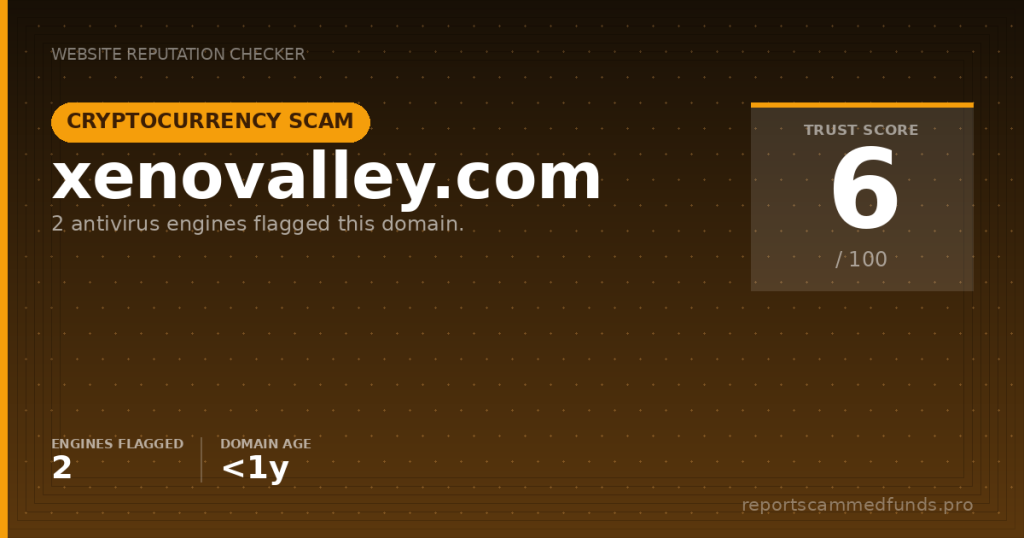
On balance, xenovalley.com exhibits too many unresolved risks for us to recommend engagement. The domain is very new, the operator is unidentified, no licences are disclosed or independently verifiable, and the site leans on third‑party market data to project the look and feel of a live exchange. Trust‑signalling graphics are present but unsubstantiated, and essential terms around deposits, fees, and withdrawals are kept out of sight until registration.
Crypto investing is already hard enough when conducted through regulated, well‑documented channels. Adding an unregulated counterparty with no public track record shifts the odds further against the retail user. If you are intent on exploring this venue despite the warnings, protect yourself: do not upload identity documents, do not wire funds, and certainly do not scale exposure based on a smooth initial “test withdrawal,” which is a known tactic to build confidence before larger losses.
Our recommendation is straightforward: avoid this site and choose providers with clear, verifiable regulatory status, transparent ownership, and years of demonstrable operation. Always cross‑check a firm’s claims against official registers, and never be rushed by offers of bonus credits, guaranteed returns, or “safe bets” on volatile assets. Caution now is far cheaper than a recovery effort later.