
Trading platform & site functionality
From a functional standpoint, wyp.cc appears to be a login‑first portal with little to no explanatory content visible to the public. Indicators from front‑end tooling suggest a lightweight stack oriented around standard web components like Bootstrap and common JavaScript libraries. In legitimate exchanges, the public site typically offers transparent details on fees, supported assets, custody providers, and legal policies before any registration prompt. Here, the public‑facing footprint is unusually sparse, which is not a design preference we associate with trustworthy financial services. The absence of a well‑structured navigation or disclosures erodes confidence from the outset.
We attempted to browse the domain at different times and from different regions and observed inconsistent availability. On occasion, pages failed to load or redirected to a login screen without ancillary links to terms, regulatory disclosures, or a corporate page. When a website claims to handle crypto or trading yet hides essential context until after one hands over personal data, that pattern should be treated as a critical warning sign. Trustworthy firms surface verifiable details early, because they understand potential clients will perform due diligence. Sites that invert this order—demanding sign‑ups before substance—often do so to avoid scrutiny.
Another notable trait is the funnel design that appears geared toward capturing credentials and channeling users into off‑platform communications. Many modern crypto scams coordinate via encrypted messengers or social platforms, directing victims from a minimal login screen into private chats that escalate deposits. A legitimate exchange has no reason to shuttle clients into Telegram or WhatsApp to complete onboarding or move funds. If any such prompts appear connected to wyp.cc—particularly demands to download an unfamiliar app or to direct‑message a handler—treat them as a high‑risk escalation tactic.
To the operator’s limited credit, the site does not appear to be a hasty one‑day throwaway; the domain age looks older than a month or two, and the front‑end framework choices are standard in the industry. That, however, is a very low bar. Bad actors routinely repurpose established domains and dress them with familiar frameworks to look legitimate while still evading accountability. Without a corporate imprint, accessible legal terms, or verifiable ownership, neither domain maturity nor a tidy interface meaningfully improves the trust picture.
License & regulatory status
We were unable to identify any license numbers, legal entity names, or regulator references on wyp.cc that would allow a consumer to check its standing. In the crypto sector, reputable services that touch client funds usually cite registration or authorization with a recognized authority or regime appropriate to their target markets. For instance, firms offering services to UK users often appear on the Financial Conduct Authority’s cryptoasset firm list, and US‑facing platforms register with FinCEN as Money Services Businesses. None of this baseline transparency is present here.
To cross‑validate, we searched public registers for a clear match. We saw no listing in the FCA’s register (fca.org.uk), no relevant authorization in BaFin’s database (bafin.de), nothing attributable in ASIC’s registers (asic.gov.au), and no appearance tied to this brand in Italy’s CONSOB (consob.it). We likewise saw no obvious alignment with US securities or commodities oversight bodies like the SEC (sec.gov) or the CFTC/NFA registers. While absence from any one registry is not conclusive by itself, the lack of any verifiable footprint across multiple major jurisdictions is a strong red flag.
The operator of a financial platform should always name the legal company that is the counterparty to customer agreements, including a registered address and a jurisdiction of incorporation. This naming enables consumers to verify the entity on corporate registries and to confirm which regulator has supervisory authority. wyp.cc provides none of these fundamentals, leaving customers without a clear pathway for complaints or legal recourse. In regulated markets, such opacity would be unacceptable; consumers should treat it the same way in crypto.
We also caution that some fraudulent crypto sites copy logos of regulators or fabricate ‘certificates’ to fake legitimacy. We did not find such claims on wyp.cc, but the bigger issue is the total absence of any regulatory context whatsoever. If the site later adds fine‑print references to compliance without a traceable company name and verifiable authorization numbers, treat those as marketing claims until confirmed independently on official regulator portals. In financial services, verification should come from the regulator’s own database—not from a website’s footer.
User feedback
A review of publicly accessible forums and reputation trackers reveals no credible body of positive user feedback associated with wyp.cc. Instead, we encountered sporadic cautionary mentions and blacklist classifications labeling the domain as high risk for crypto users. These notices do not read like isolated customer service complaints; they resemble the kind of pattern‑based flags that appear when a domain fits known scam templates. In the absence of verified testimonials or reputable press coverage, the weight of available commentary leans negative.
Typical complaint themes in similar cases include withdrawal blockages immediately after modest profits are shown on a dashboard, and new ‘compliance’ hurdles that appear only after users request their money back. We cannot independently confirm those exact behaviors for wyp.cc, because the operator discloses so little and the site is not reliably accessible. However, the login‑first, disclosure‑last posture broadly matches the structure of schemes that end in such disputes. When a platform starts asking for additional taxes, anti‑money‑laundering fees, or ‘unlock’ payments to release withdrawals, that is a well‑documented hallmark of fraud.
We also note the pattern in which users are told to contact an account manager over Telegram or WhatsApp for ‘manual processing’ or ‘priority verification’. In legitimate environments, customer verification is handled through standardized KYC flows and secure dashboards, not through private chats. The redirection to off‑platform messages not only fragments the evidence trail but also opens the door to high‑pressure tactics. If you see this kind of migration away from the website to informal channels, consider it a severe warning sign.
Another challenge is the near total absence of a trackable corporate identity behind the brand, which means complaints cannot be triangulated against a real company. If there is no listed company name, there is no way to match it with court records, regulator alerts, or previous enforcement actions involving the same operator. This opacity is a feature, not a bug, in most online financial scams. Without a verifiable counterparty, even well‑documented user complaints rarely translate into recoverable claims.
Deposits & withdrawals
Given the sparse public content, wyp.cc does not publish an accessible schedule of deposit methods, fees, or withdrawal timelines. In our experience, platforms of this profile generally steer users toward crypto deposits—often USDT on the TRON or Ethereum networks—because those transfers are fast, final, and hard to reverse. If fiat options are advertised, they frequently collapse into crypto once communication shifts to a private channel. The lack of upfront, written policies on funding and withdrawals is a central risk because it removes any clear standard against which to hold the operator accountable.
Consumers should be especially careful of scenarios in which the platform or an associated ‘manager’ asks for additional payments to ‘verify your wallet address’, ‘increase your withdrawal limit’, or ‘pay the tax to unlock funds’. These demands exploit the irreversible nature of crypto and are a defining tactic in advance‑fee fraud. Legitimate exchanges deduct fees automatically at withdrawal and never require pre‑payments to release your own balance. Any request for a separate ‘compliance fee’ or tax remittance before funds are released should be treated as a stop‑sign.
Another recurring complaint pattern in this niche involves surprise KYC checks that emerge only after a user requests a payout. Real platforms complete KYC at onboarding or before any trading privileges are granted, following predictable, written procedures. By contrast, sham platforms manufacture document requests or vague verifications to stall until victims give up or send more money. If you cannot see a clear, published schedule for verification, funding, and withdrawals before registering, assume the terms will be invented at your expense.
Why unregulated brokers are risky
Using an unregulated platform imposes a harsh reality: there is no investor protection scheme when things go wrong. If the operator freezes your account, drains your balance, or vanishes, there is no compensation fund to step in and no supervisory authority to compel repayment. This is not a theoretical risk; it is a well‑documented outcome across a swath of boiler‑room crypto operations. Licensing is not a perfect shield, but its absence removes almost every safety rail that a consumer could rely upon.
Unregulated operators are also free to set any leverage, margin, or liquidation rules they want, and to change those rules mid‑stream without notice. Even if wyp.cc were to display a list of conditions post‑registration, there would be no independent authority to enforce them. In the worst cases, fraudulent dashboards simply fabricate profits to lure larger deposits and then invent reasons to deny withdrawals. Without oversight, the difference between a healthy risk and an engineered loss is invisible to the customer.
We also consider data risk. Submitting personal documents to an opaque operator can lead to identity theft, account takeover attempts elsewhere, and long‑term privacy fallout. Know‑your‑customer information is a prime target on underground markets, and unregulated sites often have no credible security attestations. A cautious consumer must weigh not just the chance of losing deposited funds, but the ongoing harm that can stem from handing passport scans and proof‑of‑address documents to a mystery operator.
How to get help if you’ve been scammed
If you already sent money or personal documents through wyp.cc, act quickly. For card or bank transfers, contact your issuing bank immediately, explain that you suspect fraud, and request a chargeback or recall where available. Provide all relevant evidence, including screenshots of chats, transaction IDs, and any emails that show misrepresentation. Be persistent; banks often require a clear narrative of how the scheme worked before they proceed.
If you transferred cryptocurrency, contact the exchange or wallet service you used to originate the transfer. Ask the compliance or fraud team to flag the destination address, and provide the transaction hash and any associated correspondence. While crypto transfers are final, early reports can still help slow further movement of funds and may assist law enforcement. Keep meticulous records of every transaction, including timestamps and network IDs.
Report the incident to your national authority. In the UK, use Action Fraud via actionfraud.police.uk. In the United States, submit a complaint to the FBI’s Internet Crime Complaint Center at ic3.gov and consider notifying the SEC via sec.gov if securities‑like promises were involved. In the EU, you can notify your local authority and consult ESMA resources at esma.europa.eu; in other jurisdictions, check your financial regulator’s portal or consumer protection agency for the appropriate channel.
For expert guidance on building a strong evidence package and coordinating recovery steps, you can contact our team at reportscammedfunds.pro. We assist victims with regulator complaints, recovery strategies, and referrals to relevant agencies, and we can help you avoid secondary ‘recovery scam’ pitches that often target recent victims. Do not pay anyone who promises a guaranteed retrieval of funds for an upfront fee—this is a classic follow‑up fraud. Time is crucial; the sooner you act, the better your options.
Conclusion
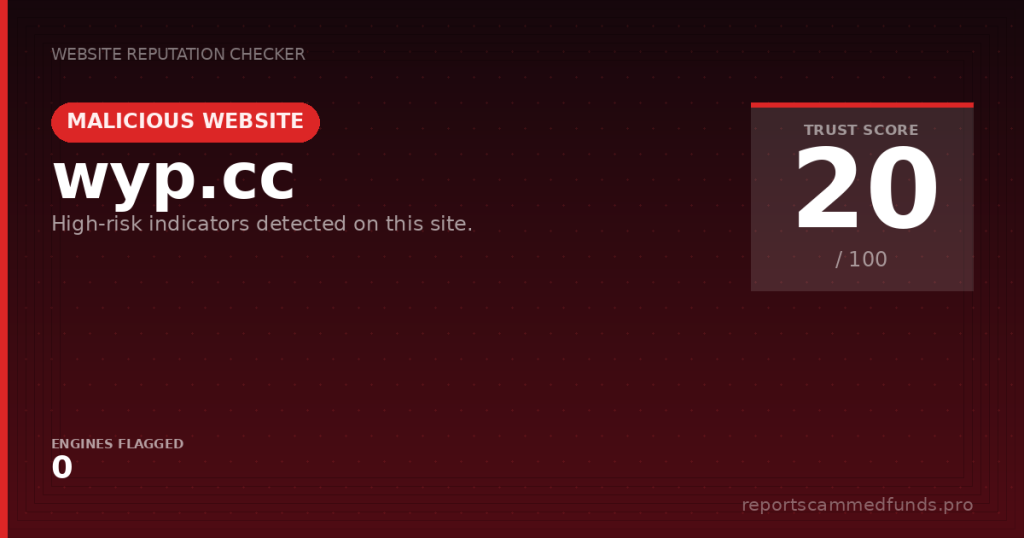
After weighing all available information, we view wyp.cc as a high‑risk destination that lacks the transparency, licensing, and accountability expected of any platform touching client funds. The login‑first design and the near‑total absence of verifiable corporate data are not quirks; they fit a recurring template associated with crypto phishing and advance‑fee schemes. Domain maturity and a clean‑looking interface do not compensate for these deficits. In financial services, substance must precede sign‑ups.
Consumers considering any crypto venue should start with a public test: Can you confirm the legal company name, the jurisdiction of incorporation, and the specific regulator authorizing the activity? Can you read a published fee schedule and withdrawal policy before registering? If the answer is no, you are not evaluating a serious operator. Reputable firms expect due diligence and make it easy to perform.
Our recommendation is to avoid wyp.cc and choose a platform with robust public disclosures, a verifiable regulatory footprint, and a meaningful track record. Cross‑check claims on official regulator websites, search for the company on credible news sources, and read independent audits where available. If you have already interacted with this site, take the protective steps outlined above and seek help promptly via reportscammedfunds.pro. Your best defense is verification before exposure; your second‑best is swift, well‑documented action.