
Trading platform & site functionality
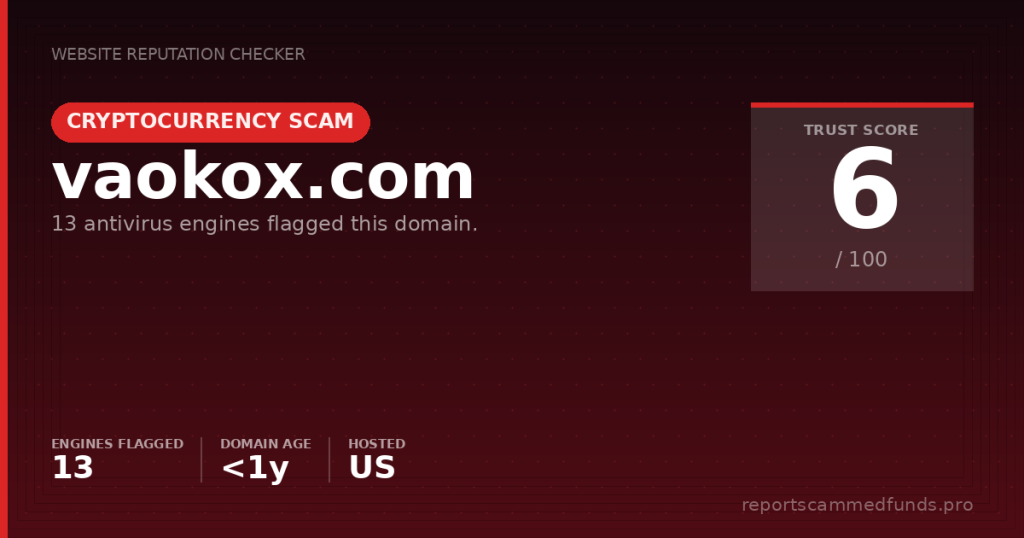
Vaokox positions itself as a blockchain-first crypto casino promising secure bets and transparent smart contracts. The public tagline, “Most Popular Online Crypto Casino Based on Blockchain,” is paired with a description that claims the service has been running since 2017. That assertion clashes with the actual domain registration, which is dated June 2026. This disconnect is a significant credibility concern: established casinos typically show a long-lived domain history, clear operator information, and references to independent audits, none of which are plainly visible here.
From a technical standpoint, the site behaves like a modern single-page application, delivering many bundled JavaScript chunks that suggest a Next.js-style frontend. It loads analytics and real user monitoring via a major content delivery and security provider, and fetches custom tracking scripts (commonly used for marketing attribution). Preloader assets with labels referencing prominent public figures appear in folders (e.g., themed color designs), which is a visual flourish rather than proof of substance. A polished interface is not unusual in this space, and it should never be equated with regulatory legitimacy or fair-game integrity.
We observed a landing attribution cookie being set with a lax configuration and without the Secure attribute, a configuration quirk that does not by itself prove wrongdoing but hints at weaker web security hygiene. The page also pulls in external beacons that measure performance and engagement, a typical growth tactic for fast-scaling funnels. In our experience, high-velocity tracking and attribution are common on aggressive acquisition sites, including those in grey or black-market niches where user identity and payment data are valuable. If the platform later requests sensitive documents for Know Your Customer (KYC) checks, users would be risking not just funds but personal data in an environment with little recourse.
The overall functionality—crypto-oriented betting framed as “transparent” due to smart contracts—remains largely unprovable from the outside. If the operator truly used smart contracts for provably fair outcomes and custody, the standard is to publish verifiable contract addresses, audits, and reproducible fairness proofs. We did not see independently verifiable smart contract references in the materials we could review. In short, while the site loads and presents itself as a slick crypto casino, the burden of proof for transparency and fairness is not met by marketing language alone.
License & regulatory status
Lawful online casinos operating in regulated markets clearly disclose their licence (e.g., UK Gambling Commission, Malta Gaming Authority, Gibraltar Regulatory Authority, Curacao eGaming) and present the licensed corporate entity behind the brand. We did not find a verifiable licence number or an identifiable operating company for Vaokox on the publicly visible materials we reviewed. Without a licence, players typically have no arbitration channel, no regulator-mandated dispute resolution, and no compliance-backed assurance that the games are fair or that funds are segregated.
The site’s messaging leans on “blockchain” and “smart contracts,” which sometimes gets used to imply trustlessness in lieu of licensing. That is not a substitute for regulatory approval. In multiple jurisdictions, any gambling operation—crypto or fiat—still requires a licence to legally serve residents, and jurisdictions outside the licence’s scope are supposed to be geo-blocked. A failure to show licensing leaves users exposed: if withdrawals are blocked or balances are voided, there is no regulator compelled to intervene on the customer’s behalf.
We also note the inconsistency between the service-age claim (“since 2017”) and the brand-new domain created in June 2026. When casinos genuinely migrate domains or rebrand, they typically provide continuity evidence, historical references, archived press, or a consistent operator name that can be checked across time. The absence of that paper trail is a common pattern among throwaway or clone sites that cycle domains to evade reputational baggage or enforcement.
We did not see a formal warning from named gambling regulators (e.g., UKGC, MGA) specifically referencing Vaokox at the time of writing; however, independent reputation tracking already categorizes the site as a crypto-scam/phishing risk. In risk assessments, the lack of an official regulator notice is not exculpatory—regulators often publish warnings after consumer harm occurs. Proactive due diligence should treat the current combination of missing licence disclosures and negative reputation signals as a strong reason to stay away.
User feedback
Because the domain is so new, there is effectively no credible volume of third-party user reviews or long-lived discussion threads to examine. This vacuum does not prove the operator’s intentions either way, but it certainly does not corroborate the bold claim of being “most popular.” Mature casinos accrue extensive histories of player feedback, audit mentions, affiliate reviews, and regulator interactions. The absence of that public footprint should be weighed heavily by any prospective user.
Given that lack of verifiable feedback, we look to recurring complaint themes in similar high-risk crypto casinos. These include withdrawal blockages triggered only after a user becomes profitable, and the imposition of surprise KYC demands post-deposit that are then used to indefinitely stall or reject payouts. We often see vague references to “bonus abuse,” “anti-money laundering checks,” or “suspicious activity” used to void winnings while leaving the initial deposit unrecoverable. In the worst cases, support stops replying after escalating the user through a series of document requests.
Another frequently reported pattern is the upsell to larger deposits via a purported VIP manager or “account specialist.” Players are encouraged to “win back losses” or “qualify for higher withdrawal tiers,” which manufactures a reason to put in more crypto while the operator delays any actual cash-out. These tactics mirror the psychology of boiler-room environments—constant pressure, urgent deadlines, and promises of access—translated into a gambling funnel.
To be clear, we cannot assert that all or any of these behaviors have already occurred at Vaokox due to the lack of verified complaints at the time of review. But the combination of a fresh domain, no licensing transparency, and aggressive marketing language creates the exact conditions in which such disputes tend to emerge. In the absence of countersigning evidence—like independent fairness audits, a known operator, and a regulator—prudence means not putting funds at risk.
Deposits & withdrawals
Vaokox brands itself as a crypto-first casino, which strongly suggests deposits and withdrawals are denominated in digital assets rather than card or bank methods. Crypto rails are attractive for speed, but they remove critical consumer protections such as chargebacks and bank-led dispute resolution. If a balance is frozen or a withdrawal is refused, a user cannot reverse the transfer the way they might dispute a card transaction.
In numerous scam case studies, we see a particular withdrawal trap: after users request a payout, they are told to send additional crypto to cover fictitious “taxes,” “smart contract gas,” or “compliance holds.” This is a textbook advance-fee fraud pattern—the extra payment is never refunded, and the user’s original balance remains locked. Legitimate casinos do not require users to prepay taxes or service fees to access their own winnings.
Another tactic is the imposition of unexpected KYC after deposits have been accepted and played through, followed by endless requests for more documentation. When combined with vague terms, this becomes a pretext to keep balances in limbo. Responsible operators conduct KYC upfront, adhere to clear, regulator-reviewed terms, and provide predictable withdrawal timelines and limits.
Even when withdrawals eventually arrive at questionable venues, it is common for users to report partial payouts or sudden changes to terms midstream—such as retroactively applying a bonus clause to void profits. We did not independently verify Vaokox’s detailed cashier rules. Given the site’s newness and lack of visible licensing, anyone contemplating a deposit should assume a high risk of delay or denial at the withdrawal stage.
Why unregulated brokers are risky
Placing funds with an unlicensed or unverified operator removes the core protections that make gambling or financial services survivable for consumers. There is no mandated dispute process, no independent auditor policing fairness, and no capital adequacy or segregation obligations to protect player balances. If terms and conditions change overnight, or if the operator simply refuses to pay, users have minimal leverage.
The site appears to be shielded behind a content delivery and security proxy, a common practice that improves performance but also makes it harder to identify the true hosting footprint or ownership. Without a named corporate entity, registered address, and responsible officers, accountability becomes purely voluntary. In that posture, the operator can rebrand quickly to sidestep reputational fallout, leaving customers with little recourse.
Crypto rails further complicate recovery. Whereas a bank transfer or a card purchase can sometimes be clawed back, crypto transactions are designed to be final. Unless law enforcement or an exchange can intervene swiftly before funds are laundered through mixers or off-ramped, the chance of recovery diminishes rapidly. That irreversibility is precisely why fraudsters prefer crypto deposits.
Users should also consider data security risks. If a platform later asks for identity documents without any regulator’s oversight, those images can be mishandled or resold. We have seen off-market operators combine KYC harvest with payment fraud—users lose both money and personal data. In this environment, the safest course is to abstain until the operator demonstrates real-world regulatory accountability.
How to get help if you’ve been scammed
If you already deposited money with Vaokox and cannot withdraw, act quickly. If any part of the payment touched a card or bank account (for example, if you bought crypto through a carded exchange), contact your issuing bank immediately and request a dispute/chargeback citing suspected fraud. Document every interaction—emails, chat logs, transaction IDs, and screenshots—because evidence improves the odds of a successful recovery effort.
For crypto transfers, move fast to notify the exchange or wallet service you used to send the funds. Provide the destination addresses, timestamps, and txids, and ask the exchange’s compliance team to flag the beneficiary as potentially fraudulent. If the receiving address belongs to an identifiable exchange, a rapid report can sometimes result in an internal freeze before funds are moved again.
Report the incident to your national cybercrime or financial regulator. In the UK, file with Action Fraud; in the US, submit a complaint to the FBI’s IC3. If you are in the EU, contact your national police cybercrime unit and, where applicable, your gambling regulator. The more formally you report, the better the chance that patterns are detected and that exchanges and analytics firms will cooperate.
Finally, do not engage with unsolicited “recovery agents” who promise guaranteed results for an upfront fee—this is a common recovery-scam layer that targets victims twice. Instead, you can request guidance from our team at reportscammedfunds.pro, where we review case details, recommend the appropriate reporting pathways, and help you structure evidence for banks, exchanges, and authorities. Time is critical; the earlier you coordinate, the higher the likelihood of containing losses.
Conclusion
Taking all evidence together—a brand-new domain, sweeping marketing claims, missing licensing transparency, and external reputation checks flagging crypto-scam risk—Vaokox does not meet a reasonable threshold of trust. The gap between its asserted history and its actual domain age is particularly concerning. Until the operator discloses a verifiable licence, corporate owner, and independent fairness attestations, the safest move is to avoid depositing any funds.
If you still feel compelled to test the platform despite the warnings, do so only with amounts you can afford to lose and never escalate deposits on the basis of promises from a “manager” or support agent. Demand written confirmation of withdrawal limits and timelines before playing, and decline any bonus that could be used to void winnings. Keep detailed records from the first interaction.
Our publication’s mandate is consumer protection, and in that spirit our verdict is clear: treat Vaokox as high risk and proceed, if at all, with extreme caution. Better yet, restrict your activity to casinos that can prove current licensing with the UKGC, MGA, or a comparable authority, publish an operator legal name and address, and submit to third-party fairness audits that can be independently verified.