
Trading platform & site functionality
The present-day vanguardtrade.com is not a working brokerage or investment portal. Visitors encounter a 'This Website Has Been Seized' page rather than any sign-up, login, pricing, or product information. That banner is not decorative; it is a red stop sign that the domain was taken out of operation by authorities. While a Cloudflare Browser Insights script still pings for basic telemetry, there is no navigable interface, no forms, and no services to inspect. In practical terms, this is not a live platform and should not be treated as one.
Because the content has been replaced by the seizure notice, there is no way to confirm what claims the domain previously made about its products. Many look‑alike trading sites pitch high-yield returns in forex, CFDs, or crypto, alongside 'managed accounts' or 'account managers' who promise to do the trading for you. We cannot verify whether those specific pitches were present here before the takedown. What we can say is that seizure by law enforcement extinguishes the benefit of the doubt — whatever was offered is now unfit for consumer use. If you encounter a 'mirror' or 'new domain' making the same pitches, treat it with heightened suspicion.
Operationally, there is no pricing table, toolset, spread comparison, or interface to evaluate. We can’t confirm whether the site once offered MT4/MT5, a proprietary web trader, or any mobile app. The absence of core pages such as Terms, Privacy, Risk Disclosure, KYC/AML policy, or an About/Legal entity profile is itself a critical quality failure for any financial service. Even if archived copies exist elsewhere on the web, those are not a substitute for a currently compliant, auditable, and supervised operation.
The brand string 'vanguardtrade' is especially problematic because it resembles 'Vanguard', a well‑known regulated asset manager. Consumers might conflate the two or assume an affiliation that does not exist. In our experience, such name‑proximity is regularly exploited by boiler‑room and clone‑site operators to piggyback on the reputation of established firms. Where the real Vanguard discloses regulator authorizations, fund prospectuses, and audited materials, this domain shows none — and now shows a seizure banner. That contrast is decisive.
License & regulatory status
Any platform inviting retail clients to trade securities, CFDs, forex, or derivatives in regulated markets must hold appropriate authorization. In the UK that’s the FCA; in Australia, ASIC; in Germany, BaFin; in Italy, CONSOB; across the EU, national competent authorities coordinated under ESMA; in the US, trading venues and derivatives intermediaries fall under the SEC/CFTC/NFA framework. We found no public license record tying those regulators to vanguardtrade.com. No firm name, no FRN or NFA ID, and no cross‑referenceable entity data are disclosed by the operator — because the operator is not disclosed.
The domain’s current nameservers point to seized.gov infrastructure, and the homepage announces that the website has been seized. In straightforward terms, that is the opposite of a healthy compliance posture. Seizures typically follow investigations into fraud, wire fraud, money laundering, or other criminal statutes — or they are part of coordinated domain‑level interventions against harmful schemes. While we do not speculate on specific charges, the presence of the seizure notice is a public signal of serious enforcement action.
Unlicensed platforms sometimes attempt to deflect scrutiny by claiming registration in offshore zones, or by publishing generic 'compliance' verbiage with no regulator name, identification number, or jurisdiction. Such text is meaningless without an independently verifiable authorization, and we did not find any for this domain. If the domain ever claimed, for example, 'licensed in St. Vincent & the Grenadines' or another light‑touch registry, that would not be equivalent to retail-investor authorization in the UK, EU, US, or Australia. The bar for lawful solicitation remains unmet.
Another hallmark of properly regulated firms is the presence of mandatory disclosures — product appropriateness warnings, cost and charges breakdowns, negative balance protection statements where applicable, and formal complaint redress mechanisms. None of those are visible because the site is no longer operational; more importantly, seizure overrides any theoretical compliance language that might once have appeared. The regulatory verdict is therefore simple: treat vanguardtrade.com and any rebrand as unregulated and unsafe.
User feedback
With the live site replaced by a seizure banner, formal support channels are gone and direct user feedback tied to vanguardtrade.com is sparse and not easily verifiable. That said, the complaint patterns seen when law enforcement takes down retail‑facing 'investment' domains are worryingly consistent across cases. Users typically report that deposits clear quickly, an online dashboard shows instant 'profits', and then withdrawals stall with new prerequisites. Those prerequisites often include a surprise KYC recheck, an 'unlock fee', a supposed 'tax' to be paid in advance, or pressure from a 'senior account manager' to add more capital 'to release' the account.
In other takedowns of similar scale, we have tracked common themes of 'withdrawal blockages after profit', 'managed‑account losses placed without consent', and 'wallet whitelisting' — where victims were told to send crypto to addresses allegedly 'linked to their account' to finalize compliance. Those tactics are textbook boiler‑room behavior, frequently escalated by high‑pressure calls and messaging. While we cannot attach those precise allegations to vanguardtrade.com in the absence of preserved case files, the presence of a seizure notice and an unregulated profile matches that wider pattern. Readers should assume the worst‑case scenario until proven otherwise by a competent court record.
Deposits & withdrawals
Because the domain no longer operates, we cannot see its historical cashier page. However, sites in this risk cohort typically accepted bank wire, card payments, and increasingly, crypto deposits. Crypto rails are favored by bad actors because transfers are irreversible, pseudonymous by default, and can be quickly 'chained' through hops that complicate tracing. Card and bank payments, by contrast, can sometimes be clawed back via chargeback or recall if acted upon quickly.
Victims often describe a seductive early stage: small deposit, instant 'profit', and a quick 'test withdrawal' approved to build trust. After that, larger deposits are encouraged, the account shows big paper gains, and when the customer asks to withdraw everything, friction begins. New paperwork is demanded, the dashboard flags 'compliance hold', and staffers insist a tax or insurance must be paid in advance — a classic advance‑fee fraud twist. By the time the customer realizes the trap, the merchant descriptor has changed or the payment gateway is gone.
Some operations segment clients into fiat and crypto flows. Fiat-facing agents push deposits through offshore processors, then ask the client to 'upgrade' into 'VIP' managed accounts with higher notional returns. Crypto-facing agents provide QR codes and insist they can 'optimize yield' by moving coins into a pooled strategy. In both scenarios, the exit disappears behind false compliance hurdles — and when a takedown lands, all payment lanes go dark, leaving victims with no official channel.
If you are reading this and you sent funds to any site bearing the 'vanguardtrade' label or a direct clone, act immediately. Contact your bank or card issuer to dispute the charges and request a chargeback; if you moved crypto, contact your exchange and initiate a freeze request on any outbound transactions possibly still pending. Document every transaction ID, address, email, and chat log. Speed is crucial: the longer the delay, the harder it is to interrupt the cash‑out.
Why unregulated brokers are risky
Unregulated platforms carry structural dangers that no marketing promise can offset. There is no prudential oversight, no investor‑compensation scheme, and no binding complaint‑resolution framework. Your funds, identity documents, and trading data are controlled entirely by an operator who may be anonymous, offshore, and judgment‑proof. If the site vanishes — whether through its own choice or a seizure — there is no legal custodian holding client assets in safeguarded accounts.
Contrast that with authorized brokers and asset managers: they keep client assets segregated, submit to periodic audits, publish key information documents, and operate under capital adequacy rules. They also face meaningful penalties if they misappropriate client money. An unregulated site flips those norms: terms are vague, withdrawals are discretionary, and the legal entity (if one is ever named) is usually a thin shell disconnected from the payment pathways you actually used.
The absence of regulation often goes hand‑in‑hand with other red flags: aggressive cold‑calling, WhatsApp/Telegram 'investment clubs', guaranteed returns, and 'no‑loss' trading scripts. Many of these are fronts for boiler‑rooms or larger transnational frauds such as pig‑butchering, where trust is cultivated over weeks before capital is extracted in bursts. Once you step outside regulated rails, the odds tilt sharply against you.
Add the present case’s seizure banner and there is no ambiguity left. Whatever claims vanguardtrade.com once made about safety, returns, or professional trading are voided by the fact that the site is no longer permitted to operate. Treat any site or agent pointing you toward 'the new vanguardtrade domain' as a continuation attempt — a common tactic after enforcement or public exposure.
How to get help if you’ve been scammed
If you have already transferred money to this brand or a related clone, move quickly. Contact your bank or card issuer, explain that you suspect fraud, and ask to file a dispute/chargeback and block future debits. Provide screenshots, invoices, chat transcripts, and any emails with transaction confirmations. If a bank transfer is very recent, ask whether a recall can be attempted.
For crypto transfers, open a case with the exchange or wallet service you used and ask whether a freeze is possible, particularly if coins remain within the service’s ecosystem. Compile transaction hashes (TXIDs), wallet addresses, and timestamps. Even if funds have moved, an early and well‑documented report helps exchanges and blockchain‑analytics teams flag related addresses and sometimes interdict cash‑outs.
File reports with the relevant authorities: in the US, submit to the FBI’s Internet Crime Complaint Center (IC3.gov) and your state attorney general; in the UK, report to Action Fraud and the FCA; in the EU, contact your national police and, if cross‑border payments are involved, your financial ombudsman as appropriate; globally, econsumer.gov accepts international e‑commerce complaints. These reports create investigative trails that can support broader actions.
Finally, get specialized support. Our publication’s case team at reportscammedfunds.pro can review your documentation, help you map the payment paths, and advise on a prioritized action plan. We cannot promise recovery — no one can — but early, structured intervention materially improves your chances. Reach out through reportscammedfunds.pro to start a confidential intake and to avoid the many 'recovery scam' impostors that target recent victims.
Conclusion
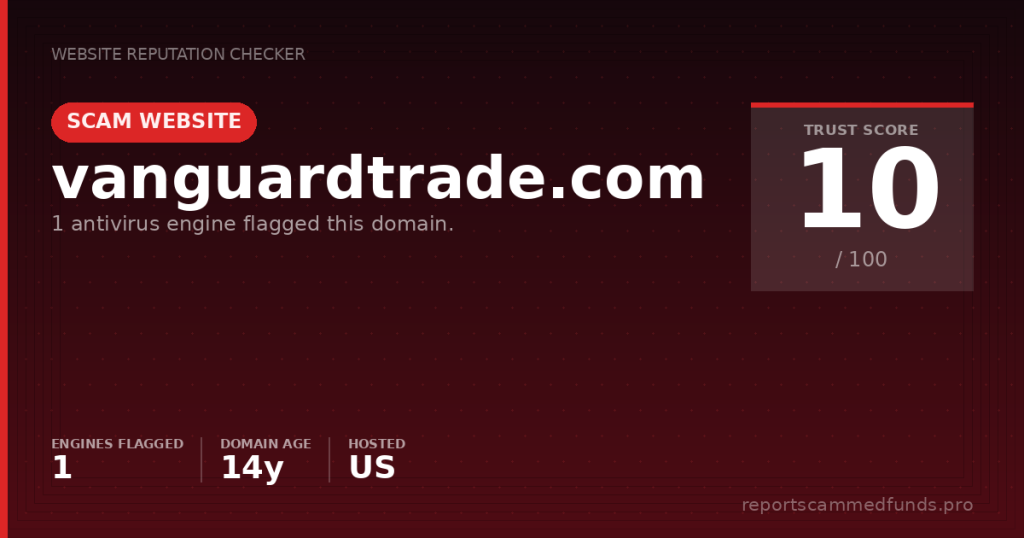
vanguardtrade.com is not a gray area — it bears a law‑enforcement seizure notice and has been classified in reputation checks as a scam website. That combination is decisive. Any residual curiosity about what the site once was is academic; as an investment venue, it is defunct and unsafe.
Do not deposit, do not register on any address presented as a 'replacement' or 'relaunch', and do not engage with agents claiming to represent this brand. Clone domains and spinoffs often appear after seizures to harvest the last pool of confused leads. If you receive such messages, treat them as direct evidence your details were exposed and tighten your personal security.
If you are still on the sidelines and researching, use this as a model for due diligence. Confirm regulator authorization on the regulator’s own register (FCA, ASIC, BaFin, CONSOB, CFTC/NFA, etc.), verify the legal entity’s registered name and number, and match it to the domain you intend to use. Demand segregation of client funds, plain disclosures, and traceable support channels.
Our recommendation is categorical: avoid vanguardtrade.com and any associated or similarly branded sites. If you have exposure, follow the help steps above immediately and consider contacting reportscammedfunds.pro for expert guidance. Safety first; do not give a seized brand a second chance with your money.