
Trading platform & site functionality
USDTgrowx positions itself as a cloud mining portal dedicated to USDT, the widely used stablecoin. The website claims secure mining with “instant withdrawals,” short mining cycles, and real‑time tracking. The landing page is promotional and uses modern front‑end libraries (jQuery, Swiper) and a stylish template, but beyond basic marketing language, there is little technical substance about hashing power, mining pools, algorithms, or verifiable infrastructure. In legitimate mining contexts, you would expect transparent operational detail: pool addresses, power costs, hashrate dashboards, and verifiable on-chain payout records—all notably absent here.
Technical traces show that the site sets a PHP session cookie and embeds a Google Maps JavaScript API, likely to imply a corporate location or to decorate the page with a map. However, during our visit we did not see clear, verifiable company coordinates or a registered business address tied to a recognized jurisdiction. Instead, contact appears to rely on Telegram links, which, while convenient, are ephemeral and not a substitute for support that is accountable under consumer protection rules. Users should be wary of services that route all communication through unvetted channels.
Functionally, the site behaves more like a lead‑capture page than an audited mining platform. We saw no downloadable client, no disclosed mining hardware, no evidence of third‑party audits, and no independent uptime or performance reporting. Claims about one‑day mining cycles and instant payouts are common motifs from cloud mining websites later accused of operating as high‑yield schemes. While the site is visually tidy and loads over HTTPS, that alone does not establish business legitimacy or solvency. In this market segment, presentation is easy to clone; proof of genuine operations is what matters and is not provided.
License & regulatory status
USDTgrowx provides no evidence of financial regulation or supervision in any jurisdiction. That absence is critical because the offering reads like an investment—pay in crypto, receive more back in a defined time frame—rather than a neutral, self‑hosted mining tool. In the UK, the FCA regularly warns consumers about crypto yield and mining schemes; in the EU, BaFin and national regulators issue similar alerts; in Australia, ASIC cautions that incentives or fixed‑style returns on crypto can fall within regulated investment activity. In the United States, the SEC and CFTC have pursued cases where marketed returns on digital assets constituted securities or commodity investment contracts.
We found no license numbers or authorizations listed on the site, and none could be independently verified against public registers of the FCA (UK), BaFin (Germany), ASIC (Australia), CONSOB (Italy), AMF (France), FINMA (Switzerland), or any US federal register (SEC/CFTC). Operators who are unregulated can solicit deposits yet operate beyond the reach of key consumer safeguards and enforcement frameworks—leaving users to rely on the operator’s word. With cloud mining in particular, many regulators have highlighted the prevalence of misrepresentation, sweetheart dashboards, and fake payout histories, followed by abrupt shutdowns.
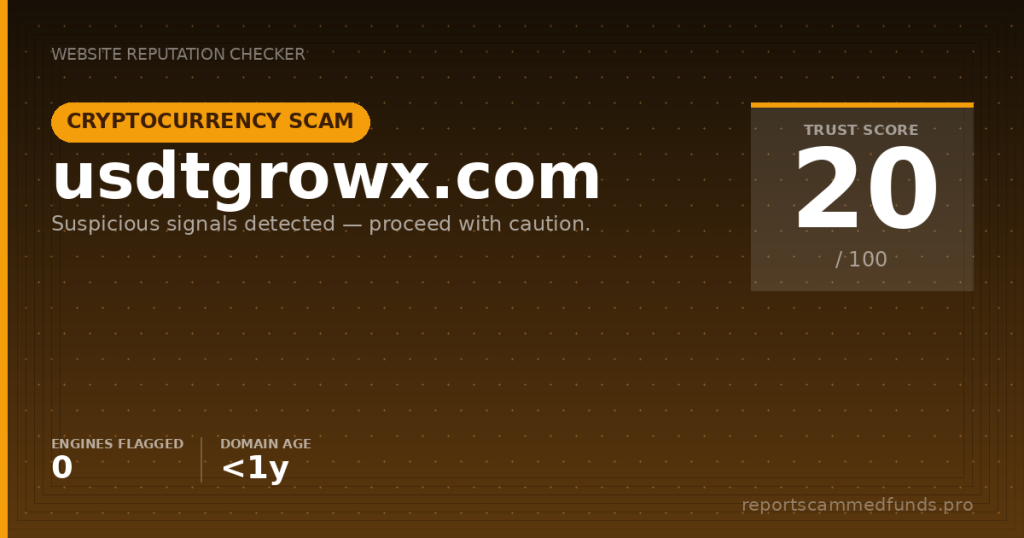
In parallel, automated reputation checks we ran categorize usdtgrowx.com under a Cryptocurrency Scam risk label and note heuristic red flags, including a very new domain life and a lack of verifiable corporate footprint. While such scans are not determinative proof on their own, they closely mirror the concerns we found in a manual review: no licensing, anonymous operation, and pitch language that fits patterns seen in prior enforcement bulletins about unregistered crypto investment schemes. Absent any official approvals or external audits, the regulatory risk for users remains high.
User feedback
Given the domain’s age (registered in late March 2026), there is very little reliable, independent user feedback in well‑moderated forums. Early‑stage, high‑yield crypto websites often operate within Telegram channels and private groups, where posts can be curated or deleted and where dissatisfied voices may be removed. We did not find verifiable media coverage, founder LinkedIn profiles, or third‑party due diligence that would help balance the narrative. The absence of substantiated, long‑running commentary is itself a risk signal when combined with the platform’s return promises.
Across similar cloud mining sites we have examined, common complaint themes typically include withdrawal blockages right after users post a profit, a sudden requirement to pay ‘tax’ or ‘unlock fees,’ surprise KYC demands triggered only when funds are being taken out, and disappearing support once larger sums are at stake. To be clear, we are not asserting that USDTgrowx has received such complaints at the time of writing; instead, we emphasize how closely its structure and marketing resemble those historical patterns. Users should not assume testimonials or scrolling payout tickers are authentic—those are trivial to fabricate.
We also note the reliance on Telegram for support. While many legitimate projects use Telegram, serious financial services typically provide staffed support lines, ticketing systems with case IDs, published service-levels, and a physical office footprint. Telegram groups can be muted, closed, or purged, leaving little trace if problems arise. If you cannot find balanced, long‑standing discussion in independent venues—and if the operator resists straightforward questions about licensing, owners, and operational proofs—treat that silence as a warning rather than a neutral data point.
Deposits & withdrawals
USDTgrowx markets ‘instant withdrawals’ and rapid mining cycles, but does not clearly disclose accepted funding rails during the public-facing journey. Given the theme (USDT cloud mining) and the presence of Telegram-first support, it is reasonable to expect that deposits are crypto‑only—most likely stablecoin transfers on common networks. Crypto transfers are generally irreversible; there are no chargebacks or dispute windows like with card or bank payments. This lack of reversibility can be weaponized by operators who accept deposits and then defer or deny payouts.
Historically, risky cloud mining sites use a similar script: small, early withdrawals to establish ‘trust,’ followed by escalating deposit asks to unlock higher tiers, and then sudden payout freezes once meaningful balances accrue. A final act may include a demand for a ‘withdrawal fee,’ ‘VIP upgrade,’ or ‘tax clearance,’ paid again in crypto—none of which are legitimate or recoverable via standard banking remedies. Users should never pay additional fees to release their own funds; that is a hallmark of an advance‑fee fraud layered onto a mining pitch.
Without transparent terms, a posted legal entity, and on‑chain proof of operational payouts at scale, users have no meaningful assurance about redemption. A platform that cannot, or will not, explain its cash management, fee model, and payment queues is asking you to fund a black box. If you still proceed despite these warnings, assume that every crypto transfer you make could be your last interaction with the funds. Always test with minimal amounts you can afford to lose, and only after verifying the business’s identity and regulatory status—neither of which is established here.
Why unregulated brokers are risky
Using any unregulated investment‑style platform places you outside the safety net of financial consumer protection. If an operator refuses withdrawals, vanishes, or blocks your account, you do not have access to a formal ombudsman, a compensation scheme, or a regulator with jurisdiction to compel redress. Crypto transactions executed directly on‑chain are final by design, so your leverage focuses on the platform’s reputation and its willingness to cooperate. Anonymous operators know this and often exploit it.
High‑yield crypto pages often leverage sleek interfaces, countdown timers, and reward tiers to normalize behavior that would be unacceptable with traditional finance—like wiring funds to unnamed wallets or paying to “unlock” your own balance. In regulated markets, these practices would trigger immediate scrutiny. When you remove that oversight, the door is wide open to mispricing risk, misrepresenting operations, and running undisclosed Ponzi‑style flows under a ‘mining’ or ‘staking’ veneer.
Beyond the direct loss of funds, there are secondary risks: identity theft via surprise KYC requests, malware links seeded in private channels, and broader social‑engineering that extends to your other accounts. Once a wallet address you control is known to an operator, it may be used to try to launder their inbound funds or to stage recovery scams—another wave of fraud where third parties claim they can retrieve your crypto for an upfront fee. Unregulated schemes create these cascades because there is no gatekeeper to vet claims or enforce standards.
How to get help if you’ve been scammed
If you have already sent money to USDTgrowx and suspect a problem, act quickly. First, stop all further payments and document everything: transaction hashes, wallet addresses, screenshots, chat logs, and any emails or invoices. If you funded the crypto purchase through a bank card or account, immediately contact your bank to request a chargeback or dispute on the original fiat purchase—even though crypto is irreversible, the fiat leg may have limited protections depending on your region and timing.
Report the incident to your national authority. In the UK, file with Action Fraud and notify the FCA if a financial product is involved. In the US, submit a complaint to the FTC and IC3, and consider notifying the SEC or CFTC if investment claims were made. In the EU, contact your national regulator (such as BaFin in Germany or CONSOB in Italy). Provide all evidence, including the website, Telegram handles, and wallet addresses. If the exchange you used to buy the crypto is regulated, open a case with its compliance team to flag the recipient address and request freezes where possible.
For specialist guidance on tracing funds and preparing regulator-grade evidence, you can contact our team at reportscammedfunds.pro. We assist victims with case assessments, escalation strategies, and coordination with banks, exchanges, and law enforcement. Reach out early—time narrows your options. Even when full recovery is not feasible, swift action can improve outcomes and reduce the risk of follow‑on ‘recovery scams’ that target recent victims.
Conclusion
USDTgrowx presents a polished landing page and enticing promises, but the fundamentals do not add up to a trustworthy operation. The domain is very new, there is no licensing, no corporate identity is disclosed, and key contact points rely on Telegram rather than formal, accountable channels. Automated reputation checks flag the site in a cryptocurrency scam category, and the claim that users can ‘mine USDT’ with instant withdrawals in a day mirrors patterns regulators have warned about for years.
In our view, the risk‑reward tradeoff here is wholly unfavorable. A legitimate miner would provide verifiable infrastructure details, on‑chain payout histories, and transparent business information—ideally supported by third‑party audits. None of that is present. If you are considering participation despite these warnings, limit your exposure to amounts you can afford to lose and do not pay any ‘extra fees’ to release funds.
Our recommendation is to avoid depositing with usdtgrowx.com. If you are seeking crypto yield or exposure, use established platforms that are regulated in your jurisdiction and that publish audited proof of reserves, clear ownership, and verifiable customer protections. Always validate claims independently before committing any funds.