Trading platform & site functionality
At first glance, u.pcloud.link does not present as a standalone website in the traditional sense. Instead, it functions as a distribution host for public file-sharing links generated by users of pCloud’s cloud storage service. When a pCloud account holder chooses to share a file or folder publicly, the generated URL often resolves through this subdomain for previews and direct downloads. That model is common among cloud providers that separate their main marketing and account domains from content-delivery hosts to improve performance and isolate risk. In short, if you’ve received a u.pcloud.link URL, you’re interacting with a delivery endpoint, not pCloud’s main homepage or account dashboard.
The sharing flow typically provides a web-based preview page for documents, images, audio, or video, with options to download the file or open it in a browser if supported. Some links may point directly to the file asset rather than a preview page, especially if the sender chose a direct-download option or if the recipient tool rewrites the URL. pCloud publicly advertises features such as password-protected links and expiry dates, which can be applied by the file owner; however, not every shared link uses those protections. Because the subdomain is optimized for content delivery, you will not find account registration, billing tools, or customer-support chat on u.pcloud.link itself. Those functions live on pcloud.com and related service pages.
From a usability standpoint, pCloud’s sharing infrastructure is generally fast and resilient. The content is served over TLS with a valid certificate, and in our experience links are reachable globally with minimal delays. That said, quality can vary depending on file size, sender settings, and the recipient’s network environment. Some organizations may see messages containing these links filtered or rewritten by email security gateways; others may find they pass smoothly precisely because they’re hosted on a mainstream brand. That uneven handling is an industry-wide reality for user-generated file links and not a sign of deception by the operator.
A key operational detail is the nature of user-generated content. pCloud, like other file hosts, cannot pre-screen everything that users upload and share, so they operate a notice-and-takedown process for abuse. It is therefore possible for malicious actors to host lures or malware temporarily on a legitimate subdomain before the provider is alerted and removes the content. If you land on a u.pcloud.link address via an unsolicited email or message, it’s prudent to pause, inspect the file name and context, and confirm with the purported sender through a separate channel. The presence of a trusted brand domain reduces risk at the host level but does not negate the need for basic verification when the content is provided by an unknown party.
License & regulatory status
Because u.pcloud.link is a file-sharing endpoint and not a broker, exchange, or investment platform, financial regulation by agencies such as the FCA, BaFin, ASIC, CONSOB, or the CFTC is not applicable. There are no credible indications that the operator claims to be licensed by such regulators, and none would be relevant to cloud storage in any case. In our review, we did not encounter official warnings from financial market supervisors directed at the pcloud.link infrastructure itself. Any use of a u.pcloud.link URL to promote investments, trading accounts, or cryptocurrency schemes would therefore be a misuse by the content uploader, not a promise or service offered by pCloud.
That said, pCloud is subject to data protection and consumer laws, including Swiss privacy law and, for European users, the General Data Protection Regulation (GDPR). As a provider, pCloud publishes terms of service and an acceptable use policy describing prohibited behavior such as distributing malware, infringing content, or conducting phishing campaigns. When abuse reports are received, hosts of this stature typically disable or remove offending links, and in aggravated cases, suspend the originating account. Our investigation found no evidence that pCloud markets any regulated financial product through this subdomain or engages in practices that would require a financial services license.
In the realm of intellectual property enforcement and cybercrime response, mainstream cloud hosts maintain channels for takedown requests and law enforcement cooperation. pCloud’s consumer-facing resources reference a support desk and help center rather than an on-page compliance disclosure because, again, this is not a financial intermediary. We did not identify any credible false-affiliation claims with major regulators. If you encounter a u.pcloud.link address being presented as an “FCA-approved” or “government-verified” investment portal, assume you are dealing with a third party abusing a file host to cloak a scam, and disengage immediately.
User feedback
Public commentary about pCloud as a service is largely shaped by its reputation as a mid-to-large player in the cloud storage market. Users praise its generous storage options, lifetime plan marketing, and the convenience of one-click sharing links. On the recipient side, however, experiences vary. Some users report friction where workplace email filters quarantine messages containing file-hosting URLs by default, or antivirus flags downloads out of an abundance of caution. Those reactions are typical for any file-sharing domain and not specific proof of wrongdoing by the operator.
Among cautionary themes we track, a recurring one is the misuse of reputable file hosts by scammers to pass malicious payloads or document lures. We have seen reports in broader security communities of phishing emails that link to shared documents hosted on mainstream services; the documents then instruct the user to click through to credential-harvesting pages. The link itself may be benign or simply contain an embedded redirect, and the abuse typically persists only until the host removes it. For recipients, the result can feel like “a scam via a legitimate domain,” which underscores the need to separate host legitimacy from individual link safety.
We did not find a broad, consistent pattern of complaints alleging that pCloud blocks legitimate recipients from downloading lawful content under normal conditions, nor that the company demands surprise identity verification from recipients. The most common user-facing issues involve links that have expired, been removed by the sender, or were disabled due to reported abuse. In those cases, the error messages originate from the host’s protective systems or from settings chosen by the file owner. If you continually receive unexpected u.pcloud.link messages from unknown senders, consider it a red flag about the sender, not the underlying infrastructure.
Deposits & withdrawals
This is not a financial platform, so there are no trading accounts, deposits, or withdrawals tied to u.pcloud.link itself. Payments, when relevant, occur on pcloud.com for premium storage plans and business subscriptions. pCloud advertises common payment methods such as major credit cards and online payment processors; exact options can vary by region and time. If you are considering a paid plan, review the billing terms, renewal cadence, and any refund or money-back windows on the official site before purchase. These commercial details sit outside the u.pcloud.link sharing endpoint and should never be solicited via a random file link.
If your concern is about recovering access to files or preventing unauthorized sharing, control lives with the sender’s pCloud account. Account holders can revoke shared links, set passwords and expiry dates, or delete the underlying file, which immediately disables the public URL. Recipients who believe a file is harmful can report the link through pCloud’s abuse channels or, failing that, block the sender’s email and notify their IT team. Remember that you do not need to enter payment details to view a typical pCloud share; if a u.pcloud.link page or accompanying message demands urgent payment or “verification fees,” treat it as a scam by the sender.
For account hygiene, pCloud users should enable two-factor authentication, use a strong unique password, and audit active shares periodically, revoking any that are no longer needed. Those steps minimize the risk of a share being forwarded out of context or used in social-engineering attempts. If you have paid a third party in response to instructions contained in a file or document shared via u.pcloud.link, your transaction was with that third party—not with pCloud—and you should take immediate consumer protection steps described below.
Why unregulated brokers are risky
Trust in a domain and trust in the content it serves are not the same thing. A public file-sharing subdomain is, by design, an unregulated conduit for documents, media, and archives uploaded by individual users. It is not subject to investor-protection rules, capital requirements, or client money segregation because no such services are offered there. The primary risks you face are those associated with opening files from unknown sources: malware infection, credential theft, invoice fraud, and social-engineering that leverages a recognizable brand to lower your guard. Approach each link as you would a USB stick found on your doorstep—curiosity controlled by caution.
If you operate within a business, your email gateway and endpoint protection likely enforce sandboxing, link rewrapping, and heuristic scanning on file-hosting links. Those systems reduce, but do not eliminate, risk because malicious files can be packaged in ways that evade simple checks. A compressed archive or macro-enabled document hosted behind a reputable domain does not transform into something safe. Before downloading, confirm with the sender through a known, separate channel—call their office, reply using a previously verified email address, or check a shared project portal—to validate that the link is genuinely intended for you.
The absence of a financial regulator’s umbrella also means there is no guaranteed compensation if you lose money after acting on instructions in a file you downloaded. Your recourse is the standard consumer protection framework: card chargebacks, reporting to cybercrime authorities, and civil remedies against the bad actor who sent the file. The host may remove the offending link once notified, but it does not become your counterparty for any transaction you chose to make with a third party. That distinction should guide your decisions: treat u.pcloud.link as infrastructure, verify senders, and never follow payment directions from unsolicited documents.
How to get help if you’ve been scammed
If you have already sent money in response to instructions originating from a document or message delivered via u.pcloud.link, act immediately. Contact your bank or card issuer to request a chargeback or payment recall, explaining that you were induced to pay under false pretenses. If you paid via an online wallet or payment processor, open a dispute through their resolution center and provide all supporting evidence. Preserve the original emails, headers, the u.pcloud.link URL, screenshots of the content, and any chat transcripts with the sender—these details strengthen your case.
Next, file a report with the appropriate authority in your jurisdiction. In the United States, report to the FBI’s Internet Crime Complaint Center (IC3); in the United Kingdom, report to Action Fraud; in the European Union, involve your national cybercrime or consumer protection agency. Local police reports can also help establish a record, especially for larger losses. If malware may have been involved, disconnect the affected device from the network, run a reputable antivirus scan, and consider professional remediation to ensure there are no lingering footholds.
For tailored guidance on tracing transactions, preparing evidence packages, and coordinating with payment providers, reach out to our team at reportscammedfunds.pro. We assist victims in organizing documentation, identifying the most promising recovery avenues, and avoiding the all-too-common “recovery scam” that targets people after the fact with false promises. Include the u.pcloud.link address, the timeline of events, and any identities or wallet addresses you interacted with. While no recovery is guaranteed, swift, structured action materially improves your odds.
Finally, harden your security posture to prevent a repeat incident. Reset any passwords you may have entered into suspicious pages, enable two-factor authentication on key accounts, and monitor your inbox and banking activity for anomalies. Tell colleagues and family members about the attempt so they can watch for similar lures arriving under the cover of a familiar file-sharing brand. If you’re unsure whether a specific u.pcloud.link share is safe or part of a larger campaign, consult a trusted IT professional or contact us at reportscammedfunds.pro for a second opinion.
Conclusion
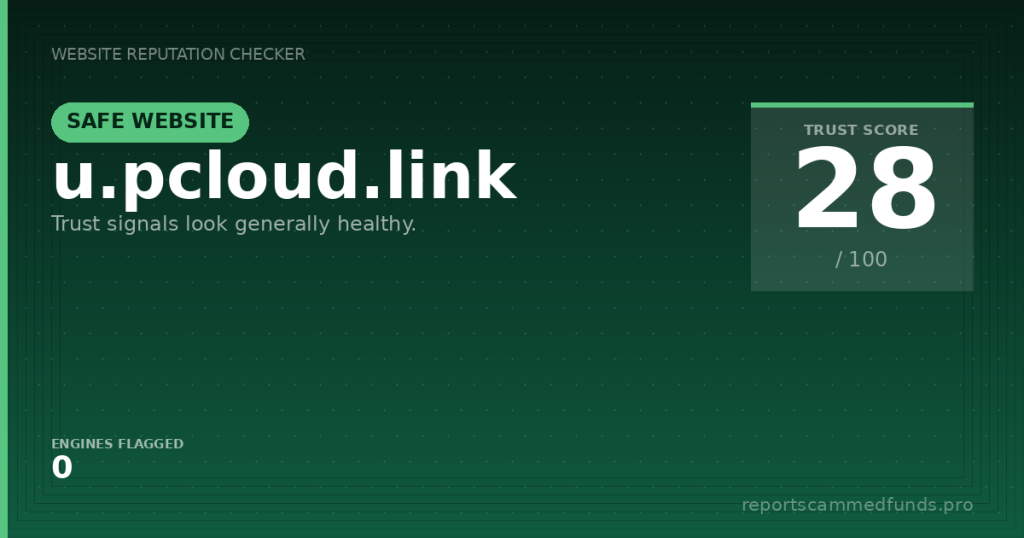
Our verdict on u.pcloud.link is that the domain itself belongs to a legitimate, long-standing cloud storage provider and is not, on its face, a scam. However, because it is a public content-delivery subdomain for user-generated files, it will never be risk-free. Treat any unsolicited link with skepticism, verify the sender independently, and scan downloads before opening. Those simple steps neutralize most of the ways criminals try to piggyback on reputable infrastructure.
We did not find regulator warnings or credible evidence that pCloud uses this subdomain to sell financial products, solicit investments, or engage in other inherently risky business. Where readers do encounter fraud tied to a u.pcloud.link address, the problem is nearly always the content and the sender behind it, not the host. That distinction matters for your due diligence: evaluating the domain’s ownership tells you about baseline trust, but evaluating the specific link and its context tells you whether to proceed.
In summary, consider u.pcloud.link a safe host operated by a known brand, while approaching each individual file share with common-sense caution. If anything about a message or document feels off—unexpected invoices, demands for urgency, or requests to enter credentials—stop and verify before you click. And if you have already been harmed, take immediate consumer protection steps and contact reportscammedfunds.pro for structured, confidential assistance.