
Trading platform & site functionality
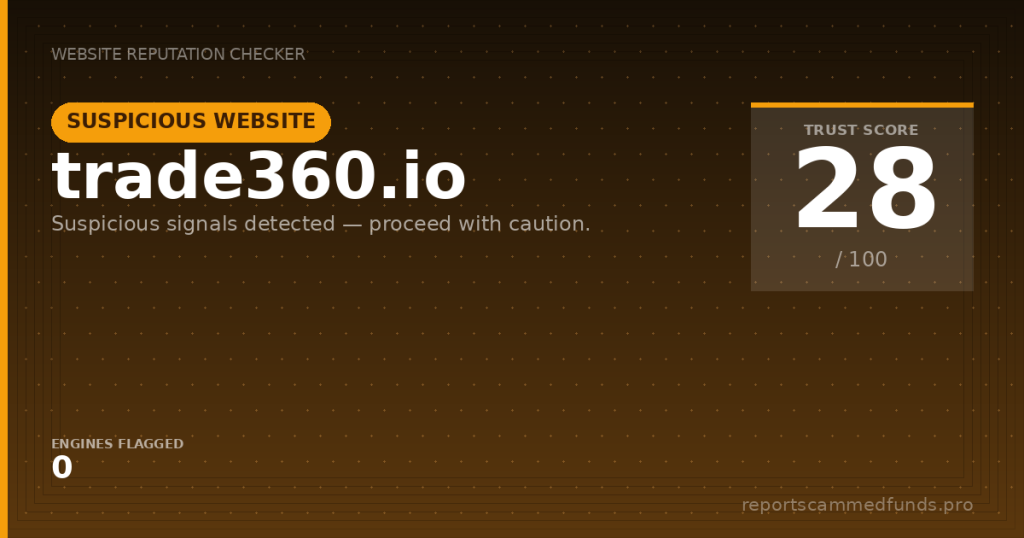
Trade360 is a brand name long associated with forex and CFD trading, and a typical offering would include currency pairs, indices, commodities, and possibly crypto-CFDs through either a web platform or a MetaTrader terminal. On trade360.io, however, the operator does not clearly identify itself or provide standardized disclosures that would let a prospective client verify who they are dealing with. In our assessment, the site appears to present marketing language consistent with online trading, but it falls short of the detailed, regulator-mandated transparency we expect: no plainly stated corporate entity, no jurisdictional address, and no confirmed license description. A credible brokerage typically shows a footer with a company legal name, registration number, and regulator—none of which are confidently established for this domain.
Historically, the Trade360 brand was known for presenting a so-called “CrowdTrading” feed—promotional content showing aggregated client positioning or trends. A legitimate version of that concept should be accompanied by disclosures clarifying whether such data is indicative, delayed, or purely illustrative. On a trustworthy site, such features would be complemented by product-specific risk warnings, a clear cost breakdown (spreads, commissions, financing rates), and leverage limits aligned to the client’s jurisdiction. We have not been able to confirm whether trade360.io offers a verifiable, compliant version of that experience, nor whether any feed is real-time, audited, or simply a marketing overlay.
Equally important is platform reliability. A regulated broker typically offers robust trading infrastructure and uptime, with transparent status pages and client communication if outages occur. In contrast, intermittent accessibility to a brokerage website—especially one without clear regulatory grounding—can pose practical barriers even to basic tasks like downloading statements or initiating withdrawals. Without demonstrable platform transparency, we view the trade360.io presentation as more aspirational than operational, and we caution readers that a polished interface (if visible) is no substitute for verifiable oversight and dependable execution records.
Finally, serious brokers give clients access to formal documentation like a client agreement, order execution policy, conflicts of interest disclosures, key information documents, and a complete schedule of fees. While some marketing sites bury these materials behind account creation, their absence from public view is a negative signal because it prevents informed comparison before depositing. If trade360.io expects users to deposit funds without sharing costs, terms, and dispute procedures upfront, that is not aligned with best practices observed among regulated EU or UK brokers. We recommend refusing any account activation step unless you can first retrieve and review the full legal pack supplied by an identifiable company.
License & regulatory status
Licensing clarity is the dividing line between retail speculation and unacceptable risk. Well-regulated European brokers supervised by authorities such as CySEC, the FCA, or BaFin will clearly display their legal entity and an active license number, and their permitted domains are recorded by the regulator. The Trade360 brand has historically been linked to a Cyprus entity, but our review could not verify any direct linkage between trade360.io and a currently authorized European or UK firm. If the entity behind trade360.io is regulated elsewhere or operating under a passport, it has not made that transparent to the retail public.
In addition to checking the regulator’s register for a license number, it is essential to verify that the listed domains match. Clone-site frauds often cite a real company’s name but use an unlisted domain. If a company were truly regulated, the regulator’s register or the firm’s official disclosures would confirm the authorized websites. In the absence of that, the safe assumption is that the domain is not covered. We therefore strongly advise readers to cross-check any regulatory claim seen on trade360.io against primary sources such as the CySEC register, the FCA register, or the national register relevant to your residence.
It is also important to examine claims about geographic permissions. European clients face leverage caps and marketing restrictions under ESMA rules; Australian clients are protected by ASIC product intervention orders; UK clients fall under the FCA’s marketing and conduct frameworks. If a site targets multiple regions but does not adapt risk warnings or leverage disclosures to local rules, that is a sign the operator is not truly tailoring its compliance to jurisdictional obligations. During our review, we did not identify localized disclosures on trade360.io that would suggest a regulated, multi-jurisdictional compliance posture.
Finally, beware of ambiguous phrasing like “licensed partners,” “regulated liquidity providers,” or “affiliate regulation.” Such language can imply oversight without the domain itself being supervised. We did not see evidence that trade360.io sits within the official domain inventory of any regulated Trade360-branded entity. As a result, we must treat the site as unverified from a licensing standpoint and advise heightened caution.
User feedback
Public feedback about the broader Trade360 brand over the years has been mixed, with some traders praising a user-friendly interface and others reporting account friction when attempting to withdraw. It is critical to emphasize that trade360.io is a separate domain whose operator is not clearly identified, so we cannot attribute any specific third-party review to this site beyond doubt. Nonetheless, common themes seen across unverified brokerage domains that borrow well-known brand names include withdrawal delays after profitable trades, sudden requests for additional documents only at the withdrawal stage, and aggressive upselling into larger deposits or managed accounts.
We have seen scattered forum posts over time—speaking generally about Trade360-branded experiences—that mention persistent phone or chat follow-ups after initial sign-ups. When such contact escalates, traders sometimes report pressure to install remote-desktop tools for so-called “guided” trading or to approve higher-risk strategies that rapidly deplete balances. While we cannot confirm that trade360.io engages in any such behavior, these broader patterns serve as red flags to watch for if you are contacted after submitting your information on a site with unclear ownership.
Concerning support, multiple anecdotal accounts in the wider retail CFD space describe unresponsive helpdesks once a dispute arises, or delays in receiving formal closure documents when accounts are shut. Reputable firms typically issue prompt ticket acknowledgments and escalation paths, including an independent financial ombudsman process where applicable. Without a named operator, trade360.io does not offer an obvious route for complaint escalation beyond the site itself. That gap alone should deter deposits until the responsible legal entity is named and verifiable.
Deposits & withdrawals
Legitimate brokers disclose payment rails clearly: segregated client accounts, accepted card processors, wire instructions held with reputable banks, and explicit timelines for withdrawals. In opaque environments, we commonly see vague deposit instructions or a heavy push toward irreversible methods such as crypto transfers. Because trade360.io does not transparently present its operator or compliance framework, we cannot verify its payment partners, processing times, or fees. This uncertainty introduces disproportionate risk at the two most consequential moments for any trader: the initial deposit and the eventual withdrawal request.
Another recurring issue across high-risk sites is a mismatch between deposit simplicity and withdrawal rigor. The onboarding may feel frictionless, but when you ask for your money back, the bar suddenly rises: requests for certified documents, a barrage of account manager calls, or new terms allegedly triggered by promotions or bonuses. We have seen cases where users are told to meet unrealistic turnover requirements before any withdrawal can be processed—an approach that contravenes best-practice standards. Without published terms on trade360.io to review in advance, clients cannot guard against these traps.
Finally, timing matters. Cards and bank wires provide some, albeit time-limited, avenues for chargeback or recall, while many crypto transfers are irreversible and pseudonymous. If a site is unwilling to confirm that it supports regulated, reversible payment methods and that withdrawals will be honored within a stated timeframe, you should assume the worst and avoid depositing altogether. Until trade360.io shows a full fee schedule, withdrawal policy, and a complete legal pack under a named, verifiable company, any money sent is money at significant risk.
Why unregulated brokers are risky
The first and most consequential risk of using an unregulated or unverified platform is the absence of a supervisory authority you can appeal to when something goes wrong. In regulated environments, traders benefit from conduct rules, capital adequacy standards, and complaint-handling obligations—sometimes with access to compensation schemes. Without that safety net, a platform can change rules midstream, close accounts without a reasoned explanation, or impose fees that were never disclosed upfront. The burden of proof invariably shifts onto the customer, who must fight to retrieve funds from an opaque counterparty.
Clone-site scenarios compound this risk. A familiar brand name on an unfamiliar domain is a hallmark of imposter operations that trade on a recognized identity to recruit deposits. Even if the underlying company name is real, if the domain is not listed as an authorized website on the regulator’s register, you have no legal tie to that regulated entity. Any assurances a salesperson gives you over the phone are unenforceable if they cannot be traced to a licensed firm.
Another dimension of risk lies in the technical and operational controls that regulated brokers must implement—segregated client accounts, best-execution policies, periodic reporting, and third-party audits. When these are absent, error correction and dispute resolution become discretionary rather than obligatory. The trader may find themselves arguing over slippage, requotes, or “server errors,” with no independent arbiter to adjudicate. That uncertainty alone should keep your funds away from any domain that cannot demonstrate regulator-backed accountability.
Lastly, personal data is at stake. Sites that do not identify an operator may also treat customer information cavalierly, sharing it with affiliate networks or overseas call centers. Once in those ecosystems, your details can fuel additional fraud as you are approached by “recovery agents” or new schemes. Strong privacy protection is yet another benefit of dealing with genuinely regulated firms bound by data protection laws and subject to real penalties for violations.
How to get help if you’ve been scammed
If you have already deposited money with trade360.io and are encountering problems, act quickly to preserve your options. First, contact your bank or card issuer immediately and explain that you suspect misrepresentation; request a chargeback for card payments or a recall for recent wire transfers. If you sent crypto, gather transaction IDs, wallet addresses, and all correspondence, and ask your exchange’s compliance team to flag the receiving address. File an official report with your national authority—Action Fraud in the UK, the FTC and IC3 in the United States, your local police or financial regulator elsewhere—and keep your case number.
Do not engage with unsolicited “recovery” firms that ask for upfront fees; many are simply a second wave of fraud. Instead, centralize your evidence: screenshots of the website, full email headers, chat logs, statements, and any promised terms or bonus conditions. Document dates and names of any callers, and note the numbers they used. The more structured your record, the better the chances your bank or regulator can act and the easier it is to assess legal avenues.
For specialist guidance, you can reach our team at reportscammedfunds.pro. We handle intake for victims of suspected broker imposters and unregulated trading schemes, and we can assist with strategy, evidence preservation, and referrals. While no outcome can be guaranteed—especially for crypto transfers and older cases—early engagement greatly increases the probability of successful dispute resolution or recovery. Use reportscammedfunds.pro to request a case review, and we will help you map next steps with your bank and the appropriate authorities.
Conclusion
Trade360 is a recognizable name in retail CFD trading, but trade360.io does not provide the basics a careful trader needs: a named operator, regulator, and verifiable domain authorization. That combination of gaps, together with the domain’s divergence from the historically recognized brand site, leads us to a cautious but clear conclusion. Until independent verification shows that trade360.io belongs to and is supervised under a legitimate license, readers should avoid opening accounts or depositing funds.
If you are intent on exploring this brand, start from a regulator’s public register and find the official, authorized domain listed there—do not take a salesperson’s word or rely on marketing slogans. Cross-check the company name, registration number, and permitted web addresses, and confirm that customer support responds through official channels before moving forward. In an industry where even legitimate speculation carries inherent market risk, there is no reason to add avoidable counterparty risk by trusting an unverified website.
Our overall recommendation is restraint. Too many consumers discover the truth only after their first withdrawal request encounters friction. Taking a few minutes to verify licensing and domain authorization now can save months of frustration later.