
Trading platform & site functionality
Trade-ideas.com presents itself as an AI-driven stock scanning and charting platform for U.S. equities. The website emphasizes real-time screening, backtesting, simulated trading, and alerting features designed to surface short-term trading opportunities. It markets automated or semi-automated workflows and signals, and highlights integrations with recognizable brokers to route orders from its environment. The site’s interface leans heavily on modern web assets and scripts, and loads a substantial number of third-party analytics pixels and advertising frameworks—common for mature SaaS marketing sites, though worth noting for privacy-conscious users.
The core proposition is not custody of client funds but access to software: Trade Ideas provides scanners, alert streams, and strategy tools that users can link to their own brokerage accounts if desired. In contrast to retail CFD brokers or offshore ‘auto-trading’ schemes, this is not an account-opening funnel for deposits; instead, visitors are steered toward subscription tiers and free trials. The technology stack we observed includes a proprietary desktop/web analytics layer, media assets for product demos, and request endpoints related to market calendars and toplist data, which is consistent with an analytics vendor that ingests and reshapes market feeds.
On the marketing pages, the platform underscores its “AI” component, describes entry/exit signals, and showcases features that might appeal to active traders, from backtests to simulated trading. Those features can be high value to experienced users who understand their limitations and who can independently vet a strategy’s logic and robustness. That said, the site does not disclose spread, commission, or funding-rate information because Trade Ideas does not act as a market-maker or broker; the quality of execution, fees, and margin rules would be entirely a function of the third-party broker the user chooses to connect.
From a usability standpoint, the website is polished and includes a help portal, social links, and partner pages that spotlight relationships with several U.S. brokerage brands. We also noted a prominently embedded accessibility widget, a sign of attention to UI inclusivity. The heavy presence of tracking scripts (Google Tag Manager, LinkedIn, Twitter, TikTok, and ad frameworks) indicates an aggressive performance-marketing posture. That is typical of subscription SaaS businesses, but readers should be mindful that marketing copy—particularly around “automation” and “AI”—is not a substitute for verified outcomes. The toolset’s utility ultimately depends on the user’s skill, risk management, and the specifics of their broker connection.
License & regulatory status
Unlike brokers or investment advisors, a market-scanning software vendor such as Trade Ideas generally does not require authorization from securities regulators like the FCA (UK), BaFin (Germany), ASIC (Australia), or the CFTC/SEC (U.S.) to sell analytics. The platform markets screeners, strategy tools, and alerts; it does not hold client money, nor does it advertise client deposits, spreads, or leverage. That puts it outside of the regulatory perimeter that applies to broker-dealers, CFD market-makers, or portfolio managers. As a result, the right frame for assessing this site is not “licensing for custody or trading” but “quality, transparency, and fairness of SaaS billing and claims,” alongside the safety of any broker integrations.
The presence of broker logos and partner mentions on site may create the impression of formal endorsement or shared regulation. In practice, integrations with brokers are commonplace in the trading-tech ecosystem and do not, by themselves, indicate that the software provider is regulated as a broker. We did not find claims that the company itself is a broker-dealer or offers regulated investment services. That aligns with industry norms for analytics vendors who provide tooling and optional routing features via APIs or partner arrangements while leaving execution, pricing, and compliance to the connected brokerage account.
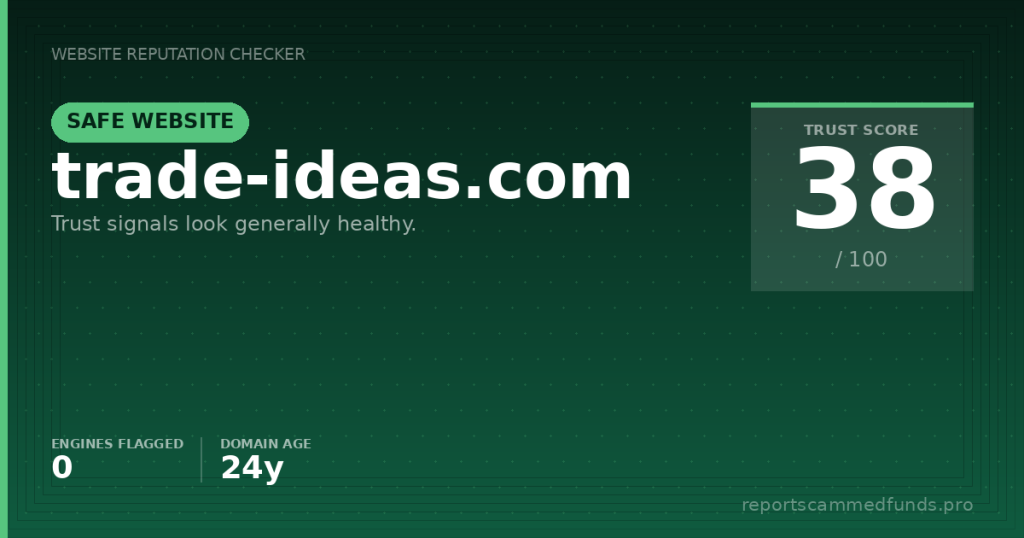
We also looked for any public notices from major market regulators (FCA, BaFin, CONSOB, ASIC, FINMA, CFTC, SEC) warning against trade-ideas.com. During our assessment, we did not encounter regulator blacklists naming this domain. The site has existed for over two decades, which tends to correlate with lower incidence of outright fraud, though longevity alone is not proof of quality. Because the service sells software and not financial products, the most relevant consumer protection issues are billing accuracy, cancellation clarity, data handling, and honest marketing about what automated or AI signals can—and cannot—deliver.
Bottom line on regulation: this is a software subscription platform and not a retail broker taking deposits. That means you should not expect protections like FSCS/FINRA/SIPC coverage from this vendor itself. Any investor protection you benefit from will stem from your chosen broker, not from Trade Ideas. As always, verify any on-site claims about broker integrations directly with the broker, and treat screenshots or outlier performance anecdotes as marketing, not guarantees.
User feedback
User commentary about Trade Ideas that we have encountered historically tends to cluster around a few themes: the learning curve, pricing relative to alternatives, and the mixed results that inevitably come with rule-based signals in changing markets. Advanced traders and technically inclined users often praise the depth of scanning and the ability to test ideas quickly. Others, particularly newer traders, sometimes report frustration that “AI” or automation did not translate into effortless profits, which is a misunderstanding common across the industry. Strategy tools are only as effective as the trader’s understanding of their edge, data biases, and risk constraints.
Billing and cancellation are another recurring theme in public reviews of many SaaS trading tools, and Trade Ideas is no exception. Some reviewers report smooth trials and upgrades, while others complain about auto-renewals they say they missed, or difficulty getting a timely response to refund inquiries. As with any subscription, the safest route is to document your trial start and end dates, save confirmation emails, and cancel through the official account portal well before the renewal window if you are undecided. We did not find systematic allegations of withdrawal blockages—unsurprising, because this site does not accept trading deposits—but we did see the familiar SaaS frictions around renewals and customer service response times.
On the performance side, the usual caveats apply. Public testimonials naturally emphasize positive outcomes, but markets are volatile and strategy returns can degrade as conditions change or as more users pile into the same ideas. A responsible approach is to treat every scan output as a starting point for research, not an endpoint. If you adopt any signal or “automated” routine, paper trade first, monitor slippage and fill quality through your broker, and keep your position sizes modest until you’ve observed behavior across different market regimes.
Deposits & withdrawals
Because trade-ideas.com sells software access and does not run trading accounts, there are no investor ‘deposits’ or ‘withdrawals’ in the broker sense. Payments are for subscriptions, most commonly via standard card processors. Technical evidence in the domain’s DNS suggests Stripe verification records, which is consistent with mainstream card processing infrastructure. The critical questions for readers are therefore billing cadence (monthly vs. annual), cancellation windows, trial-to-paid transitions, and refund terms for renewals; these are governed by the vendor’s Terms of Service rather than by financial-market withdrawal rules.
If you try the service, set calendar reminders for key dates, screenshot your subscription page, and save PDF copies of receipts and cancellation confirmations. This makes it easier to contest any unintended renewal with the vendor, and if necessary, to escalate with your card issuer. Some user reviews in the broader SaaS trading space cite delayed responses or back-and-forth on refunds after renewing without intending to; proactive documentation greatly improves your chances of a favorable outcome. Also confirm in writing whether add-on data or modules (if any) have separate cancellation paths, to avoid partial charges you didn’t anticipate.
If you connect Trade Ideas to a brokerage, remember that funding, margin calls, and cash withdrawals occur inside your broker account. Trade Ideas has no direct access to your money unless you separately grant billing authorization for the software subscription. If anything about an integration flow appears to request card data in an unusual pop-up or demands credentials that don’t align with your broker’s documented API process, stop and confirm directly with the broker’s support. As with any third-party connection, use unique, strong passwords and 2FA where supported.
Why unregulated brokers are risky
Although the absence of broker-style regulation does not automatically make a software vendor unsafe, it shifts the risk profile. There is no investor-compensation scheme if you lose trading capital while following a scanner’s outputs, nor is there a regulator to complain to about spreads or trade rejections—because those facets live with your broker. The real risk in analytics platforms is over-reliance on signals that may have looked compelling in backtests but do not survive live markets, coupled with the possibility of billing misunderstandings.
Mitigating those risks means resisting the allure of ‘set-and-forget’ promises and keeping your autonomy as a trader. Validate any idea on out-of-sample data, observe it across volatility regimes, and maintain strict risk controls at the broker level (hard stop-losses, per-trade exposure limits). With billing, read the Terms carefully, check for auto-renewal timing, and use payment methods with strong dispute rights. A healthy skepticism toward marketing superlatives will serve you well—even with long-established vendors.
How to get help if you’ve been scammed
If you believe you’ve been charged in error for a subscription, start with the vendor’s official support channels and provide order IDs, timestamps, and any cancellation confirmations. Ask for a written response and a case number. If you granted card authorization via a mainstream processor, you typically have strong consumer protections: contact your card issuer promptly to initiate a dispute or chargeback if the merchant is unresponsive or declines a legitimate refund under the stated terms.
Where the issue involves suspected misuse of personal data or a deceptive billing flow, also report it to your national consumer protection authority. In the U.S., you can file at reportfraud.ftc.gov and, if you suspect online fraud, with the FBI’s IC3 at ic3.gov. In the UK, use Action Fraud at actionfraud.police.uk. If there is any aspect that touches a brokerage connection—unauthorized trades, API misuse, or credential concerns—notify your broker immediately and rotate keys/passwords.
For hands-on guidance and escalation strategies, our team can assist. Visit reportscammedfunds.pro to describe your case, attach documentation, and request a free initial assessment. We specialize in helping users structure effective evidence packages for banks, card networks, and regulators, and we can advise on realistic next steps for recovering funds or preventing further losses.
Conclusion
Everything we observed about trade-ideas.com is consistent with a mature, commercial analytics platform rather than a fly-by-night broker or deposit-taking scheme. The domain is long-lived, the site is technically well maintained, and we did not see the classic hallmarks of boiler-room operations (fake regulators, fabricated celebrity endorsements, or urgent withdrawal obstacles). The chief risks here are the same ones that attach to any trading SaaS: overconfidence in backtests, misunderstanding what ‘AI’ can do, and missing fine print around trials and renewals.
If the product fits your workflow, approach systematically: start with a trial or the most affordable tier, paper-trade longer than you think you need, and measure realistic slippage through your broker. Keep tight control of your account connections and review permissions periodically. Avoid extrapolating isolated marketing examples into expected returns, and build your own validation routines for any strategy you intend to automate.
Our recommendation is guardedly positive: the site appears legitimate, but it is still your responsibility to verify billing terms, confirm broker integrations directly with your broker, and manage trading risk diligently. Treat Trade Ideas as a toolkit—not a shortcut—and you can evaluate it on its merits without compromising your financial safety.