Trading platform & site functionality
Visiting titaninversion.com does not reveal a functioning business website at all. Instead, the domain resolves to a generic registrar parking page sometimes labeled as a lander, which is a holding template used when no real site exists. The page shows search-style advertising links and a banner that appears to auction ad space. There are no menus, sign-up flows, or dashboards that any real investment firm would provide. In short, what you see is infrastructure built for parking and monetizing type-in traffic, not for serving customers.
The parked template attempts to load third-party widgets to simulate credibility, including a Trustpilot module, but it does not actually render any rating or review content. That failure is consistent with placeholder code embedded in many parked domains. A small on-page disclaimer also indicates that references to companies or services are not controlled or endorsed by the registrar, which is standard on such placeholders. This is the opposite of a professional corporate presence with verifiable company details and service information. The absence of core pages such as About, Pricing, Legal, or Support is glaring.
We also noted behavior typical of domain-parking ecosystems: telemetry events and ad-feed calls meant to log visits for revenue attribution. None of this activity benefits a potential customer, nor does it establish any trust about who is behind the name “Titan Inversion.” There is no working contact email, no address, and no phone number for a business operator on the domain. The site does not provide a company-specific privacy policy, only generalized registrar notices. Taken together, these are strong indicators that the domain is not prepared to interact with consumers in good faith.
Why does this matter? Because scammers frequently keep domains in a parked state while they prime them with surface-level trust signals, then flip the content to an aggressive sales or phishing funnel once traffic builds. The brand string here is ambiguous enough to aim either at Spanish-speaking investors or at shoppers searching for “inversion tables,” which makes it flexible bait for different lures. Either way, there is no legitimate service currently attached to the site. The safest conclusion is that any outreach tying itself to titaninversion.com should be treated as suspect until a fully transparent and regulated operation is publicly documented.
License & regulatory status
A legitimate investment platform will display its regulator, firm reference number, and the legal entity that owns the domain. titaninversion.com displays none of these basics. There is no corporate name, no company registration jurisdiction, and no licensing statement anywhere on the page. The only explicit message is a generic registrar disclaimer distancing itself from any implied endorsements. That absence is a red flag when a domain name implies financial activity.
During our review we checked for matches across well-known regulator registers such as the FCA in the United Kingdom, BaFin in Germany, and ASIC in Australia. We could not find any entry that tied the “Titan Inversion” name or this domain to a supervised firm; this could not be independently verified because the site provides no firm reference to search against. The situation is similar with ESMA-linked databases, the CFTC, and CONSOB, where regulated entities are precisely identified by legal names and license numbers. Without that baseline transparency, any claim of oversight should be assumed false until proven otherwise. If a salesperson waves away the missing license with excuses, consider that a decisive warning.
It is also worth stressing that a domain parked behind a registrar template is not a recognized disclosure channel for regulatory information. Real brokers and investment managers publish detailed documentation, including risk statements, terms of business, and complaint procedures that reference the supervising authority. They typically host secure client portals that are tied to a named legal entity and audited custodial accounts. None of those hallmarks are present here. The contrast is stark and unfavorable to titaninversion.com.
We did not locate a specific warning about this domain on any regulator site at the time of publication. However, regulators often post alerts only after substantial harm occurs, and clone operations can cycle through domains faster than warnings can be issued. The combination of a financial-sounding name, zero disclosures, and a parked template is exactly the pattern we see in many unlicensed campaigns. Treat the domain as unregulated and risky by default, and demand verifiable registration data before engaging with anyone using it in correspondence.
User feedback
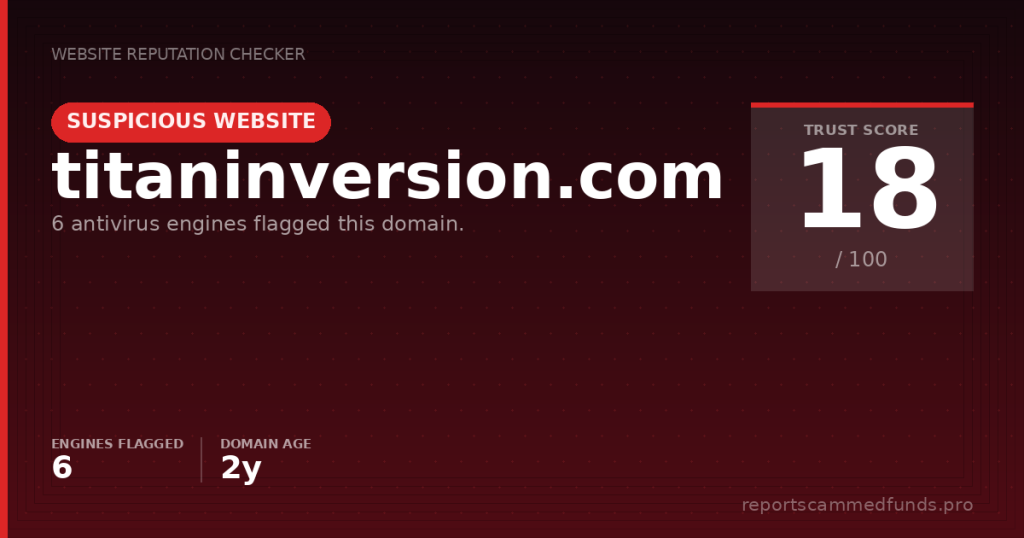
There is effectively no authentic user feedback about a functioning business at titaninversion.com because there is no functioning business page to review. Our reputation checks note low-trust and blacklist tags attached to the domain from monitoring sources, but we found no credible customer testimonials, case studies, or third-party audits. The parked page’s attempt to surface a Trustpilot module without actual content is particularly telling. It hints at an effort to imply social proof while providing none. In our experience, that gap between presentation and substance often precedes misuse.
Because there are no legitimate service interactions to evaluate, the most relevant lens is the complaint pattern seen across similar domains once they go live. Victims typically report withdrawal blockages immediately after an apparent profit, sometimes accompanied by accusations of “market manipulation” that vanish when more deposits are made. Others encounter a “surprise KYC” hurdle only after trying to withdraw, even though the same operators accepted deposits with no verification. Managed-account pitches turn into rapid losses followed by pressure to add funds to “average down.” These are textbook behaviors for boiler-room style operations.
A second wave of harm often arrives via messaging apps. People receive unsolicited texts or WhatsApp introductions that quickly pivot to an “investment opportunity” allegedly run through the named site, a playbook widely known as pig-butchering. The domain itself may barely feature in the process, serving instead as a prop to make the sales pitch sound grounded. Screenshots of fabricated dashboards and fake profit statements are used to nudge larger transfers. If you see a domain like titaninversion.com dropped into such a chat as “proof,” assume the goal is to disarm you, not to inform you.
Finally, when targets hesitate or ask for verification, operators escalate to advance-fee tricks: a small “release fee,” a “tax prepayment,” or a “compliance stamp” allegedly required to unlock funds. Paying these charges never results in a payout and only signals that the victim may send more. The absence of any transparent support channel or legal documentation on the domain makes disputes impossible by design. That asymmetry is the whole point. Steer clear and do not allow the lack of complaints today to lull you—this site does not provide a legitimate avenue for service or redress.
Deposits & withdrawals
There is no deposit or withdrawal interface on titaninversion.com. That should be the end of the story, but in practice scammers frequently route victims around a dormant domain by asking them to send money directly via bank transfer, card processors, or, most commonly, cryptocurrency. The pretext is that the “main platform” is undergoing maintenance or that they onboard clients manually. Any operator who refuses to move the conversation back onto a secure, verifiable corporate website is signaling risk with neon lights. The safest policy is to decline and disengage.
Typical demands start with a low-looking minimum such as 200 or 250 in your local currency to “activate an account.” If you pay by card, you may find later that the merchant descriptor does not match the claimed company, complicating chargebacks. If you pay by wire, recall becomes difficult the moment funds leave your bank. Crypto payments are worst of all; they are deliberately chosen because they are near-irreversible and easy to launder through mixers or exchanges. A parked domain like titaninversion.com gives these actors plausible deniability while they collect deposits elsewhere.
Withdrawal friction follows a scripted sequence. After you deposit, a dashboard—hosted on a different domain or a white-label app—shows fast, implausible profits. When you request a payout, you are told to complete identity checks, pay a service fee, or cover taxes before funds can move. If you comply, new reasons appear: anti-money-laundering reviews, liquidity holds, or margin offsets. This cycle continues until you refuse further payments, at which point the operator vanishes or blocks you. None of this has anything to do with regulated finance; it is simply a mechanism to extract more money.
If you shared identification documents or banking details with anyone claiming to work under the “Titan Inversion” name, treat the situation as a data-exposure incident. Monitor your bank and credit files for unusual activity, place a fraud alert where available, and be ready to replace compromised documents. Do not send pictures of cards, passports, or seed phrases under any circumstances, even to “compliance staff.” Recovery starts with cutting off the data flow as firmly as the money. The earlier you act, the better your chances of limiting collateral damage.
Why unregulated brokers are risky
Transacting with an unregulated or unidentified operator carries risks that no profit projection can offset. There is no investor-compensation scheme to make you whole if funds disappear, no court-recognized contract to enforce, and often no identifiable counterparty to sue. The operator can freeze your account, rewrite rules midstream, or simply close the website. Even if you trace the domain to a registrar, that registrar is not your service provider and bears no duty to return your money. The entire arrangement is structurally tilted against you.
Contrast that with dealing through a firm authorized by the FCA, BaFin, ASIC, or another top-tier supervisor. Regulated brokers must segregate client funds, disclose fees, maintain adequate capital, and submit to audits. They publish a firm reference number you can verify independently and a real-world address where complaints can be served. Misconduct in that context has consequences, including license suspension and compensation pathways. In the world surrounding parked domains and shadow operators, there is none of that accountability.
Another underappreciated risk is data exploitation. Unregulated sites and spam campaigns often harvest IDs and financial details that are resold or recycled for account takeovers, loan fraud, or further phishing. Because you have no binding privacy contract and no supervision, there is no meaningful route to force deletion. Even a simple “registration” on a suspicious page can trigger a long tail of unwanted outreach. If a domain looks like titaninversion.com—empty, ad-stuffed, and anonymous—assume that any data you submit may be misused.
Finally, consider the operational reality of these schemes: they are ephemeral by design. Domains appear, collect some funds, and then vanish or are repurposed the moment scrutiny increases. Hosting, nameservers, and certificates can be rolled over in hours, wiping practical traces. That churn is a feature, not a bug, and it prevents victims from building collective pressure. The best defense is preventative—do not engage with unverified operations in the first place.
How to get help if you’ve been scammed
If you already interacted with someone referencing titaninversion.com, stop all communication immediately. Take screenshots of chats, transaction histories, email headers, and the website as you saw it; save invoices and wallet addresses if cryptocurrency was involved. Do not delete anything; evidence that may look trivial now could prove critical later. Document dates, amounts, and the communication channels used. This paper trail will materially improve your position with banks, exchanges, and investigators.
Next, contact your bank or card issuer and request a chargeback or dispute for unauthorized or misrepresented services. If you sent a wire, ask your branch to initiate a recall or a fraud freeze; time is crucial, so do this the same day if possible. For cryptocurrency transfers, notify the exchange you used and file an abuse report, providing the destination addresses and transaction IDs. Some exchanges can flag addresses internally and may assist if the funds are still in their ecosystem. Change passwords reused elsewhere and enable two-factor authentication across your financial accounts.
You should also report the incident to the appropriate authorities. In the United States, file a complaint with the FBI’s IC3. In the United Kingdom, submit a report via Action Fraud. In the European Union and other jurisdictions, inform your national financial regulator and consider submitting a cross-border complaint at econsumer.gov. Include the domain name, contact handles, payment proofs, and a concise narrative of what occurred.
For specialized guidance and hands-on support, contact our investigative team at reportscammedfunds.pro. We assess cases daily, help victims structure bank disputes, and coordinate regulator notifications. Where cryptocurrency is involved, we can assist with tracing, evidence packaging, and exchange escalations. Be wary of anyone who cold-messages you promising guaranteed recovery for an upfront fee—that is a common recovery scam. Work instead with organizations that explain their process, set realistic expectations, and put your safety first.
Conclusion
titaninversion.com is not a functioning company website; it is a registrar parking page wearing a financial-sounding name. Multiple reputation engines classify it as risky, and there are no disclosures, licenses, or contact details to support trust. This is not a place to open an account or send money. It is an avoidable hazard.
Our recommendation is unequivocal: do not engage with the domain or with anyone who references it in messages or ads. If you intend to invest, use only firms you can verify on regulator registers like the FCA, BaFin, ASIC, or your national supervisor, and confirm the exact domain those entries use. Insist on a firm reference number and legal entity details that match. Anything less is not worth the risk.
If you have already been drawn into a conversation tied to titaninversion.com, act now using the steps above and reach out through reportscammedfunds.pro for help assembling your case. Share this warning with anyone who might be approached by the same actors; awareness blocks harm before it starts. In the world of online fraud, hesitation favors the scammers. Swift, informed action favors you.