
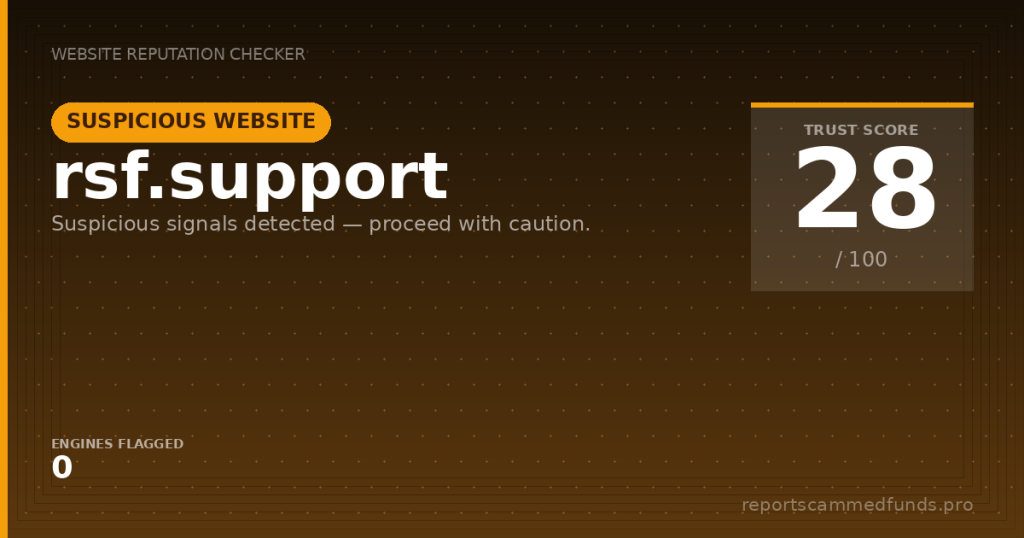
Trading platform & site functionality
Our manual attempt to access rsf.support did not produce a working page, which leaves most of its functionality and purpose undisclosed. The domain itself suggests a support or helpdesk role, the kind of endpoint many companies use for ticketing or account assistance. However, legitimate support portals almost always present a visible brand identity, sign-in interface, or a pass-through to a known parent domain. When none of those elements are observable, the value proposition—and the degree of operational transparency—remains unclear.
Because the front end did not load, we checked for signs of a common ticketing platform footprint. Many reputable businesses host support sites on recognizable stacks or subdomains—think branded Zendesk or Freshdesk portals, identifiable URL patterns, or SSL certificates referencing the parent company. In this case, no independently verifiable linkages were available. The absence of brand continuity makes it difficult to confirm that rsf.support belongs to any particular organization or that it functions as a customer-facing system at all.
A well-run support portal typically offers certain public essentials even before login: an accessible privacy policy, cookies disclosure, the operator’s legal name, and a method to contact the team outside the portal. Those elements exist to reassure users who might be asked to upload personal information, submit sensitive case details, or authorize account actions. If rsf.support is intended for those purposes, it withholds the very disclosures that allow users to evaluate risk. To be fair, it could be restricted to invited users only, but a walled-garden approach heightens the need for out-of-band verification.
We also consider the risk of brand impersonation in the support domain space. The abbreviation ‘RSF’ could evoke multiple well-known entities, and a lookalike domain can be used in phishing or social-engineering flows even if it carries no obvious web content. An email signed ‘Support Team’ that directs you to rsf.support might appear reasonable at a glance, especially if it references past interactions or a known vendor. In such scenarios, an unverified support domain can become the pivot point for payment requests, document harvesting, or account takeover. This is precisely why clear branding and verifiable provenance matter.
License & regulatory status
We found no public claim on rsf.support regarding financial regulation, licensing, or membership in a recognized dispute-resolution scheme. That may be acceptable if the site merely acts as a private helpdesk for a legitimate, regulated parent company. Yet without a visible link back to such a parent entity—and without stated governance—consumers have no straightforward way to place the site within a legal or compliance framework. If the domain expects users to share personal data or send fees, the lack of declared oversight is a fundamental concern.
Regulators worldwide have repeatedly warned about service sites that collect ‘case fees’ or ‘unlock charges’ in the context of investments or crypto losses. Authorities like the FCA (UK), BaFin (Germany), ASIC (Australia), CONSOB (Italy), the CFTC (US), and FINMA (Switzerland) have issued general advisories about recovery scams and unlicensed financial intermediaries. We did not locate a specific regulator warning about rsf.support itself, but the site’s opacity echoes patterns these agencies highlight: no verified operator, no license claims, and vague or inaccessible disclosures.
If rsf.support positions itself as affiliated with any well-known organization—charity, watchdog, newsroom, bank, or regulator—always confirm that relationship at the official, primary domain of the claimed entity. Genuine affiliations are typically listed on an ‘Our Partners’ or ‘Contact’ page, and license numbers can be checked on official registries like the FCA’s Financial Services Register or ASIC’s Professional Registers. Never accept a PDF, an email signature, or a loose claim of ‘regulatory approval’ without independent corroboration on a regulator’s own website.
Data protection obligations also matter. In the UK and EU, any site that processes personal data must provide a named data controller, geographic location of processing, and lawful bases under GDPR, among other details. A US-facing operation that stores consumer data should outline privacy practices that satisfy state-level requirements, such as the CCPA/CPRA in California. A bare or unreachable support domain that solicits sensitive uploads—IDs, bank statements, crypto transaction logs—without visible privacy notices or controller identity is not just inconvenient; it’s potentially non-compliant and risky.
User feedback
We looked for credible, third-party user reviews referencing rsf.support and did not find independently verifiable accounts connected to this domain. The absence of chatter is not inherently damning, but in fraud investigations it often points to a site that is new, dormant, or used in targeted outreach rather than broad consumer marketing. Trusted services typically accumulate a traceable history: forum posts, press mentions, Better Business Bureau entries, or official social profiles with consistent branding. With rsf.support, that public trail appears faint or nonexistent.
In the broader category of support-branded or recovery-themed domains, recurring complaint themes include surprises and stall tactics: evaluation fees that lead nowhere, ‘compliance bonds’ requested to release funds, and delayed responses once money changes hands. Another common pattern is document harvesting—asking victims to upload passports, utility bills, and card photos under the pretext of ‘verification’—followed by silence or additional fees. While we cannot attribute these behaviors to rsf.support, their prevalence in support-style outreach warrants vigilance, especially when the operator remains unnamed.
We also considered the possibility of targeted contact via messaging apps. Cold outreach on Telegram, WhatsApp, or email may route victims to a ‘ticket portal’ with a minimal landing page, using a domain like this to convey legitimacy. The follow-up often cites ‘case managers’ or ‘forensic teams’ who can only proceed once a fee is paid or more documents are shared. If you encounter such scripts tied to rsf.support, pause and verify the sender through a separately known-good channel before you share data or money.
Deposits & withdrawals
Because rsf.support did not present a functional interface during our review, we could not identify any accepted payment methods, pricing tables, or fee schedules. Legitimate service providers normally publish at least a skeleton outline of costs and a clear refund policy. By contrast, entities that rely on pressure often present costs only after they have established contact and gathered personal details. When no standard payment architecture is visible, consumers can be steered toward harder-to-reverse methods like bank wires or crypto transfers.
Across cases we track, unverified ‘support’ or ‘recovery’ sites frequently escalate fee requests in stages: an initial ‘assessment fee,’ then a ‘trace fee,’ followed by larger ‘unlock’ or ‘liquidity provision’ fees allegedly required by banks, exchanges, or blockchains. Each step is framed as the final gate before release of funds. This choreography keeps victims invested and less likely to walk away, even when promised outcomes never materialize. If any party connected to rsf.support proposes such sequences, treat it as a serious warning sign.
By contrast, if rsf.support is a genuine support endpoint for a known brand, it should not require unsolicited payments at all. A proper support portal would redirect billing to the company’s verified main website or an established, auditable payment processor with clear receipts. Any request that channels you toward gift cards, cryptocurrency, or peer-to-peer transfers is suspect by default. Even if a card payment is offered, demand written terms, refund policies, and the legal name of the merchant before authorizing a charge.
Why unregulated brokers are risky
When a website’s operator, jurisdiction, and purpose are opaque, the consumer’s protection stack is thin to nonexistent. There is no meaningful recourse if fees are collected and the promised service never appears, nor is there an ombudsman to mediate disputes. Even in regions with strong consumer protection, it is difficult to enforce rights against a party that cannot be clearly identified. This asymmetry is precisely why professional services—especially those touching finances—must disclose who they are and where they operate.
A parallel risk involves privacy and identity. Support portals often request sensitive documentation that can be exploited for account takeovers, credit fraud, or secondary scams. If rsf.support cannot be tied to a verified company with a robust privacy policy and a stated data controller, any upload of IDs, selfies, or bank records is high stakes. The long-term harm from identity misuse often exceeds the original monetary loss.
Finally, an unregulated or undisclosed service can become a conduit to more elaborate schemes. We routinely see ‘boiler-room’ operations hand victims off to ‘recovery teams’ that recycle the same databases of contacts. Without transparent oversight and genuine accountability, the cycle repeats: fresh fees, new promises, and ultimately, deeper losses. The safest course is to refrain from sharing data or paying fees until an operator’s legitimacy has been independently, concretely verified.
How to get help if you’ve been scammed
If you have already paid someone connected to rsf.support or shared personal information, act quickly. Contact your bank or card issuer and request a chargeback or dispute, explaining that you suspect misrepresentation. For bank wires, ask your institution to initiate a recall and file a fraud report; for cryptocurrency, immediately notify the exchange or custodian that handled the transfer and submit a fraud ticket with the transaction ID. Preserve every email, message, invoice, and screenshot as evidence.
Report the incident to the appropriate authorities in your jurisdiction. In the United States, file with the FBI’s Internet Crime Complaint Center (IC3). In the United Kingdom, report to Action Fraud and, if financial services were claimed, notify the FCA. In the EU, alert your national police or cybercrime unit, and consider contacting BaFin, CONSOB, or your country’s relevant regulator if investment or recovery services were promised. More reporting increases your odds of intervention and creates a public record that can help others.
For tailored guidance, you can contact our team at reportscammedfunds.pro. We review documentation, map payment flows, and help you structure chargebacks and regulatory complaints while screening for ‘recovery scam’ red flags. Reach out before sending any further money or documents; a short consultation can prevent deepening losses. We will not promise miracles—but we can help you pursue practical remedies and avoid common traps.
Conclusion
rsf.support currently offers too little transparency for a comfortable trust decision. With no working page, no clear ownership, and no declared purpose, the domain sits in a grey zone where consumers bear disproportionate risk. A legitimate support portal would provide unmistakable branding and a verifiable link to a known organization. Until such proof appears, the safest assumption is to avoid engagement.
If you encounter rsf.support in an email or message, verify the sender through an independent, trusted channel—such as a phone number listed on a known-good website—not by replying to the same thread. Decline to upload IDs or pay fees without a contract, full legal entity name, and confirmation on the organization’s official site. Be skeptical of urgency, guaranteed outcomes, and staged fee requests. Sensible friction now can prevent months of frustration later.
We will continue to monitor this domain and update our assessment if verifiable information emerges. If you possess documents that establish ownership or a legitimate affiliation, share them securely so we can re-evaluate. For everyone else, caution is not paranoia; it is prudence. There are many reputable firms out there—make sure any site you trust proves it deserves that trust.