
Trading platform & site functionality
Road Coderr functions as a digital services portfolio and lead-generation site, describing offerings that include SEO, WordPress development, and UI/UX work. The stack is conventional: the site runs on WordPress with Elementor and the Hello Elementor theme, plus Contact Form 7 for lead capture. A CookieYes banner appears on load and communicates consent status to a third-party endpoint, which is consistent with mainstream consent management implementations. The site loads fonts and styles from local WordPress paths and presents a series of image-heavy sections highlighting prior projects and services. Overall, the build feels like a standard freelancer or boutique agency site rather than a large corporate property.
From a user-experience standpoint, navigation is straightforward, with headers that lead to About, Portfolio, and Contact sections. The network requests show numerous Elementor and Elementor Pro assets (frontend modules, sticky nav, image carousel, animated headlines, and Swiper.js), which explains the animated components and sliders present in the design. This plugin-driven layout is common and not inherently problematic, but it does mean the site’s feel and structure are template-driven. That is useful for speed of delivery and lower costs, though it can also expose sites to plugin-related maintenance issues if not actively patched and managed.
Functionally, the site is geared to convert visitors into inquiries rather than complete transactions online: there is no checkout flow, no self-serve account creation, and no digital-asset downloads. Instead, Road Coderr links out to social platforms (Instagram, Facebook, TikTok, YouTube, LinkedIn, and Behance) and provides a WhatsApp contact link, suggesting the operator is accessible and intends to converse directly with prospects. The site displays recent portfolio items and references international clients, but as is typical for freelancer sites, those claims are not independently verified on-page. In terms of performance and reliability, nothing in the scan suggests misconfigurations or broken pages; SSL is valid, and the cookie banner loads correctly, which are positive hygiene indicators.
License & regulatory status
As a freelance web/SEO service provider, Road Coderr does not operate in a sector that requires financial or investment regulation. That means oversight by bodies like the UK FCA, Germany’s BaFin, Italy’s CONSOB, Australia’s ASIC, the U.S. CFTC, or ESMA is not applicable. We did not see claims on-site that the operator is regulated by any financial authority, nor would such claims be relevant for the services described.
We also did not find third-party trust seals or partner accreditations (for example, a verified Google Partner listing) presented in a way we could independently verify. Sites sometimes mention partnerships or badges that are loosely defined; that was not specifically observed here, but we caution readers to verify any professional certifications or logos directly with the issuing organization if they appear later. At the time of our review, no official regulator warnings (FCA, BaFin, ASIC, CONSOB, or others) were located that pertain to roadcoderr.com, which aligns with the non-financial nature of its services.
The pages mention a privacy policy and terms, and the CookieYes banner indicates some attention to consent norms, which is broadly positive. However, consent tooling and privacy pages do not substitute for transparent corporate identity or clear contractual frameworks. If you plan to hire Road Coderr, request a formal contract that spells out jurisdiction, deliverables, ownership of code and creative assets, revision rounds, and payment schedule. Those instruments, not regulation, will govern your recourse if a project goes off track.
User feedback
Our research did not surface a large body of third-party reviews on major, independent platforms with high moderation standards. That does not make Road Coderr untrustworthy, but it means there is limited crowd-sourced history to evaluate consistency of delivery, timeliness, or support responsiveness. On-site testimonials and social posts can be informative, but they are curated by the operator and should be weighed alongside external references you can verify directly with past clients.
In the absence of strong review footprints, risk control comes from process: insist on a statement of work that defines scope, milestones, acceptance criteria, and deployment responsibilities. Common friction points for small web projects include missed deadlines, disagreements about what is “in scope,” and handover of credentials post-launch. Another recurring issue across the freelance market—generally, not specifically tied to this site—is content ownership and license clarity. If your build will include paid themes, premium plugins, or stock media, ensure license terms and renewals are documented so you do not lose functionality later.
We saw no flood of public complaints alleging fraud, withdrawal blockages, or similar high-severity patterns that typically accompany scam operations. Again, that is consistent with the site’s non-financial focus and with a normal freelancer business model. Still, if a provider asks for unusually large upfront payments without offering verifiable references, or seeks to move conversations exclusively to ephemeral channels without a paper trail, take that as a cue to slow down and formalize terms in writing.
Deposits & withdrawals
Road Coderr does not appear to process payments on-site—it is not an e-commerce checkout or trading platform—so the standard ‘deposit and withdrawal’ model does not apply. Engagements are likely handled by invoice and direct settlement (bank transfer, card link, or other method agreed between parties). If you proceed, we recommend milestone-based payments tied to demonstrable deliverables (for example, wireframes approved, staging site delivered, SEO audit handed over) rather than paying the full amount upfront.
Ask for an invoice that includes full business details, tax number (if applicable), and the legal entity that will deliver the work. For cross-border projects, consider an escrow service or a marketplace with built-in dispute resolution that can hold funds until milestones are accepted. If the vendor prefers WhatsApp for coordination, that can be fine for quick Q&A, but request that estimates, scope changes, and approvals also be confirmed by email so you have a searchable record suitable for banks or platforms should you ever need to escalate a dispute.
Refund and revision policies should be stated unambiguously before you pay the first milestone. Agree on the number of design revisions included, turnaround times, bug-fix windows after go-live, and who will be responsible for hosting, DNS changes, and security updates. Finally, clarify ownership: ensure the contract specifies that you will receive administrator credentials and that code, designs, and content are transferred to you upon final payment.
Why unregulated brokers are risky
Although regulation is not expected for a freelance web/SEO service, the absence of an external supervisory body means your protection relies on contracts, documentation, and your payment method’s dispute channels. If a vendor fails to deliver, you do not have investor-compensation schemes or statutory ombudsman processes to lean on as you would with regulated financial products. For that reason, vet the operator’s identity, gather verifiable references, and avoid paying the full fee before work has been demonstrated to meet the agreed specification.
Another structural risk is business continuity. Freelancers can be fast and cost-effective, but a single-person operation may be unavailable due to illness or life changes, which can stall projects if handover contingencies were never planned. Ask upfront about backup plans, source code access (for example, a shared Git repository), and documentation that would allow another developer to step in if needed. These are straightforward safeguards that cost little but dramatically improve your resilience.
Finally, hosting and plugin dependencies can outlast the engagement. A WordPress site built with Elementor and multiple add-ons runs well when maintained, but unsupported themes or lapsed licenses can cause security holes or break layouts over time. Be sure you understand which licenses are included, which are your responsibility to renew, and how to apply security updates without disrupting customizations.
How to get help if you’ve been scammed
If you have already paid Road Coderr and believe you were misled or did not receive the agreed deliverables, gather all documentation immediately: invoices, the statement of work, emails, chat transcripts, and links to staging sites or repositories. If you paid by card, contact your card issuer to request a chargeback, citing non-delivery or goods/services not as described. For bank transfers, speak to your bank promptly to explore recall or fraud reporting options; time is critical.
Next, file a complaint with the appropriate authority based on your location: in the U.S., submit a report to IC3.gov; in the UK, use Action Fraud; in the EU, consult your national consumer protection body and consider econsumer.gov for cross-border disputes. Include the domain, payment details, and a clear chronology of events; well-structured evidence improves your chances of recovery or mediation. If the dispute spans jurisdictions, be explicit about where you and the vendor are located and which law the contract specified, if any.
You can also seek independent guidance and case handling support from reportscammedfunds.pro. Their team can help you triage the situation, prepare evidence for banks and authorities, and advise on realistic recovery routes. Even if your case does not meet the threshold for a formal investigation, a quick consultation can help you avoid common missteps and decide whether escalation is warranted.
Conclusion
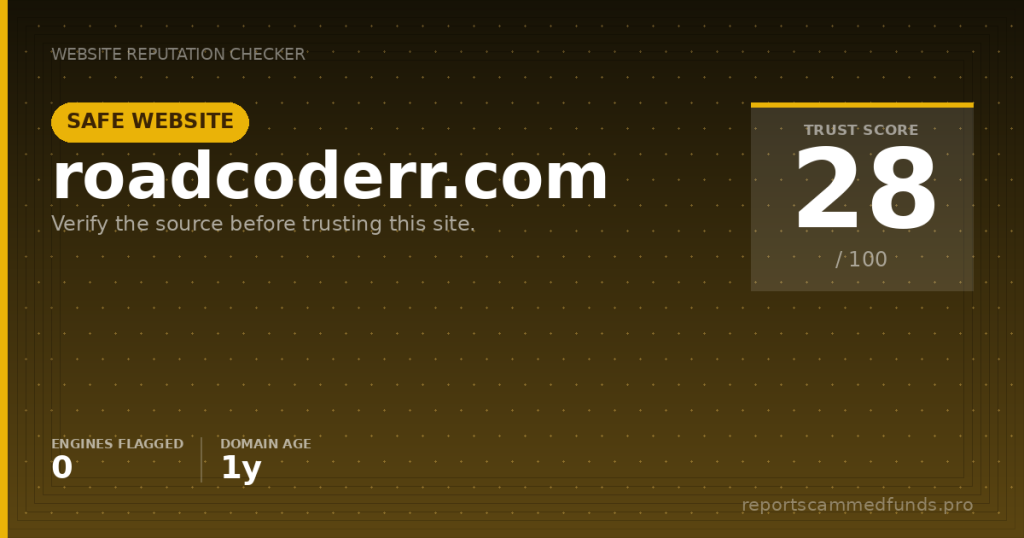
Based on our review, roadcoderr.com looks like a normal freelancer web/SEO site with a current SSL certificate, working cookie consent, and a portfolio-driven layout built in WordPress. It is not flagged by malware engines, and we did not find regulator warnings, which aligns with its non-financial nature. The main caution stems from its youth and the limited corporate disclosures typical of solo or small-team vendors.
If the services and price points fit your needs, conduct standard vendor diligence: ask for verifiable references, lock down deliverables and timelines in a written contract, and structure payments around clear milestones. Confirm license ownership for themes and plugins, and plan for maintenance and handover so you are not dependent on a single contact channel such as WhatsApp. Simple steps like these reduce the likelihood of misunderstandings and give you recourse if things slip.
We do not label Road Coderr a scam, but we do recommend approaching it as you would any young freelancer brand: verify identity, keep a paper trail, and use payment methods that allow dispute resolution. If any proposal feels rushed or demands unusually large upfront transfers without documentation, pause and renegotiate terms. Independent verification is always your best safety net.