
Trading platform & site functionality
Quantum-ai.io presents a polished landing page that markets an AI-powered cryptocurrency trading experience. The site highlights broad language coverage and a prominent sign-up flow that invites users to register quickly. Technical assets include custom JavaScript, WebP images, and calls to an internal endpoint associated with click tracking. The interface appears more like a lead-capture funnel than a fully documented brokerage or exchange, with little in the way of transparent fee schedules or platform manuals. This is common in high-pressure marketing sites, where the objective is collecting contact details and deposits rather than offering verifiable information up-front.
Aside from generic statements about AI and education, the platform’s core features are not clearly outlined. There is no downloadable terminal, no audit of bot strategies, and no published performance methodology that an investor could independently scrutinize. The site’s static assets even reference unrelated brand names, suggesting recycled creative or a white‑label template re-used across multiple domains. That pattern is typical of boiler-room operations: a common front-end, tweaked logos, and language variations to target different jurisdictions. While a modern front end can be a positive, here it mostly masks missing fundamentals: verifiable ownership, licensing, and product transparency.
Navigation links to About, Terms, and Privacy exist, but the sections do not remedy the core information gaps. There are no clear legal entities, registration numbers, or supervisory authorities named with precision. The Terms do not list custodianship, banking partners, or dispute-handling frameworks—items that reputable firms normally publish to reassure clients. Importantly, no fee table, margin policy, or risk-parameter documentation is presented before users are asked to sign up and share data. When a trading site puts marketing claims first and disclosures last, it raises the practical question of what service—if any—is truly being offered.
License & regulatory status
We looked for concrete licensing claims across the site’s pages and found none that could be independently verified. A legitimate investment firm soliciting clients in the UK would need authorization from the FCA; in Germany, BaFin; in Australia, ASIC; across the EU, a MiFID passport via a national authority such as CySEC or CONSOB; and in Switzerland, FINMA would be relevant for certain activities. Quantum-ai.io provides no regulator license numbers, no firm reference numbers, and no jurisdictional carve-outs. The absence of such basics is a red flag for any platform offering trading or investment services.
When a platform provides multi-language access and implies global availability, it must also present regulator-specific disclosures and limitations. We found none. There were no tailored warnings for high-risk derivatives, no leverage caps under ESMA rules, and no statements about client money segregation or compensation schemes such as the FSCS in the UK. That silence is meaningful: legitimate firms spotlight these safeguards precisely because they reduce client anxiety and meet legal obligations. Without them, users face a marketplace where contractual rights and enforcement paths are unclear.
We also assessed potential false-affiliation cues, a frequent tactic used to project credibility. While we did not see overt claims of endorsement by named institutions, the branding as the “Official & Updated Trading Platform 2025” reads like borrowed authority. Similarly, re-used imagery and references to other brands are a hallmark of white‑label funnels that move from one website to the next after complaints accumulate. In short, nothing on the site changes the basic finding: this appears to be an unregulated investment solicitation with no independently verifiable oversight.
User feedback
External chatter around “Quantum AI” as a label in the crypto sphere is mixed, and much of it centers on aggressive marketing funnels rather than transparent trading services. While we cannot independently verify each anecdote, recurring complaint themes in similar funnels include surprise KYC demands only after deposits, difficulty speaking with a real compliance officer, and constant outreach from so-called “account managers” pushing for larger deposits. Users often report that displayed profits in dashboards do not translate into cashable withdrawals. The pattern fits the classic boiler-room lifecycle: nurture via calls, escalate deposits, then stall withdrawals.
Another common thread in posts about AI trading schemes is friction at the point of payout. Customers describe being told to pay additional fees, taxes, or margin top-ups before a withdrawal can be released—a telltale sign of advance-fee tactics. Others say support channels go silent or respond only with canned replies once a payout is requested. The complaints usually spike after initial small withdrawals are allowed, encouraging greater deposits before later requests are blocked. Although each case is individual, the repetition across threads is a serious caution flag.
We also caution that brand names like “Quantum AI” are frequently repurposed across different domains over time, complicating the task of tracing which operator handled which user’s money. This diffusion hampers chargebacks and formal complaints, because victims might not know the true legal entity or payment processor behind their transaction. In such circumstances, time is critical: disputing charges quickly with the issuing bank and preserving all communication records can materially improve recovery odds. For would-be users, the signal is clearer still—avoid entanglement in the first place by refusing to deposit until you verify licensing and company identity beyond doubt.
Deposits & withdrawals
Quantum-ai.io does not publish a transparent list of accepted funding methods, nor does it present a fee table or withdrawal timeline prior to registration. This opacity is unusual for a platform soliciting funds, as reputable brokers generally post exact details for cards, bank transfers, and any crypto rails they support. The absence of clear instructions for withdrawals—such as cut-off times, bank details, and standard processing windows—creates predictable friction points later.
Reports from similar AI-trading funnels often describe a predictable sequence: deposits are easy; withdrawals are drawn-out or refused without verifiable cause. Users may be told a payout is pending compliance checks, taxes, or platform unlock fees—charges that legitimate institutions would net against the account rather than demand in fresh, off-platform payments. If a site asks you to send more money to receive your own funds, that is a classic sign of an advance-fee scam layered on top of a trading pretext.
Given the lack of published banking partners or custodianship details, consumers have no way to know where their funds would be held or under what country’s insolvency and restitution laws. That uncertainty directly affects your recourse if anything goes wrong. It also makes tracing and freezing assets far more difficult for law enforcement, especially if payments are routed through multiple processors or converted into crypto immediately after deposit. For a service marketing itself as an advanced trading solution, these basic omissions are anything but advanced.
Why unregulated brokers are risky
Using an unregulated platform for trading or investing exposes you to elevated, often uninsurable risks. There is no capital adequacy standard to keep the operator solvent, no mandated segregation of client funds, and no compensation scheme if the operator disappears. You have minimal leverage in disputes, because the contract typically places you outside the jurisdiction of powerful investor-protection regimes. When the entity is opaque from the outset, the practical chance of a fair, timely resolution plummets.
Major regulators like the FCA, BaFin, ASIC, CONSOB, and the CFTC exist precisely to enforce transparency, conduct rules, and client-protection standards. A platform that avoids those frameworks is, by definition, asking you to trust it instead of the law. The marketing pitch might stress speed and innovation, but the trade-off is stark: you surrender rights that come with regulated status, including audited reporting, capital buffers, and official complaints channels.
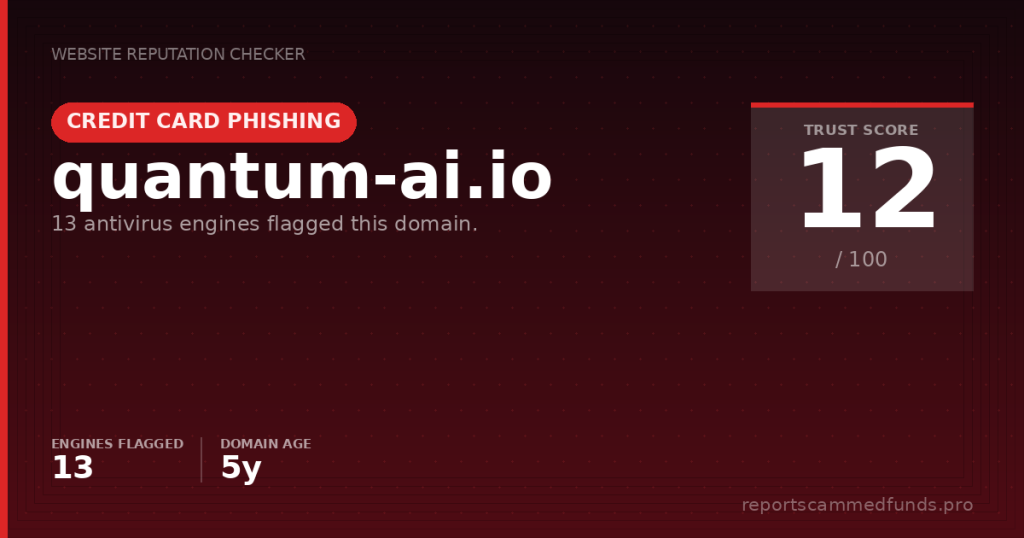
If a website is flagged by multiple security engines for phishing or scam behavior, the risk profile worsens still. Phishing designations often correlate with attempts to collect payment-card data and personal identity information for misuse. Even if you never deposit, submitting KYC data on such a site can lead to identity-theft fallout elsewhere. In other words, with an unregulated and widely-flagged platform, both your money and your data may be at risk.
How to get help if you’ve been scammed
If you have already deposited money with quantum-ai.io and are now facing withdrawal blocks or pressure to pay new fees, act quickly. Contact your bank or card issuer immediately and request a chargeback, citing suspected fraud and any evidence you have (screenshots, emails, chat logs, payment receipts). If you paid via wire, ask your bank to initiate a recall; if you used crypto, gather the transaction hashes and wallet addresses for tracing. Time limits apply—do not wait for yet another promised email from the platform.
Report the incident to your national regulator and relevant cybercrime authority. In the UK, use Action Fraud; in the EU, notify your national financial supervisor; in the US, file with the FTC and IC3; in Australia, report to Scamwatch and ASIC. Provide all the same evidence so they can correlate cases and warn others. Each report increases the odds of coordinated action, even if you do not get an immediate response.
For specialized assistance compiling your evidence, mapping payment paths, and advocating with banks or processors, you can reach our team at reportscammedfunds.pro. We review documentation, help structure disputes, and liaise with payment networks where appropriate. The sooner you involve experienced case handlers, the better your chances of stopping additional charges, challenging unauthorized debits, and preserving data useful for law enforcement.
Conclusion
Quantum-ai.io bears the hallmarks of a high-risk, unregulated trading funnel rather than a transparent, licensed investment service. From aggressive “official” branding and recycled marketing assets to the absence of regulator credentials and basic fee disclosures, the site offers marketing gloss but no verifiable substance. Reputable brokers lead with their licenses, legal entities, and clear withdrawal policies; this site does not.
Because multiple reputation engines flag the domain for credit-card phishing and financial-scam behavior, the prudent course is to disengage. Do not deposit, do not share personal or card data, and do not allow remote access tools if anyone asks to “help” you set up an account. If you have already shared information, monitor your cards and credit reports closely and place fraud alerts as needed.
In short, avoid the platform. If you remain curious about algorithmic or AI-assisted trading, only consider firms that are directly authorized by a top-tier regulator (FCA, BaFin, ASIC, FINMA, CFTC, or equivalent) and that publish full legal entity details, audited statements, and client-protection mechanisms. Independent verification is not paranoia—it is basic self-defense in a market full of lookalike funnels.