
Trading platform & site functionality
Polygate.tech positions itself as an AI‑driven market‑making agent tailored for Polymarket, using phrasing like “autonomous spread‑arbitrage protocol.” In practice, that means the site implies it can algorithmically trade or provide liquidity across prediction markets to extract profit from bid‑ask spreads. Although the concept sounds sophisticated, the website provides minimal concrete documentation of how this is implemented, who controls the funds, or what safeguards exist. There is no public whitepaper, no code repository, no audits cited, and no independent verification of performance claims or security posture on the landing content.
Technically, the site loads behind a CDN proxy and pulls in a mix of third‑party trackers and its own analytics endpoints. Our review observed custom API calls (for example, visits and pool statistics) and a separate analytics subdomain, suggesting data collection funnels are in place. The presence of Facebook Pixel and Yandex Metrika also indicates the operator is tracking visitor behavior for remarketing or conversion optimization. None of this is unusual for a marketing funnel, but it does underline that the site prioritizes acquisition over substantive investor documentation or governance transparency.
From a usability standpoint, the visible public pages are thin on essential details: no legal entity, no responsible persons, no disclosures on custody arrangements, and no regulator license references. Instead, the call‑to‑action pushes users toward social channels such as Telegram and X, where promises or instructions can be delivered with little accountability and can be deleted or edited retroactively. The content is framed to sound cutting‑edge—“AI,” “autonomous,” and “spread‑arbitrage”—but omits real, auditable specifics that would allow a prudent user to evaluate counterparty risk.
The site references Polymarket in its positioning, yet it does not prove any official partnership, integration, or endorsement from Polymarket itself. This matters because users could mistakenly assume Polygate benefits from Polymarket’s trust or compliance program, which is not substantiated on the page. Without visible audits, published smart‑contract addresses, or independent verifications, the site remains an opaque interface asking users to believe the narrative and submit to a process that could include wallet approvals or off‑site instructions. Those are the exact circumstances in which crypto users have historically been steered into unrecoverable losses.
License & regulatory status
Any service that accepts customer funds, executes trades on their behalf, or manages pooled capital triggers regulatory questions. Yet polygate.tech does not disclose a license number, regulator name, or operating jurisdiction. We could not independently verify registration for “PolyGate” or the domain in databases of major regulators such as the FCA (UK), BaFin (Germany), ASIC (Australia), CONSOB (Italy), or the CFTC/NFA (United States). A legitimate financial operator generally displays its legal entity, license details, and regulator contact information prominently.
The site’s likely defense is that it is a DeFi tool or a non‑custodial “agent,” but that still demands clarity. If there is any pooling of user funds, discretionary execution, or fee‑sharing, then consumer‑protection and market‑integrity standards ordinarily apply. Without those, customers face pure counterparty risk. Moreover, if the tool requests broad wallet permissions or approval allowances, the operator can unilaterally move assets even without formal custody in the traditional sense—again, a risk that warrants independent audits and clear terms that are not present.
We did not find formal regulator warnings specifically naming polygate.tech at the time of review. However, multiple regulators have repeatedly cautioned against crypto arbitrage and “AI trading bot” schemes that solicit deposits or permissions while offering little verifiable oversight or accountability. The lack of any credible licensing footprint here is a critical and unresolved risk, and in our view it is substantial enough on its own to warrant declining engagement.
Finally, the customer‑service model revolves around Telegram. For a putative financial or market‑making solution, this is neither professional nor compliant. It leaves users with no defined complaints process, no formal dispute resolution, and no binding set of terms under a known jurisdiction. All of those are stress‑tested hallmarks of a reputable operation.
User feedback
Because this domain is only days old, there is virtually no trustworthy, independent public feedback. The social channels attached to such projects can show quick bursts of positive comments, but those are easily manufactured and frequently lack corroborating evidence such as transaction hashes, audit links, or long‑term performance histories. We give more weight to sustainable, third‑party reviews on established platforms and to disclosures that can be independently checked; in this case, those are lacking.
In comparable schemes we’ve tracked over time, users commonly report the same patterns after initial engagement: withdrawals blocked following perceived profits, shifting rules that require extra fees or “tax clearance” payments before releasing funds, and abrupt demands for unexpected KYC only after deposits have been made. Managed‑account narratives and “arbitrage pool” offerings in particular often turn into dead ends where deposits are visible on a dashboard but cannot be retrieved without further payments that never resolve the hold. While we cannot attribute specific incidents to polygate.tech due to its recency, the risk profile is essentially identical.
Telegram‑centric support also tends to degrade quickly under scrutiny. When users ask for proofs, external audits, or regulator details, the responses often move into private chats or vanish. That asymmetry—loud, public marketing followed by private, ephemeral explanations—is a hallmark of high‑risk operations. Until substantive, third‑party‑verifiable evidence to the contrary emerges, prudent users should assume the worst rather than the best.
Deposits & withdrawals
Polygate’s landing page does not clearly list accepted deposit methods or withdrawal mechanics, which is already a significant concern. Given its Polymarket focus, the most plausible flow is wallet connection and USDC approvals on the Polygon network, potentially followed by deposits into a so‑called market‑making “pool.” In these models, the fine print—if any exists—matters: token allowances can enable unlimited spending, and pooled funds can become functionally illiquid if the operator or smart contract withholds redemptions.
Across similar DeFi‑themed arbitrage products, we see two recurring friction points: first, funds are “locked” pending a performance cycle or “cool‑down,” then users are told to pay additional gas, unlock, or “liquidity” fees to release balances. Second, after paying those fees, a new barrier emerges (for example, an “anti‑money laundering certificate” or “tax” payment) that again extracts more money without actually allowing the withdrawal. While we cannot state this is occurring here, the omission of a clear, audited withdrawal policy is a grave risk signal.
If any off‑chain payments (cards, wires, or exchanges) are solicited, users face the added danger of chargeback‑hostile pathways. Crypto‑only withdrawals with no documented timelines, caps, or dispute procedures are even worse—there is no way to compel performance, and tracking the counterparty through a CDN proxy is notoriously difficult. In short, deposits or token approvals here are high‑risk actions with low odds of smooth, documented reversals.
Why unregulated brokers are risky
Using an unregulated market‑making or arbitrage service means you have no safety net. If funds are seized, lost, or simply never returned, there is typically no recourse to compensation schemes, no ombudsman, and no recognized adjudication framework. The operator can claim software bugs, market conditions, or liquidity shortages, and there is no authority empowered to compel restitution.
Moreover, AI and “autonomous” branding can obscure human discretion and control. Without credible audits, smart‑contract addresses, and on‑chain, independently verifiable strategies, users cannot tell whether any trading occurs at all or whether inflows are simply used to pay earlier withdrawals—classic hallmarks of circular, unsustainable schemes. The absence of a whitepaper, published risk factors, and licensing further compounds that risk.
Finally, handing over wallet permissions or making deposits into opaque pools creates a dependency that the operator can exploit—either technically (through allowances) or procedurally (through ever‑shifting withdrawal hurdles). That structural asymmetry is why prudent investors avoid unregulated crypto “bots” and why multiple regulators worldwide warn against them.
How to get help if you’ve been scammed
If you have already deposited or granted wallet permissions, act immediately. For card or bank transfers, contact your issuing bank and file a dispute or chargeback, providing any evidence of misleading claims or non‑delivery. If crypto was used, revoke token allowances for any contract addresses you interacted with (via a trusted token approval tool) and move remaining funds to a secure wallet you control.
Next, file reports with your national authority: in the United States, submit a complaint to IC3.gov; in the United Kingdom, report to Action Fraud; in the EU, contact your national regulator or police cybercrime unit. Include all transaction hashes, chat logs, emails, and screenshots. These reports help establish patterns across cases and may aid broader enforcement even if they do not immediately recover funds.
For case assistance, evidence preservation, and strategy on recovery or escalation, reach out to reportscammedfunds.pro. Our team can assess the specific payment rails used, coordinate appropriate reporting, and help you avoid secondary “recovery scams” that target victims after an initial loss. Do not pay any additional fees requested by the operator to “unlock” your funds without independent validation—this is a common advance‑fee trap.
Conclusion
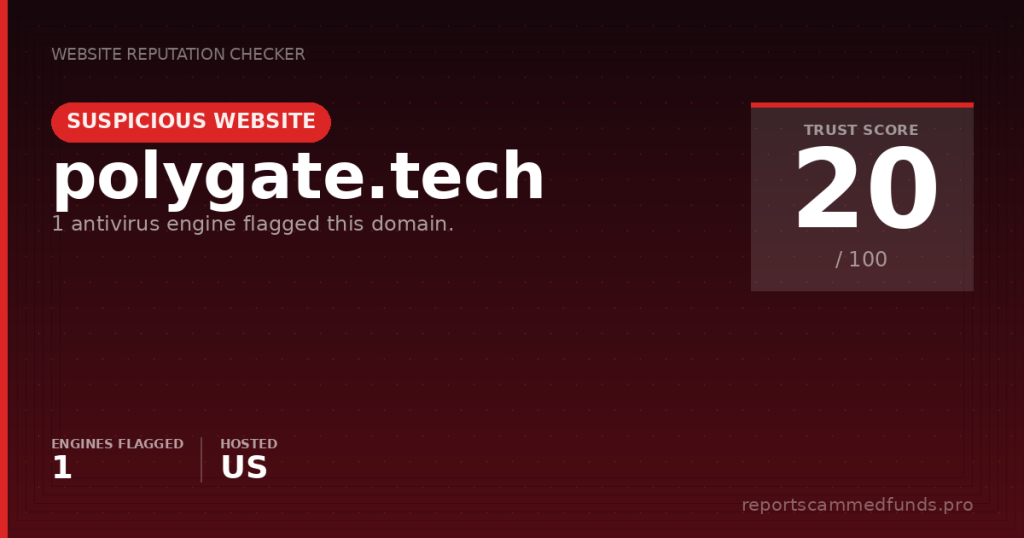
Polygate.tech exhibits the classic profile of a high‑risk, unregulated crypto scheme: brand‑new domain, no disclosed legal entity or license, heavy marketing language about AI arbitrage, and a support funnel that relies on Telegram instead of accountable, documented processes. There are no audits, no verifiable performance records, and no published consumer protections. The opacity here is not a minor oversight—it is the core risk.
Even if you are familiar with Polymarket or prediction markets in general, do not conflate a known venue with an unrelated, unverified third‑party “agent.” Unless and until the operator publishes a verifiable legal footprint, regulator oversight, audited code, and a defensible set of terms, the only rational stance is to stay away. FOMO is not a due‑diligence method, and smooth marketing cannot substitute for governance and compliance.
Our recommendation is unequivocal: do not deposit, do not grant wallet approvals, and do not engage with polygate.tech. If you have already interacted with the site, take the protective steps outlined above and contact reportscammedfunds.pro for support. Your safest outcome is to avoid exposure entirely.