Trading platform & site functionality
Pinnacle Market’s landing page bills the product as an “AI‑powered crypto trading platform” with “funded account challenges”, a combination often used to capture fee payments up front, then funnel users into opaque web dashboards. On a technical level, the site loads as a single‑page application behind Cloudflare, referencing bundled assets and Google Fonts. That minimalism is not the issue; the issue is the hollow presentation—no audited performance metrics, no risk framework, no verifiable operations playbook. Marketing language is heavy on buzzwords and light on concrete, testable claims.
The funded‑account angle is particularly concerning because legitimate proprietary trading challenges publish detailed rules, payout schedules, jurisdictional disclosures, and corporate identities. Here, we could not locate standardized rulebooks, named counterparties, or payout proof that can be independently checked. Instead, the pitch lumps together prop‑style testing with what reads like broker‑style live trading access, a dangerous ambiguity. If a platform is not a regulated broker, it should not be holding retail client funds or representing live brokerage services.
On user experience, the site renders quickly via Cloudflare’s content delivery and telemetry scripts, but that says nothing about trading integrity or custody security. We saw no download links for regulated third‑party platforms (like MT4/MT5) and no API integrations documented with recognizable exchanges or prime brokers. Spread and fee transparency is missing. The absence of well‑structured legal pages (complaints, conflicts of interest, execution policy) is telling for an entity inviting people to deposit or pay challenge fees.
The final functional red flag is the reliance on buzz claims like “AI‑driven edge” without minimum substantiation—no model family, no oversight process, no drawdown statistics per market regime. When firms really deploy quant or ML trading, they disclose governance and validation procedures, even if they protect IP. Here, the unverified AI label functions as a marketing lure to hurry decisions. Put plainly: if the operators cannot document how strategies are supervised and how payouts are honored, they have not earned trust.
License & regulatory status
We found no regulatory license identifier on the website—no FCA FRN, no ASIC AFSL, no BaFin license, no CySEC CIF number, no NFA/CFTC registration. Our public register checks at the time of review yielded no match under the brand name. For any platform that invites deposits or offers live trading access, that absence is decisive. A platform holding or transmitting client money without appropriate authorization sits outside investor‑protection regimes and acts at its own discretion.
The domain’s WHOIS shows a very recent creation date and heavily masked registrant details indicating Kenya, which we were not able to verify as a genuine, regulated corporate presence. Jurisdictional ambiguity is a classic venue‑shopping technique: advertise globally, avoid local oversight, and relocate responsibility if funds go missing. In reputable markets, operators list a legal entity, corporate register number, registered office, and responsible directors by name. None of that is present here.
Some readers may argue that a prop firm challenge is not a broker service. That is true in narrow terms, but it also misses the bigger picture: if the site handles payments for challenges, represents market access, and advertises trading accounts and payouts, consumer‑law duties and truthful commercial communication still apply. Regulators like the FCA, BaFin, and ESMA have repeatedly warned that unlicensed online trading schemes—whether labeled broker, copy‑trade, or “AI platform”—expose users to gratuitous risk and offer little recourse.
Equally worrying is the potential for false affiliations. We saw no credible disclosures of bank counterparties, regulated liquidity providers, or audited financial statements. If the marketing text implies regulated market access but the operator is not listed with the relevant authority in your country, treat the claims as misrepresentation until proven otherwise. In this posture, the safest reading is that Pinnacle Market operates as an unregulated provider outside normal oversight.
User feedback
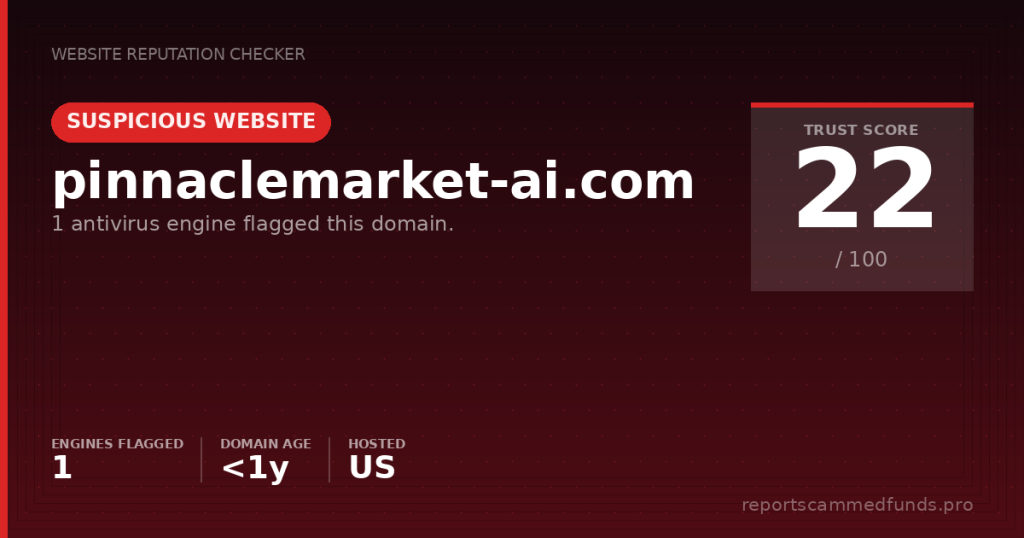
Given how new the domain is, there is little in the way of trustworthy, time‑tested user reviews. That does not mean the operation is clean; it means the public evidence trail has not yet had time to accumulate. Reputation monitors already classify the domain as suspicious, and the theme matches profiles we track: fast‑launched websites, vague AI narratives, and a rush to collect payments ahead of verifiable service delivery.
Complaints we see in similar cases tend to cluster around a few themes. First, withdrawal blockages immediately after users show a profit or pass a “challenge”, followed by surprise identity checks or “risk reviews” used as a pretext to delay or deny payout. Second, shifting goalposts—suddenly citing undisclosed rules, additional fees, or “compliance” tiers that require another payment. Third, support going dark once funds are sent, sometimes after promising an imminent payout to extract one last fee.
We also track familiar contact patterns: Telegram or WhatsApp outreach, unsolicited DMs on social networks promising quick-funded access, and high‑pressure pitches to pay within a countdown. If any of those tactics surface, treat them as serious red flags. Unfortunately, the newness of this domain means victims may not realize the trap until after funds are irreversible.
Deposits & withdrawals
The operator does not clearly disclose deposit and withdrawal methods on the public pages we inspected, which is a problem by itself. In our experience, entities running this playbook prefer irreversible rails—cryptocurrency transfers, obscure processors, or bank wires to offshore accounts. Once you pay via those methods, the balance of power shifts completely. Reclaiming the money becomes an uphill battle without clear contracts and regulated oversight.
Even where card payments are offered, problems routinely arise in the next step: to withdraw or receive a 'payout', users are asked to submit additional fees, taxes, or liquidity costs. Legitimate platforms do not charge withdrawal 'unlock' fees or 'broker liquidity' surcharges; those are hallmark excuses in boiler‑room and advance‑fee frauds. Another common wedge is to impose surprise KYC reviews only after a user requests a withdrawal, then stretch the process indefinitely.
Keep a close eye on the refund policy for any 'funded challenge' fee. Serious prop firms publish formal refund triggers and provide transaction records you can use in a dispute; fly‑by‑night sites keep policies vague and move conversations to encrypted messengers. If the site cannot provide a transparent, reversible payment path with named beneficiaries and a clear withdrawal SLA, do not send a cent.
Why unregulated brokers are risky
Unregulated platforms ask you to trust them with money and data while offering you no statutory protections—a textbook asymmetry. If the operator chooses to freeze your account, cancel your supposed profits, or vanish altogether, there is no investor compensation scheme, no mandated segregation of client funds, and no prudential oversight to lean on. You become reliant on the goodwill of an unknown counterparty hiding behind masked WHOIS details.
The 'AI' buzz is not a mitigation; it is a risk amplifier when unsupported by governance. Black‑box strategies can be used to justify any outcome—'the model saw a regime shift'—while the real driver is poor execution or fabricated statements. Platforms that refuse to publish audited performance, independent verification, or model‑risk controls are asking you to accept narrative in place of evidence.
Lastly, ambiguity about business model—prop firm versus broker—creates levers for pressure. Users can be bounced between 'compliance' departments, asked to upgrade tiers, or told to pay release fees after passing challenges. Every one of those moves is easier to pull off when there is no regulator to complain to and no legal entity under a well‑known jurisdiction. The rational response is to stay out.
How to get help if you’ve been scammed
If you have already deposited, act immediately. Contact your bank or card issuer and request a chargeback, citing misrepresentation and failure to deliver services if applicable. Ask them to block further debits and to monitor for merchant descriptors linked to the transaction. If you paid by bank transfer, alert your bank’s fraud team to send a recall or fraud‑report notice to the receiving institution.
For cryptocurrency payments, compile transaction hashes, wallet addresses, correspondence, and any on‑site receipts. Open a ticket with the exchange or wallet provider you used, asking them to tag the destination address as involved in suspected fraud and to freeze assets if they surface. While crypto refunds are not guaranteed, fast reporting improves the odds of tracing flows and engaging with compliance teams.
Report the incident to your national authority. In the UK, use FCA ScamSmart and file with Action Fraud. In the US, file a complaint with the FTC and the FBI’s IC3. In the EU, contact your national regulator (for example, BaFin in Germany, CONSOB in Italy) and consumer protection agency. The more formal complaints exist, the harder it is for operators to pivot to new domains without scrutiny.
Finally, get practical, case‑level assistance. Our team at reportscammedfunds.pro reviews documentation, coordinates chargebacks, prepares regulator‑ready narratives, and, where appropriate, supports blockchain tracing and recovery outreach. Visit reportscammedfunds.pro to open a case, and include every artifact you have (screenshots, chat logs, invoices). Time matters—earlier intervention improves the recovery window.
Conclusion
Everything about pinnaclemarket-ai.com points in the wrong direction: a weeks‑old domain, masked WHOIS, no licensing, sweeping 'AI' claims, and a muddy sales pitch that blends prop challenge fees with broker‑style promises. That is an architecture built for extraction, not for long‑term service. Without a license, there is no safety net; without a corporate identity, there is no accountability.
If you are still tempted, set hard tests the operator will not pass: demand a regulator license and verify it in the official register; ask for audited financials or third‑party verification of payouts; request a $25 test withdrawal before sending anything larger; insist on a fully reversible, named‑beneficiary payment method with a clear SLA. If any of those simple, reasonable checks triggers deflection, you have your answer.
Our recommendation is unambiguous: avoid Pinnacle Market. Do not open accounts, do not pay 'challenge' fees, and do not send crypto. If you have already engaged, follow the recovery steps above and contact reportscammedfunds.pro for tailored guidance.