
Trading platform & site functionality
Phillip Capital’s website is a clean, brochure-style presence that focuses on institutional clearing and execution, rather than retail trading features. The site is built on a mainstream content management system and uses common web assets for layout and fonts. From a usability perspective, it is straightforward: a top-level overview of capabilities, a global footprint message, and calls to action that direct applicants to an account portal. There is no visible emphasis on spread tables, leverage marketing, or high-pressure deposit prompts that characterize many risky retail broker websites.
Two calls-to-action stand out. First, there is an “Open an Account” pathway that routes users to a separate secure portal subdomain for applications, which is appropriate for compliance-controlled onboarding. Second, the site includes references toward regulatory transparency, including a link out to BrokerCheck, the disclosure database operated by FINRA. These navigational details feel consistent with an established institutional or professional brokerage rather than a speculative contracts‑for‑difference (CFD) seller.
Technical behavior appears orderly. We observed normal redirects from the root domain to the www hostname, a valid TLS certificate, and standard third‑party resources from reputable providers, consistent with many corporate brochure sites. The site hosts images and style bundles via a well‑known CDN aligned with the underlying website platform. We did not encounter broken pages, pop‑ups, or aggressive sign‑up widgets; nor did we see promises of guaranteed returns, aggressive bonuses, or autoplay content, which are common red flags in high-risk trading sites.
Still, one limitation is the lack of detailed product and fee disclosures on the landing pages. Prospective clients cannot immediately see the list of supported exchanges, available platforms, margin frameworks, or precise fee schedules without proceeding into the application or contacting the firm. For an institutional‑leaning FCM/broker‑dealer, this is not unusual, but it does mean a new customer should insist on full written documentation before initiating an application or sending any funds.
License & regulatory status
The site’s headline description asserts that Phillip Capital is a broker-dealer and FCM, implying oversight by regulators such as the SEC and FINRA (for securities brokerage) and registration with the CFTC/NFA (for futures). The presence of a FINRA BrokerCheck link is a positive sign: it directs users to the authoritative database for verifying a broker-dealer’s registration history, disclosures, and supervisory structure. That said, we could not independently verify the exact legal entity name and registration identifiers directly from this homepage alone. Before any engagement, prospective clients should search BrokerCheck by firm legal name and confirm the domain and contact details shown there match what they are using.
Given the group’s global footprint messaging (North America, Europe, and Asia), customers should be alert to jurisdictional nuance. In the United States, futures activity is supervised by the CFTC with membership oversight by the NFA, while securities brokerage is overseen by the SEC and FINRA. In Europe, equivalent oversight might involve national regulators like the FCA (UK), BaFin (Germany), or CONSOB (Italy), and EU‑level frameworks influenced by ESMA. In Asia‑Pacific, oversight can include ASIC (Australia) and other local authorities. Firms often operate through separately capitalized subsidiaries with distinct licenses, so always confirm the precise entity you will contract with, especially if you are located outside the U.S.
We saw no evidence of regulator warnings against this domain, no claims of exotic offshore licenses, and no inflated or false affiliations. The language is conservative and consistent with a regulated institutional business. Even so, we advise a standard check routine: use NFA’s BASIC database to confirm FCM registration if you are engaging for futures, confirm FINRA BrokerCheck for broker-dealer status, and, if you are based outside the U.S., look up the entity in your local regulator’s register. This is especially important because brand names like “Phillip Capital” can recur across multiple regions and lines of business.
A final verification point is operational. Ask for the firm’s most recent Form ADV or equivalent disclosures, execution venues, clearing relationships, and segregation/custody details. Regulated FCMs and broker‑dealers will have formal documents for these topics and can supply them upon request. If you cannot get clear, written confirmations or if contact information diverges from what appears in the regulator’s database, pause and escalate your due diligence.
User feedback
We did not find broad, consistent complaint clusters against this domain in mainstream consumer‑complaint aggregators at the time of review. That is not surprising given the site’s institutional positioning: professional clients and introducing brokers tend to rely on direct account teams, and their feedback often circulates via industry networks rather than mass‑market rating portals. Still, an absence of noise is not a guarantee of universal satisfaction, and individual experiences can vary with onboarding, client service responsiveness, and technology integrations.
In the wider brokerage industry, the patterns to watch for are fairly consistent. Retail‑facing scams often involve withdrawal blockages after profits, surprise KYC demands only after deposits, or “managed accounts” that quickly rack up losses before communication goes dark. We did not see those signals here. The site makes no promises of risk‑free earnings or guaranteed returns, does not dangle bonuses, and does not push cryptocurrency deposits — all typical hallmarks of boiler‑room operations and higher‑risk CFD promoters.
For institutional and professional clients, the more practical questions revolve around operational quality: onboarding speed, post‑trade support, exchange connectivity, clearing efficiency, and resilience to market stress. Those are legitimate due‑diligence questions that cannot be answered from a brochure site. If you are considering onboarding, ask the firm for references (where appropriate), service‑level targets for client support queues, and escalation paths for trade breaks or margin events, and then assess whether those commitments are documented in writing.
Deposits & withdrawals
The public pages do not list deposit methods, withdrawal time frames, or banking details, which is common for an institutional FCM/broker‑dealer and not, on its own, a problem. In regulated U.S. contexts, client funding for futures and securities is typically done by bank wire to named, pre‑approved accounts, and client money rules require strict controls. It is wise to treat any emailed funding instructions with caution: verify wire details by calling a known good phone number from the regulator’s register or the firm’s official contact page, not from a message that could have been spoofed.
Avoid sending funds via cryptocurrency or to personal accounts: regulated broker‑dealers and FCMs do not fund that way. Expect robust KYC/AML before funding, and be prepared for the firm to ask for documentary verification ahead of any account activation. If you are given deposit instructions that deviate from what you expect in a U.S. regulated environment — for example, a request to send money to an unrelated overseas account — pause immediately and verify with the firm’s compliance team.
On withdrawals, institutional brokers normally remit proceeds via the same bank channels used for deposits, subject to internal controls and regulatory requirements. If you ever encounter unexplained withdrawal delays, new fees introduced after the fact, or demands for tax prepayments to release your funds, those would be material red flags, and you should stop further transfers until the issue is clarified. Retain all communications and, if needed, raise the matter with the relevant regulator (e.g., the NFA or FINRA for U.S. accounts).
Why unregulated brokers are risky
While this site presents as a regulated brokerage business, a major risk in today’s landscape is the prevalence of clone sites. Fraudsters routinely mirror well‑known brands and then circulate phishing links via messaging apps and social platforms to capture deposits. The countermeasure is straightforward but essential: obtain the entity name from the regulator’s register (NFA BASIC, FINRA BrokerCheck, SEC, FCA, BaFin, ASIC, CONSOB, or your local authority), confirm the official website domain listed there, and verify phone numbers independently before any transfer. If a relationship manager supplies a secondary domain or a different bank account, escalate the verification.
With unregulated platforms, the dangers are more severe: there is no prudential oversight, no capital adequacy checks, and no investor‑protection backstop. Funds can be frozen without recourse, trade records can be manipulated, and jurisdictions may be chosen precisely to evade enforcement. Even if a site looks polished, the lack of verifiable authorization from recognized regulators is the key warning. Do not be tempted by offers of high leverage, deposit bonuses, or promised returns if the operator cannot show valid licensing that you can confirm on a regulator’s website.
In short, regulated brokers put disclosure and verification first. Unregulated outfits put speed and secrecy first. Treat every funding request as a verification checkpoint and never rely solely on screenshots or PDFs — go to the regulator’s database and cross‑check the facts in real time.
How to get help if you’ve been scammed
If you have already sent money to a website you now doubt, time is critical. Immediately contact your bank or card issuer and request a recall or chargeback where possible, citing suspected fraud. If a wire has not yet settled, your bank may be able to place a recall; if it has, your bank’s fraud team can still initiate a follow‑up with the receiving institution. Keep all records: emails, chat logs, transaction receipts, and any screenshots of the site or portal.
Next, report the incident to the appropriate authority in your jurisdiction. In the United States, that can include the CFTC and NFA (for futures issues), the SEC and FINRA (for broker‑dealer matters), and the FBI’s IC3 for online crime. In the UK, lodge a report with Action Fraud and check any FCA warnings; in the EU, check your national authority and ESMA notices; in Australia, report to ASIC. Provide as much detail as possible, including URLs, account numbers, and contact names you were given.
Finally, reach out to our team at reportscammedfunds.pro. We assist victims in documenting the facts, engaging with banks and platforms, and coordinating regulator reports in a structured way. We also advise on the next step to avoid “recovery scams,” a secondary fraud pattern where impostors pose as investigators and demand additional fees to release trapped funds. You can contact us through reportscammedfunds.pro for case triage and tailored guidance.
Conclusion
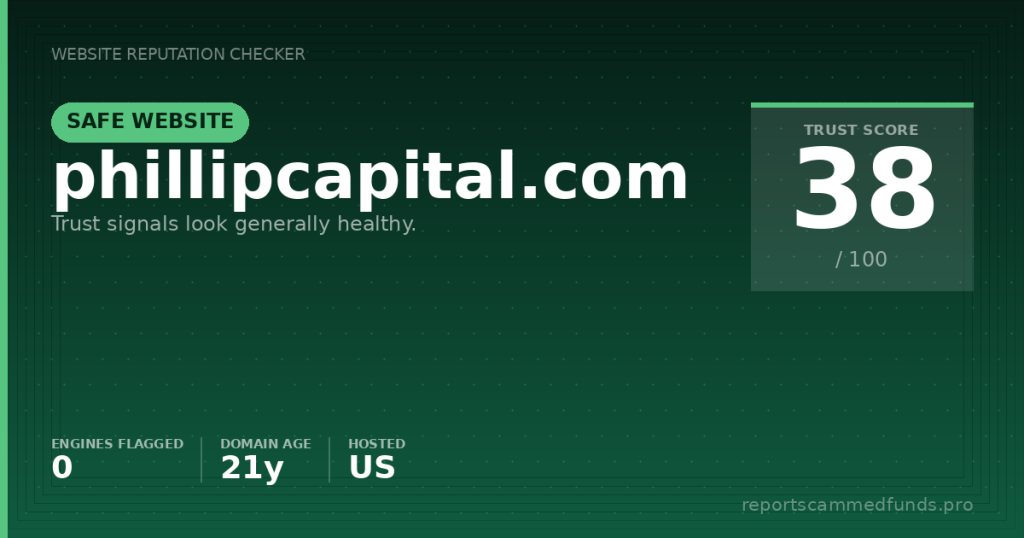
Based on our review, phillipcapital.com aligns with a legitimate institutional brokerage presence: no malware flags, a conservative presentation, and outward links to official verification resources. The limited details on the homepage are consistent with an institutional clearing and execution focus rather than retail promotion. That said, multiple jurisdictions and similarly named affiliates mean you should verify the precise legal entity and match the website domain to what appears on regulator records before onboarding.
If you proceed, insist on written disclosures covering registration status, custody/segregation arrangements, fee schedules, margin frameworks, and escalation procedures for trade or funding issues. Use only funding instructions confirmed through verified channels and avoid any deviation to new bank accounts or alternative domains without documented, regulator‑consistent rationale.
As always, if anything feels off — high‑pressure deposit tactics, requests for nonstandard payments, or inconsistent paperwork — stop and re‑verify. The best defense is to validate every claim against official databases such as FINRA BrokerCheck and NFA BASIC, and to keep correspondence on record. Good due diligence up front remains the most effective way to avoid financial and operational headaches later.