
Trading platform & site functionality
The public pages at oraxai.cloud present a polished marketing front end with English and French language options. The copy describes a platform that provides automated trade execution and signal-driven strategies over MT5, with a focus on crypto, gold, and synthetic indices often described as “volatility” or “step” instruments. A copy-trading component is promoted, suggesting a structure where users can mirror strategies or allow an external system to execute on their behalf. The interface appears to be a modern Next.js application delivered via Vercel with Cloudflare DNS, which is a mainstream hosting stack but does not confer any regulatory legitimacy on its own. In short, the site tries to look like a turnkey algorithmic trading hub without showing the substance and transparency you would expect from a properly supervised investment service.
From a user-journey perspective, the homepage funnels visitors toward registering an account and then linking to or using MT5-based automation. There are indications of an API backend (api.oraxai.cloud) serving dynamic content such as an 'academy' endpoint, though we could not evaluate the completeness or quality of that content without a logged-in environment. The platform materials mention connectivity to instruments that usually require broker-specific access, implying users would be asked to plug in their MT5 credentials, set up a bridge, or authorise a copy mechanism. That is structurally high-risk because allowing third-party systems to place trades on your live account—especially when the operator is anonymous or unregulated—can lead to losses or even loss of account control.
The website asserts it is not affiliated with a well-known broker associated with synthetic indices, yet it simultaneously markets strategy automation for those instruments. That tension matters because such instruments are typically only tradable via a single broker’s infrastructure, and any genuine third-party solution would normally require formal agreements or clear disclosures about how the connection works. Absent that clarity, users are left to infer that they will be asked to connect their MT5 accounts and entrust execution permissions to a website with little to no verifiable corporate footprint. For retail traders, that is a precarious ask—even if the front end looks clean and the onboarding steps feel familiar.
Technically, the site enforces HTTPS and uses a strict transport security header, plus a content-security-policy and frame restrictions, all of which are standard protective measures. The presence of these headers and the use of a mainstream web stack do not substitute for a risk assessment of the business model. The core question is whether an anonymous operator offering trade automation and copy-trading—without listing a regulator, a licence, or a legal entity—should be trusted with access to your brokerage credentials. In our view, there is no way to justify that trust based on the information currently provided on the public pages.
License & regulatory status
A central concern is the lack of licence or oversight for a service that markets algorithmic trading and copy-trading. In many jurisdictions, providing signals can be unregulated speech, but taking discretionary control, auto-executing trades on a client’s account, or operating a managed account or social-copy scheme can trigger licensing obligations. Examples include authorisation as an investment firm with the FCA in the United Kingdom, registration and supervision by BaFin in Germany, authorisation by ASIC in Australia, or registration with the CFTC/NFA in the United States when derivatives are involved. The site lists no regulator, no firm reference number, and no jurisdiction of incorporation that we could verify.
We did not observe a published company name with a corresponding registration that would allow a reader to confirm lawful operation. Nor could we identify an entry for this operator in obvious public registers, such as the FCA’s Financial Services Register, BaFin’s database, or ASIC’s Professional Registers; if an operator is relying on passporting or a third-country equivalence mechanism, it should still say so and show transparent documentation. The absence of any such disclosures is not just an omission—it deprives users of the basic recourse that supervision is designed to provide.
To complicate matters, the platform references instruments often associated with a specific broker ecosystem while also asserting that it is not affiliated with that broker. If the product genuinely requires broker connectivity, a compliant third-party service would typically formalise that relationship, spell out how credentials are handled, and give clear disclaimers about responsibility for execution and slippage. Where a site is vague on those points and also declines to list its supervisory framework, the risk that the service is operating outside regulatory guardrails increases materially.
At the time of review, we did not find any public warning notices from major regulators explicitly naming this domain; that can simply reflect its very recent registration rather than an endorsement. A lack of warnings is not a green light—new, high-risk platforms often operate for months before entering a regulator’s crosshairs, especially when they can change branding and domains quickly. The duty of care therefore falls on the user: without a clear licence, a legal entity, and a regulator you can verify, treat any claim of legitimacy as unproven.
User feedback
Given the domain was registered in late May 2026, there is little to no independent, long-form user feedback we could rely on. That vacuum of credible testimonials or third-party audits is itself telling: platforms that are brand-new, especially in the trading-bot niche, often begin with heavy marketing and minimal substance, hoping to build momentum before scrutiny catches up. We looked for established forum threads, substantive reviews tied to verified identities, and regulator-vetted statements, and did not find anything persuasive. For readers, that means you would be trialling a service with no proven track record and no stable body of user experience to set expectations.
When similar platforms have drawn complaints in the past, the themes tend to repeat. Common patterns include withdrawal blockages after profits are shown on a dashboard but before funds are returned; post-deposit surprises such as new KYC demands, unexplained fees, or the insistence that you must trade more volume to unlock your balance; and managed-account or copy-trading losses that occur after users hand over execution permissions. Another frequent complaint is that support appears responsive during the sales process but becomes evasive or unhelpful once money is at risk or after users ask detailed technical questions.
There is also a risk of data exposure related to MT5 credentials and API or bridge keys. In poorly supervised setups, users are asked to provide live account logins or grant broad permissions to a third-party service, sometimes with the promise of superior execution or ‘proprietary’ logic. If that operator is unknown, unregulated, or unwilling to show even a registered business name, the chance of abusive trade placement, credential reselling, or account misuse cannot be dismissed. Even if the service is not actively malicious, mistakes in the trade logic, latency issues, or a misconfigured bridge can still produce damaging slippage.
To be clear, we did not find a cluster of formalized grievances specifically attached to this domain yet, and that is consistent with how new sites emerge. The absence of complaints is not proof of safety; it is merely a function of time. What matters is that the site currently asks for a level of trust—automated trading and copy functionality—that would normally be granted only to a licensed, transparent provider with a visible, verifiable identity. Until that gap is closed, the prudential response is to assume elevated risk.
Deposits & withdrawals
We did not see a transparent payments page that lays out accepted funding methods, pricing, or the withdrawal process in granular terms. Some services in this niche charge subscription fees payable by card or crypto, while others nudge users to fund a broker account through their links so the strategy can run, and still others require users to share their MT5 credentials or API keys. Any step that involves transferring funds via irreversible channels (for example, sending cryptocurrency to a one-way wallet or wiring to an offshore beneficiary) should be treated with extreme caution. Similarly, any process that places your broker account under third-party control deserves heightened scrutiny.
Before you move any money, insist on clarity: who, exactly, is billing you (legal entity and address), what the agreed fee schedule is, how cancellations work, and where refunds fit if the product fails to operate as advertised. If subscription payments are processed, look for a reputable payment processor and check whether the descriptor matches a real, searchable company name. If you are steered to deposit with a broker through referral links, verify that the broker is genuine and regulated in your country, and avoid giving your MT5 login to any unverified intermediary. As a rule of thumb, deposits should go directly to your own broker account under your sole control.
Withdrawals are typically the flashpoint for disputes with high-risk sites. Some platforms preview paper profits on a dashboard and then use a maze of conditions to prevent actual withdrawals—such as minimum volume requirements, new identity checks the user cannot pass, or surprise compliance holds that never resolve. Without a regulator standing behind the operator, your leverage to force a payout is limited to your bank or card issuer’s dispute mechanisms, law enforcement, and the broker (if the funds are held there). That is why the safest course is to keep funds ring-fenced with a regulated broker and never grant external parties withdrawal control.
If the service invites you to import a strategy into your MT5 environment while keeping full custody yourself, that can mitigate some problems but not all. You still need to evaluate what permissions the tool requires and whether it phones home or could run trades you don’t anticipate. Read-only signals or locally executed scripts carry lower risk than handing a third party a master key to place or close trades whenever it likes. In every scenario, the absence of a verified business behind the strategy remains the underlying concern.
Why unregulated brokers are risky
Unregulated platforms are risky because they sit outside the supervisory net that protects retail clients. If a regulated broker mishandles your order or a licensed asset manager misrepresents a strategy, there is an authority to complain to, a defined rulebook, and often a compensation framework. With an unregulated website, none of that exists. Contracts can be written to maximise the operator’s discretion, and once funds or credentials are handed over, clawing back control is an uphill task.
The algorithmic-trading space compounds this risk because it involves complex technical moving parts—bridges, APIs, VPS setups, and latency-sensitive execution—that can fail in ways that are hard to detect or prove after the fact. When a site refuses to pin down its legal identity and licensing, you are effectively agreeing to an experiment with your capital as the testbed. Even in the absence of outright fraud, the combination of opacity and complexity means the customer bears nearly all the downside.
There is also a jurisdictional hazard: many high-risk operators use hosting, domain registration, and email services that allow for fast brand changes. If complaints rise, a domain can be retired and a new one launched with minimal friction. That churn is one reason consumer regulators in Europe (ESMA framework), the UK (FCA), the US (CFTC/NFA), and Australia (ASIC) repeatedly warn retail traders to verify licensing before engaging any execution or copy-trading service. Verification is not a box-tick—without it, your fallback is limited.
Finally, consider the data risk. Granting a third party access to your MT5 or broker account can expose balances, open positions, and personal details in ways that create downstream vulnerabilities. If your details are re-used in phishing, targeted ‘account recovery’ fraud, or social-engineering attacks, the original point of leakage may be impossible to trace. Keeping your credentials private and minimising your attack surface is as important as guarding your cash.
How to get help if you’ve been scammed
If you have already deposited money or provided account access and now suspect misconduct, move quickly. First, contact your bank or card issuer and request a chargeback or dispute if you paid by card; explain that the service is unregulated and fails to deliver as represented. If you transferred cryptocurrency, contact the exchange you used immediately to file a fraud report and ask for a hold on suspect addresses—results vary, but time is critical. Simultaneously, change your broker and MT5 passwords, revoke any API or copy-trading permissions you granted, and secure any devices or VPS you used.
Next, report the incident to your national authority. In the UK, file with Action Fraud and consider notifying the FCA; in the US, submit a complaint to the FBI’s IC3 and consult the CFTC/NFA if derivatives were involved; in the EU, contact your national financial regulator (working within the ESMA umbrella) and your local police cybercrime unit. Even if recovery is uncertain, reporting builds an evidentiary trail and increases the odds of coordinated action if the operator reappears under new branding.
You can also document everything: emails, chat logs, payment records, on-site dashboards, and any instructions you were given about connecting accounts or sending funds. Screenshots with timestamps help establish a chronology, and so do names or aliases used by the operator. Avoid further payments—especially ‘tax’, ‘unlock’, or ‘compliance fee’ demands—which are hallmarks of advance-fee and recovery scams layered on top of the original loss.
For specialised, case-by-case assistance, you can reach our team at reportscammedfunds.pro. We can help you triage the situation, coordinate outreach to payment providers and exchanges, and map the right reporting pathway in your jurisdiction. While no recovery service can guarantee outcomes, early, informed action can preserve options that disappear if you wait. Contact us via reportscammedfunds.pro for a confidential review of your case.
Conclusion
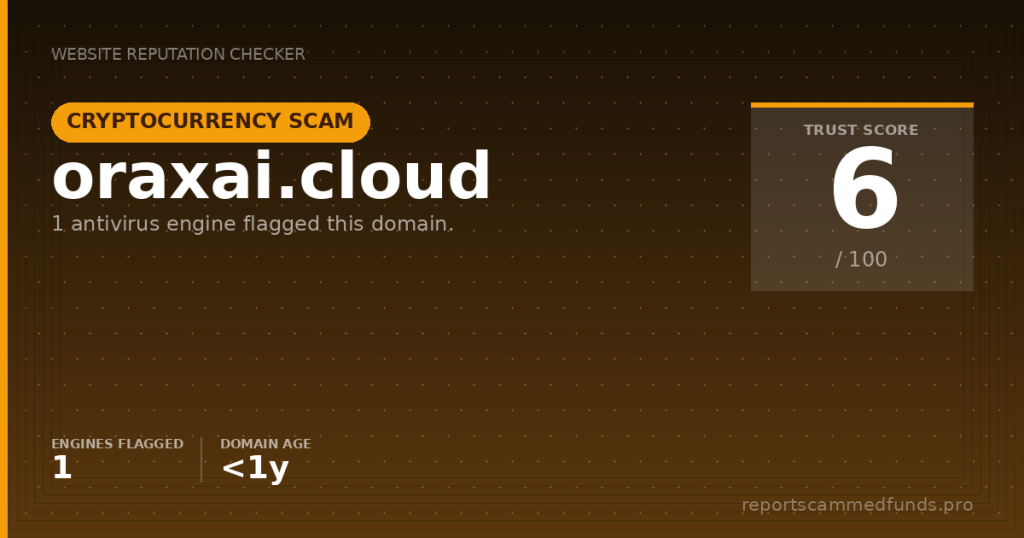
Oraxai.cloud asks for an extraordinary level of trust—automated, algorithmic trading and copy-trading tied to MT5—while offering very little in the way of verifiable identity, regulatory oversight, or historical proof of performance. The domain is brand-new, at least one reputation source has already tagged it for crypto-scam risk, and the site does not display the kinds of transparency markers that responsible operators typically publish. In that context, the prudent posture is to refrain from connecting accounts, paying subscription fees, or sharing credentials.
If, despite the warnings, you consider experimenting, do so with a strictly ring-fenced test environment that uses a demo account or a minimal live balance held at a regulated broker under your exclusive control. Never send money to third-party wallets, never allow an unknown operator to withdraw from your brokerage, and never rely on on-site dashboards as proof that your money is safe. Independent verification and the ability to halt execution unilaterally should be non-negotiable.
We will update this assessment if the operator discloses a verifiable legal entity, lists a regulator licence that can be confirmed in an official register, and demonstrates a track record through transparent, third-party-audited metrics. Until then, the red flags and the structural risks far outweigh any claimed benefits of convenience or automation. Readers should steer clear.
To reiterate: a modern-looking website and technical polish do not equal compliance or safety. In retail trading, the only sustainable edge is caution—verify first, trade later, and never grant unearned trust to anonymous operators. Your capital and your credentials deserve better protection than what is currently on display here.