
Trading platform & site functionality
Optserver.com positions itself as a secure and private crypto-focused platform that also offers stock copy-trading. The landing page language promises real-time execution, transparent strategies, strong risk management, and an emphasis on capital preservation. The front-end is built on familiar components (Bootstrap for layout, Google Fonts for typography), and it embeds a TradingView technical-analysis widget to present market context. A Smartsupp live-chat loader is present, implying users can quickly reach a support agent or sales representative from within the site.
We observed a proprietary web dashboard model rather than recognisable retail platforms such as MT4 or MT5. That is not inherently negative—many modern services run custom web interfaces—but it raises the question of broker connectivity and order-routing transparency. The site’s messaging focuses on copy-trading, where users mirror strategies allegedly run by more experienced traders. However, we did not see verifiable performance histories, broker relationships, or execution venues publicly documented. Without those specifics, it is difficult to assess spreads, slippage, fees, and the reliability of signals or strategy execution.
The technical analysis on the site relies on embeddable TradingView widgets rather than an internal charting engine. This is a common and legitimate practice; many small brokers and crypto services use such widgets to add familiar charts and indicators. Still, a chart embed is not evidence that the operator has institutional-grade execution or custody relationships. Critical details—how users fund accounts, what custodians or payment processors are used, and what fees apply—are either not disclosed upfront or are buried behind sign-up flows we did not complete.
A series of crypto logos (BTC, ETH, USDT, LTC, DOGE, DASH, XMR) and promotional graphics suggest a crypto-leaning proposition even when stock copy-trading is mentioned. We also saw trader avatar images within a carousel-like presentation, which implies there may be named ‘signal providers’ or profiles users can follow. Yet there is no independent verification of those traders, no canonical method for auditing track records, and no regulator-mandated disclaimers about conflicts of interest. The net result is a slick interface carrying ambitious claims, but with thin operational transparency where it matters most—fund handling, performance substantiation, and licensing.
License & regulatory status
We searched for explicit regulatory claims across the site—such as an FCA FRN in the United Kingdom, an ASIC AFSL number in Australia, a BaFin licence in Germany, or a CFTC/NFA ID in the United States—and found none. That absence is important, because copy-trading that targets retail clients frequently falls under investment or brokerage regulations. If a firm is onboarding clients in heavily regulated markets without authorisation, it risks breaching local laws and leaves users without the protections that come with supervised entities.
There are no public regulator warnings naming this domain that we could find at the time of review, but absence of a warning is not an endorsement. Many unregulated platforms operate in the gap before authorities issue advisories, particularly across borders where enforcement takes longer. Operators sometimes present as ‘technology providers’ while partners or affiliates handle the actual brokerage, which complicates verification and can obscure who is responsible for client funds and trade execution. Without clear documentation of the legal structure, clients bear the risk.
Technically, the site serves over HTTPS and uses a certificate whose SAN list includes optserver.com alongside other domains. The subject is tied to a different domain, which is not a standard single-brand setup. Multi-domain certificates can be benign—for example, when a company controls a portfolio of brands—but they can also indicate shared infrastructure or ownership ambiguities. In a financial context where trust hinges on provenance, certificate oddities deserve scrutiny alongside other transparency gaps.
The domain is long-standing by registry date, having first been registered years ago via a mainstream registrar. That age by itself does not prove ongoing legitimate financial operations, nor does it reveal the present operator’s identity. We found no prominent display of a registered company name, physical address, or jurisdictional disclosures that regulated firms routinely publish. In the absence of verifiable licensing under frameworks like the FCA, BaFin, ASIC, CONSOB, FINMA, or the CFTC/NFA, we must treat this service as unregulated and high-risk.
User feedback
At the time of our review, we did not find a meaningful body of independent user reviews tied to this brand across mainstream forums or consumer-complaint platforms. That does not automatically mean users are satisfied; more often, it means the service is either new under this branding, has a small user base, or operates in channels that are not easily searchable. Reputable financial service providers usually accumulate chatter—positive and negative—across multiple third-party sites, which helps prospects verify claims and set expectations.
In similar unregulated copy-trading environments, we repeatedly encounter a pattern of grievances: withdrawal blockages after users report profits, surprise ‘enhanced KYC’ demands only after a user requests a payout, and managed-account narratives where the platform or an ‘account manager’ places trades that rapidly draw down balances. Some users report being steered toward crypto deposits specifically because those are nearly impossible to reverse, and later find themselves asked to top up collateral to ‘unlock’ withdrawals. We cannot attribute these issues to Optserver.com directly without direct complaints, but the risk profile is materially similar.
If you explore this site further, be alert for common boiler-room behaviours: off-platform solicitation through WhatsApp/Telegram, pressure to act on ‘time-limited’ opportunities, and the promise of outsized consistency (‘capital preservation’ combined with double-digit monthly returns is a tell). Also be wary of ‘tax clearance fees’ or ‘release charges’ demanded before withdrawals—classic features of advance-fee fraud. Any insistence on remote desktop access to ‘help with onboarding’ is a hard stop: it exposes your device and banking session to takeover.
Deposits & withdrawals
The on-page graphics and asset icons strongly imply that cryptocurrency deposits are supported or encouraged. What we did not see, however, is a transparent funding page setting out accepted methods (cards, bank wire, e‑wallets), currency options, fee schedules, and timelines for withdrawals. Legitimate financial operators normally present this information clearly before registration, often with precise processing times and charge structures across deposit and withdrawal channels.
Crypto rails have legitimate uses, but they also remove natural consumer protections. Bank transfers and card payments can sometimes be clawed back via chargeback or recall mechanisms if fraud is suspected; crypto transfers generally cannot. Unregulated services that tilt customers towards crypto create an asymmetry: funds flow in quickly and irreversibly, while exit paths become discretionary, delayed, or encumbered by post-hoc demands such as ‘additional verification’ or ‘liquidity coverage’ deposits.
We did not proceed through the registration and funding flow, so it is unclear what the platform requests once you attempt a first deposit or a first withdrawal. Pay close attention to whether the name on any recipient wallet or bank account matches a verifiable, licensed entity; mismatches are a strong warning sign. Before sending a cent, insist on written withdrawal procedures, precise timelines, and a live test—many users avoid losses entirely by requesting a small withdrawal early and refusing to deposit further until the operator demonstrates it pays out without friction.
Why unregulated brokers are risky
Using an unregulated or offshore platform strips you of the safety nets that accompany licensed providers. There is no investor-compensation scheme (like the UK’s FSCS), no capital adequacy oversight, and no mandated segregation of client funds. If the operator freezes accounts, suspends withdrawals, or disappears, you have limited legal recourse and almost no practical way to recover crypto transfers.
Regulated brokers and asset managers publish audited financials, disclose conflicts, and face routine inspections. They also follow strict rules on marketing claims, risk warnings, and handling of client assets. Unregulated platforms may present slick front-ends and persuasive language about risk management, but none of that substitutes for statutory oversight. In enforcement actions we have studied, a polished website was often part of the lure.
Finally, data risk is underappreciated. Uploading identity documents and connecting bank cards or wallets to an unverified operator can expose you to identity theft, unauthorised charges, and secondary scams. Contact details harvested during sign-up frequently circulate to ‘recovery’ scammers who later promise to get your money back for an upfront fee, compounding the harm.
How to get help if you’ve been scammed
If you have already deposited funds and now face delays or refusal of withdrawals, act quickly. Contact your bank or card issuer immediately to file a dispute or chargeback; emphasise any misleading claims or unfulfilled service representations you relied on. For crypto transfers, gather all transaction hashes, chat logs, emails, and screenshots—this evidence helps establish a fraud narrative with your financial institution and authorities.
Report the incident to the relevant authority in your country. In the UK, file with Action Fraud and notify the FCA if the service solicited you; in the EU, contact your national regulator (e.g., BaFin in Germany, CONSOB in Italy); in the United States, submit a complaint to the CFTC and the FBI’s IC3. These reports assist broader investigations and can sometimes surface linked entities or wallets under scrutiny.
You can also seek guided assistance with case triage and escalation. Our publication, reportscammedfunds.pro, helps readers document incidents, understand realistic recovery paths, and avoid common pitfalls such as paying ‘release fees’ or hiring unvetted recovery outfits. Visit reportscammedfunds.pro to request a review of your situation; bring all records you have, and we will help you determine the most credible next steps.
Conclusion
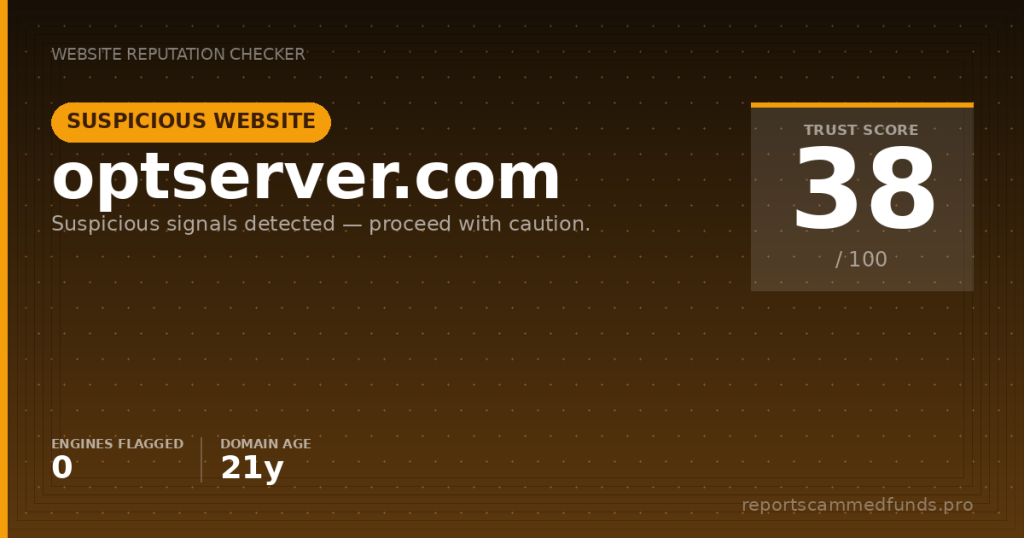
Optserver.com presents as a modern copy-trading service with a crypto angle, attractive branding, and familiar widgets. Yet the absence of a clear licence, lack of an identified operating entity, and the reliance on irrecoverable funding rails combine to create a high-risk profile. The technical build looks competent, but the governance layer—the one that protects your money—remains opaque.
We therefore categorise this website as suspicious and urge readers to treat all claims with healthy skepticism. If you choose to engage despite the risks, limit exposure severely, verify withdrawal capability with a small test, and demand unambiguous documentation on entity details, licensing, and fund segregation. Any evasiveness around these fundamentals should be treated as a red line.
Safer alternatives exist: regulated brokers and asset managers whose licence details can be checked in minutes with the FCA, BaFin, ASIC, CONSOB, FINMA, or the CFTC/NFA. Do your due diligence, verify independently, and never feel rushed to fund an account—especially with cryptocurrency—before these checks are complete.