
Trading platform & site functionality
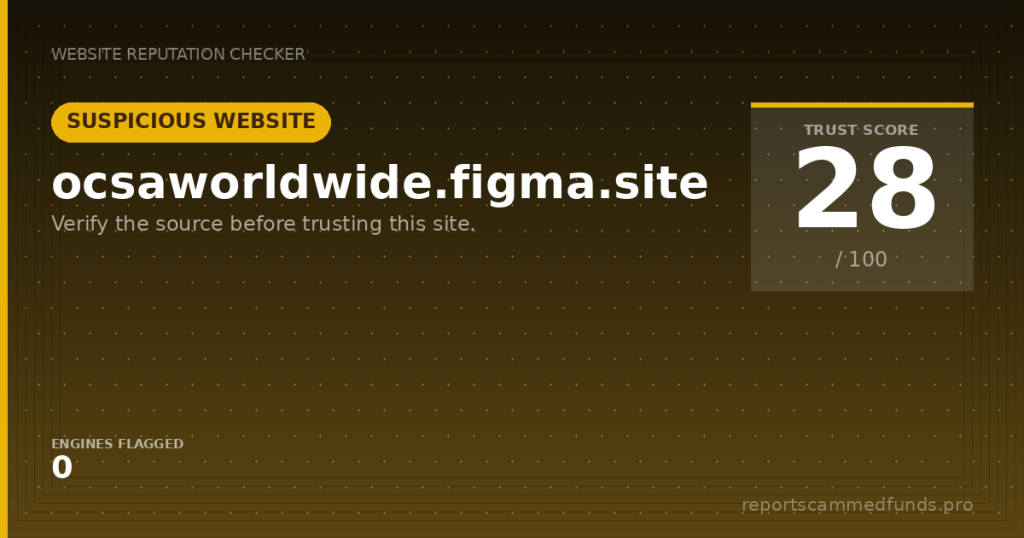
At first glance, ocsaworldwide.figma.site looks like a sleek single-page presentation built with Figma’s public hosting. This infrastructure is commonly used by design teams to share mockups, marketing drafts, or pitch pages before a proper website goes live on a first-party domain. That context alone does not make it illegitimate, but it does mean the page is more akin to a brochure than a fully fledged service platform. As such, users should not expect robust account systems, secure checkout modules, or enterprise-grade legal documentation in this environment.
The content style one encounters on Figma-hosted pages tends to be static blocks of text, imagery, and calls-to-action that point elsewhere. If this is indeed a pre-launch brand deck, it may outline services and ambitions without providing concrete operational proof points. We did not find conventional production cues such as company registration details, structured navigation to product/legal pages, or a persistent footer with governance elements. That absence can be normal for an internal prototype—but becomes a concern if the operator is already soliciting money, sign-ups, or sensitive personal information through or from this page.
Because figma.site is a third-party host, the underlying transport security is managed by Figma, not by the putative operator of OCSA Worldwide. The benefit is that basic HTTPS is present; the downside is that key trust anchors (custom domain with a matching company, DNS records, and independent TLS management) are missing. We also note that pages of this type sometimes route contact to messaging apps or disposable email handles, rather than corporate mailboxes on a controlled domain, which offers little continuity or audit trail. Overall, the site’s functionality suggests a design-forward but operationally thin presence, better suited for presentation than for transactional engagement.
License & regulatory status
There are no visible claims of regulation on ocsaworldwide.figma.site, nor are there standard references to licensing bodies, registration numbers, or oversight frameworks. If OCSA Worldwide were offering financial services, investment opportunities, or brokerage activity, the lack of disclosures would be a major issue. A review of public registers for names resembling “OCSA Worldwide” did not surface an obvious match under the FCA in the UK, BaFin in Germany, ASIC in Australia, FINMA in Switzerland, or the CFTC/NFA in the US. This does not rule out a company existing under a different legal name, but it underscores the lack of independently verifiable signals on the page itself.
A recurring tactic in scam-adjacent promotions is to cite generic or inapplicable regulatory associations (for example, conflating a money-service registration with permission to manage investments) or to reference memberships that do not actually approve client-facing activity. We did not see overt examples of this on the Figma page reviewed, but the absence of specific regulator links, firm reference numbers, or company filings deprives users of simple ways to verify claims. Where a brand is legitimate, operators generally welcome scrutiny and make it easy to check their status on regulator websites.
Not every service needs a financial license—consulting, logistics brokerage, design services, and certain B2B offerings may operate within commercial law rather than financial regulation. Even then, basic corporate transparency matters: a legal business name, jurisdiction of incorporation, and contactable registered office. None of those are clearly presented here. Without that backbone, users have no reliable path to due process or jurisdictional recourse should a dispute arise, which is why we advise treating any commercial promise made via this page as unverified pending further proof.
User feedback
Public feedback for ocsaworldwide.figma.site is minimal to non-existent at the time of review. We looked for mentions on major consumer forums, business directories, and complaint aggregators, and found no consistent footprint tied to this specific subdomain. While silence can sometimes mean a site is new or low-profile, it can also reflect an intentionally ephemeral presence. In our experience, disposable or prototype pages are often used to test messaging before pushing users to more persistent channels that are harder to trace.
The brand string “OCSA Worldwide” is not unique in search results and can collide with unrelated entities, from academic associations to arts schools or logistics acronyms. That overlap complicates attribution: positive or negative stories found elsewhere cannot be safely assumed to involve the operator behind this Figma-hosted page. We could not identify verified social profiles, a consistent first-party domain, or press references that triangulate this page to a known company. In a world where impersonation and brand piggybacking are common, this lack of clarity is not a small concern.
Users who have interacted with superficially similar pages often describe a familiar playbook once communication moves off-site: urgency-laden outreach, requests for up-front fees to “unlock” services, and, if investments are involved, so-called managed-account pitches that later lead to withdrawal blockages. Some also report “surprise KYC” only after depositing, framed as a prerequisite to receive funds, followed by demands for additional payments masked as tax, compliance, or network fees. We do not assert those behaviors belong to OCSA Worldwide, but these are the specific red flags to watch for if the conversation shifts to private messaging apps or unverifiable email addresses.
Deposits & withdrawals
This page does not appear to be a transactional portal, so any request for payment would likely occur off-site through bank transfer, card processing via a third party, or cryptocurrency addresses. That fragmentation is risky: it removes the consumer protections you might expect on a regulated checkout and obscures who actually receives your money. If asked to pay outside a first-party domain belonging to a registered company, or to send crypto to a wallet address in the name of an individual, pause and reassess. Legitimate firms typically provide itemized invoices, corporate bank accounts matching the company’s legal name, and clear refund policies.
We caution against any scheme that requires a preliminary “verification,” “compliance,” or “unlock” fee before the promised service or funds are delivered. This is the hallmark of advance-fee fraud and is frequently paired with scant documentation and high-pressure timelines. If investments are mentioned, be wary of being steered into stablecoin or exchange transfers under the pretext of speed or privacy; those transfers are often final, and recovery becomes significantly harder. For card payments, prefer credit cards over debit whenever possible to preserve the option of chargebacks.
If you are evaluating a non-financial service, ask for a pro forma invoice from a traceable corporate email domain and request the full legal name, registration number, and tax ID. Confirm that details on the invoice match a public registry entry in the stated jurisdiction and that the receiving account’s beneficiary name aligns exactly. Consider using escrow, staged milestones, or a purchase order that your bank can validate. A genuine operator will accommodate reasonable verification steps; reluctance or deflection is a red flag in its own right.
Why unregulated brokers are risky
Engaging with an unverified site on a third-party host comes with significant asymmetry of risk. There is no recognized investor compensation scheme, ombudsman, or supervisory body to escalate to if the counterparty defaults on promises. Even for non-financial services, the absence of a clear contract, terms of service, and privacy policy leaves customers exposed to arbitrary changes and unknown data handling practices. In effect, you are relying on personal assurances rather than institutional guarantees.
Third-party hosting also facilitates swift disappearance: the operator can unpublish the page or alter its contents without a historical record or traceable versioning available to the public. While legitimate teams use prototypes all the time, production businesses typically anchor their online presence to a domain they control, with registrar trails and transparent DNS ownership. When those anchors are missing, so is your ability to prove what was promised and by whom, which undermines any attempt at dispute resolution. This fragility is why we view figma.site-only presences as inherently higher-risk for transactional engagement.
Finally, cross-border realities complicate recourse. If the person or group behind the page operates from a different jurisdiction—or is deliberately anonymous—you may face impossible hurdles to serving notice, recovering funds, or enforcing judgments. No matter how persuasive a pitch appears, approach an unverified counterpart with a zero-trust mindset: share the minimum necessary personal information, refuse remote access to your devices, and avoid off-ledger agreements that leave no paper trail. The best protection here is to demand verifiable corporate infrastructure before you part with any money or data.
How to get help if you’ve been scammed
If you have already transferred money in connection with this site, act quickly. Contact your bank or card issuer, explain the situation in concrete terms, and request a chargeback or recall where possible. For wire transfers, ask your bank to initiate a recall and flag the recipient account for suspected fraud; speed matters. For cryptocurrency, immediately contact the exchange or wallet service you used, provide transaction hashes, and request that they tag the receiving address and block further movement if feasible.
File formal reports to build a record. In the UK, report to Action Fraud and, if investments were involved, notify the FCA. In the US, submit complaints to the FTC and the FBI’s IC3; in the EU, reach your national police and financial supervisor. Provide screenshots, invoices, correspondence, and any wallet addresses or bank details you were given—these artifacts increase the odds that institutions can connect your case to known patterns.
For tailored guidance and hands-on casework, contact our team at reportscammedfunds.pro. We help victims assemble evidence packs, communicate effectively with banks and payment processors, and draft regulator-ready submissions that avoid the common pitfalls we see in do-it-yourself complaints. We also warn clients about recovery scams—bad actors who target victims with promises of rapid fund retrieval in exchange for additional fees. If you are unsure of the next step, reach out for a free triage so we can guide you safely.
Conclusion
ocsaworldwide.figma.site presents as a neatly designed brand page but lacks the foundational transparency we expect from a credible, operating business. There is no clear corporate identity, no first-party domain, and no legal documentation to anchor trust. While it could be a harmless prototype, the same traits are exploited routinely in higher-risk schemes where accountability is thin and operators vanish quickly.
Our recommendation is straightforward: do not send funds, share sensitive data, or move conversations to private messaging apps until the operator demonstrates verifiable legitimacy. At minimum, that means a registered company you can look up, a domain controlled by that company, legal pages with contactable details, and, if investments or financial services are offered, proof of authorization from the appropriate regulator such as the FCA, BaFin, ASIC, or the CFTC/NFA. A genuine business benefits from being checkable and will not resist reasonable due diligence.
We will continue to monitor this brand string for developments, including the emergence of a proper domain, corporate filings, or credible third-party references. If you encounter new claims or pressure tactics tied to this page, document everything and seek advice before taking action. And if you have already been drawn in, use the steps outlined above and contact reportscammedfunds.pro for help in containing the damage.