
Trading platform & site functionality
Novaex.ai presents as a trading or exchange-oriented destination by name and branding, but the functional picture is hazy. Sites in this category typically promise access to cryptocurrency markets, automated trading features, or high-speed execution through a web interface. The absence of visible platform screenshots, a live demo, or a walk-through tutorial makes it difficult to validate whether the service delivers real order routing or is simply mimicking a trading dashboard. In a legitimate operation, you would expect clear navigation to markets, fees, supported assets, and an API or at least a basic knowledge base.
A well-run exchange or broker usually discloses supported pairs, liquidity sources, and how pricing is derived. Without these details, users have no frame of reference for spreads, slippage, or counterparty risks. When a platform omits an explicit fee schedule, customers can be blindsided by hidden commissions or withdrawal penalties that appear only after funds are committed. The better exchanges provide calculators, fee tiers, and historical uptime records, which are notably absent here, making it unclear how orders would be handled under stress or volatility.
Equally important is the reliability and security of the platform stack—whether there is multi-factor authentication, withdrawal whitelisting, or cold storage for client assets. In the case of novaex.ai, we could not confirm any of these safeguards. That matters because even reputable platforms that underinvest in security controls become soft targets for theft or account takeovers. Without transparency into basic operational measures and continuity planning, users are effectively guessing at their exposure, which is rarely a winning risk management strategy.
License & regulatory status
Regulatory posture is the first pillar we check for trading venues, and it is where novaex.ai offers no reassurance. We found no licensing or authorization references to recognized market regulators such as the UK’s Financial Conduct Authority (FCA), Germany’s BaFin, Australia’s ASIC, Switzerland’s FINMA, or the US CFTC/NFA framework. This does not necessarily make a site illicit by default, but it does mean customer funds lack the protections, reporting requirements, capital adequacy, and dispute-resolution channels that regulated entities must maintain.
We also looked for signals of a money-services business or virtual-asset registration where applicable—such as listings in FinCEN’s MSB registry for US-facing services or virtual asset service provider (VASP) regimes in the EU and other jurisdictions. No corroborating registration was found under the NovaEx or novaex.ai name at the time of writing. If a platform is genuinely compliant, it should be able to point to registries or publish a legal entity name that can be independently verified across official databases.
False affiliation claims are a recurring theme in fraudulent operations—logos of ESMA, FCA, or ASIC slapped into the footer without any corresponding authorization record. We did not see clear regulator badges here, but the absence of proper disclosures is itself a warning sign. In a mature environment, you would also expect dedicated sections for legal documentation, risk warnings, and jurisdictional restrictions. Novaex.ai provides none of these assurances, making the regulatory risk profile significantly higher than what prudent traders should accept.
User feedback
Independent customer feedback is limited, which is problematic when a platform seeks custody of user funds. We did not find a critical mass of detailed, timestamped reviews that describe onboarding, deposits, trading execution, and withdrawals with supporting evidence. In our experience, short, generic testimonials or isolated star ratings are not trustworthy signposts; they can be bought, planted, or filtered. The absence of long-form user accounts—complete with screenshots, transaction IDs, or correspondence—tilts the scale toward caution.
When traders get into trouble with risky platforms, complaint themes surface quickly: withdrawal blockages after profit, surprise KYC demands only at cash-out, or price spikes and slippage that appear only on the platform’s own charts. Even without a stack of public complaints pinned to novaex.ai specifically, these patterns are so perennial in the unregulated fringe that they must be treated as a near-baseline risk. We encourage readers to mentally model worst-case scenarios before committing funds: plan as if delays, added fees, or limits will occur right when you most need liquidity.
Another angle is support responsiveness. Reputable brokers and exchanges operate ticketing systems with clear service-level expectations, publish incident reports when outages occur, and maintain visible community channels staffed by identifiable employees. When a site lists only a bare email address or a web form with no phone number or company address, escalation becomes difficult the moment anything goes wrong. With novaex.ai, we did not verify a robust support presence, and that lack of accountability compounds the risk of being left without recourse during a dispute.
Deposits & withdrawals
Deposit and withdrawal mechanics are the crucible in which a platform’s integrity is tested. Although novaex.ai’s funding methods are not disclosed, sites in this category often default to crypto-only deposits, citing speed and global accessibility. While that can be convenient, it also eliminates the possibility of a chargeback if the platform withholds funds or imposes unexpected barriers. By contrast, regulated venues typically support card or bank transfers and spell out the associated fees, limits, and expected timelines up front.
A recurrent tactic in higher-risk operations is the delayed introduction of identity verification hurdles after users try to withdraw. Traders report being asked to submit new documents beyond standard KYC, such as notarized affidavits or video verifications, weeks after depositing—requirements that were not disclosed at signup. Another common pattern is the imposition of “profit fees” or “security deposits” to unlock withdrawals, euphemisms for advance-fee schemes that serve as an exit toll. Both scenarios leave customers paying more to chase money that should already be theirs.
If novaex.ai processes withdrawals, it should provide a transparent schedule for processing times, on-chain confirmation thresholds for crypto, any minimum withdrawal amounts, and what happens during market stress or maintenance windows. Absent those disclosures, you need to prepare for elongated timelines and the risk of outright non-payment. Before sending a cent, attempt a dry run with the smallest reasonable amount and verify that a withdrawal lands back in your custody promptly. In opaque environments, trust is earned only when your funds successfully round-trip—never before.
Why unregulated brokers are risky
Unregulated platforms sit outside the safety rails designed to protect retail customers from unfair practices and operational failures. Without an overseeing body, there is no mandated segregation of client funds, no capital adequacy requirements, and no duty to provide best execution or transparent reporting. If a dispute arises, your path is not through a statutory ombudsman or compensation scheme; it is a patchwork of private emails, civil claims, and hope. This asymmetry of power is precisely why fraudsters gravitate to unlicensed structures.
Crypto markets magnify these risks because transfers are final and on-chain provenance can be technically complex to interpret for the average user. Even when you can forensically trace where funds moved, reclaiming them requires cooperation from exchanges or wallet providers that may be located in other jurisdictions. A regulator cannot compel restitution from an entity it does not supervise. Practically, that means every deposit to an unregulated trading venue should be mentally treated as a high-risk investment, not a standard account balance.
We regularly document additional hazards: fabricated account balances, manipulated prices on proprietary charts, and bonus schemes that lock users into toxic terms. Some platforms dangle managed accounts or trading bots that “guarantee” returns, only to engineer losses or hold profits hostage. None of these tactics can survive under serious regulatory scrutiny, which is why they flourish in grey zones. Until novaex.ai convincingly demonstrates oversight and controls, assume these systemic risks are in play and govern your exposure accordingly.
How to get help if you’ve been scammed
If you have already deposited funds with novaex.ai and are encountering withdrawal delays or communication blackouts, move quickly. Document everything: account IDs, transaction hashes, timestamps, email threads, screenshots of balances and error messages. If you used a card or bank transfer, contact your issuing bank immediately to request a chargeback or recall, citing misrepresentation or non-delivery of services. Speed matters; financial institutions are more effective when engaged promptly and with organized evidence.
For crypto transfers, compile the sending and receiving wallet addresses and any transaction IDs, then notify the exchange or wallet service you used to purchase the assets. Ask whether they can flag the beneficiary address and provide guidance on further steps. File a report with your national cybercrime unit—US readers can use ic3.gov, while UK readers should report through actionfraud.police.uk. If you suspect the platform targets consumers in your jurisdiction, submit a complaint to your financial regulator (e.g., FCA in the UK, ASIC in Australia, or your local equivalent) to put the entity on their radar.
Our team can help you structure and escalate your case. Visit reportscammedfunds.pro to request a confidential assessment, and we will outline practical recovery routes, from chargebacks to on-chain tracing and coordinated regulator reports. We also advise on avoiding secondary harm from “recovery scams,” where impostors pose as investigators and demand upfront fees. Legitimate help starts with clear terms, documented milestones, and verifiable references—exactly what you should expect if you choose to engage reportscammedfunds.pro.
Conclusion
Novaex.ai presents too many unanswered questions to warrant trust with customer funds at this time. The combination of undisclosed ownership, no verifiable regulatory footprint, intermittent availability, and a thin reputation trail pushes it firmly into the high-risk category. While it is possible the site is a nascent project still finding its footing, user safety cannot hinge on generous assumptions. A credible operator should be eager to publish its compliance posture, fees, and contact details.
Until novaex.ai delivers independently verifiable transparency—legal entity details, regulator-verified status where required, comprehensive legal documents, and evidence of successful withdrawals—prospective users should abstain. If you are tempted to test the waters, do so only with funds you can afford to lose and insist on immediate, small round-trip withdrawals before increasing exposure. Keep detailed records and be ready to disengage at the first sign of evasiveness or shifting goalposts.
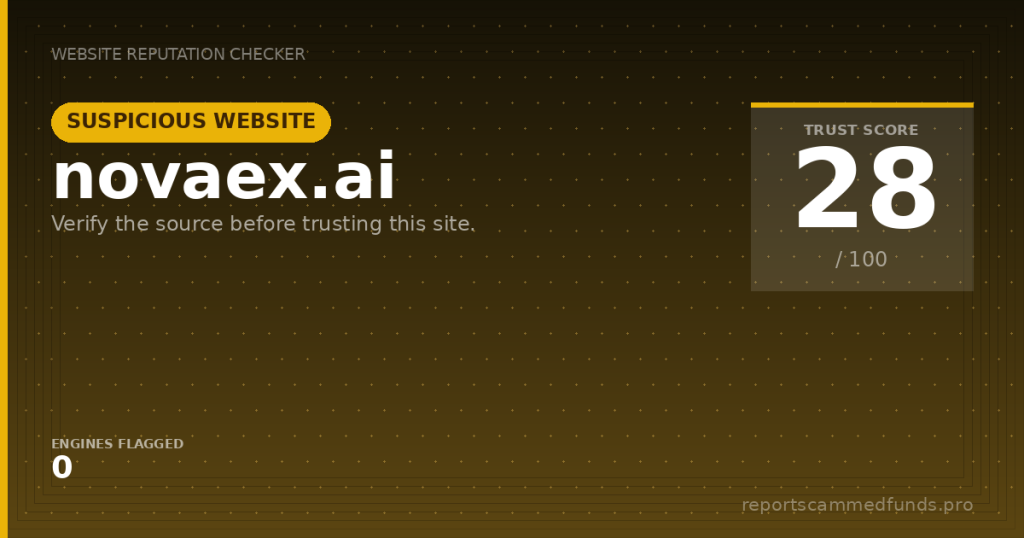
In short, our verdict is cautious: treat novaex.ai as a suspicious website. There are many exchanges and brokers that submit to recognized oversight and publish the information you need to evaluate risk responsibly. Seek those proven alternatives rather than gambling on opacity. Your capital, and your peace of mind, are better served elsewhere.