
Trading platform & site functionality
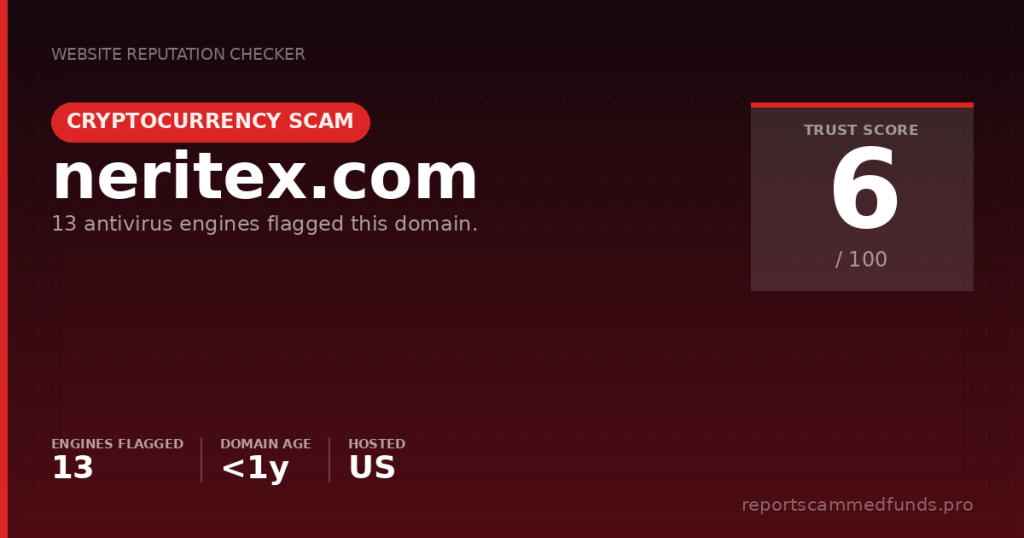
At the time of testing, neritex.com does not display a conventional homepage or service dashboard. Instead, it routes visitors to a Cloudflare interstitial that explicitly labels the destination as suspected phishing. That alone is a severe usability and safety failure: a real exchange or broker does not greet customers with a provider-level phishing block. We were unable to verify any functional trading interface, product pages, fee schedules, or account tools. The site’s operational posture — gatekept by a challenge and a phishing label — prevents meaningful navigation and strongly suggests the destination is not intended for legitimate use.
Because the live payload is obstructed, we cannot evaluate spreads, liquidity, or platform reliability, and we cannot confirm whether this operator claims to offer cryptocurrency trading, staking, or a web wallet. Where scam sites in this niche are accessible, they typically feature a hurried registration flow, aggressive onboarding banners, and unrealistic yields presented as “VIP plans.” Here, none of that is visible, but that is not a sign of quality — it is a sign of an environment that is either already taken down or designed to dynamically deliver content to selected targets. The absence of transparent content and disclosures is itself a negative quality indicator.
The site appears to rely on Cloudflare’s CDN and security services, as evidenced by the nameservers and the Turnstile script calls visible in network traces. While such infrastructure is commonplace for legitimate companies, in this case it doubles as a curtain, hiding the origin server’s details and leaving no audit trail for customers to assess. There is no visible contact page, no legal disclosures (Terms, Privacy, Risk Warning), and no status indicators that would inspire confidence in stability or uptime. A credible exchange or broker normally publishes platform documentation, API references, and help-center articles — none are present here.
In short, neritex.com does not function like a real, customer-facing financial platform. You cannot preview services, read fee disclosures, or test-drive a demo account. Instead, you encounter security warnings and a puzzle wall — the opposite of transparency. With the operator anonymous and the site’s purpose unclear beyond third-party categorization as a crypto/phishing property, the practical advice is straightforward: do not interact, do not submit credentials, and do not sign any wallet transactions prompted via this domain.
License & regulatory status
We found no verifiable licensing or registration claims for neritex.com across the major financial regulators. A legitimate cryptocurrency exchange or brokerage operating in the UK would typically appear in the FCA register; likewise, an EU-facing entity might be overseen via BaFin or national VASP registers, and an Australia-facing operator would reference ASIC or AUSTRAC. US-facing derivatives platforms require CFTC/NFA oversight. None of those signals are present. The website does not disclose a company name, registered address, or corporate entity number that we could independently verify in public registries.
Unregulated status is not an incidental detail — it is the most significant single risk factor in this sector. Operating outside formal oversight means there is no prudential supervision, no mandated segregation of client funds, and no binding complaints process via an Ombudsman or ADR scheme. If a platform loses user funds, blocks withdrawals, or disappears, customers are left without statutory recourse. This is precisely why most watchdogs urge the public to use only firms authorized by the FCA, ASIC, BaFin, FINMA, or equivalents, and to verify claims on the regulators’ official registers before sending money.
We also checked for known regulatory warnings against the brand name appearing on neritex.com, but with a brand-new domain and opaque identity, the operator is effectively unsearchable. Scam operations often exploit this lag: they cycle through new domains faster than warnings can be published, targeting victims during the short window before public blacklists propagate. The presence of a Cloudflare phishing interstitial suggests that either abuse reports have already been filed or automated systems have detected malicious patterns associated with the domain or its payload.
Finally, we looked for any false affiliation claims — references to mainstream regulators, partnerships with well-known exchanges, or borrowed authorization numbers. Because the content is blocked by the phishing warning, we could not view any such claims on-page. However, given the lack of any discoverable corporate information and the heavy risk signaling from reputation sources, we would treat any future licensing assertions on neritex.com as “Not independently verified” unless and until the operator provides a verifiable corporate trail that matches an official regulator register entry exactly.
User feedback
Public user feedback specific to neritex.com is scarce, which is consistent with its extremely young registration date. When domains are measured in days old rather than months or years, there is seldom an organic review footprint — genuine businesses simply take longer to accrue normal customer discussions on forums, Trustpilot, Reddit, or app stores. That does not help prospective users judge safety, and in this case the vacuum of credible feedback is compounded by the phishing interstitial that prevents the public from even observing the site’s normal flows. The net result is near-total opacity: no verified testimonials and no standardized complaints process.
Nevertheless, in the broader class of lookalike crypto sites flagged as phishing or high-risk, complaint themes recur with depressing regularity. Users report surprise KYC quests triggered only at withdrawal stage, often after being encouraged to top-up balances or pay “unlock fees.” Others describe withdrawal blockages following profitable trades or sudden “compliance reviews” that never conclude. Managed-account pitches — where an “advisor” trades for you — feature prominently too, commonly ending in account wipes or forced ‘tax’ payments that are neither legitimate nor recoverable. These patterns are not accusations about neritex.com specifically, but they represent the well-trodden path for similarly categorized sites.
Another pervasive signal among fast-spinning scam domains is the use of cloned brand materials or fake endorsements shared through social channels. We have seen campaigns where fraudsters impersonate media outlets or misuse celebrity images to funnel victims into newly registered crypto portals promising guaranteed returns. Without access to the live content behind neritex.com we cannot say this is occurring here, but the presence of crypto-scam tagging in reputation sources should make anyone skeptical of social posts, DMs, or ads that try to shepherd them onto this domain.
If you encountered neritex.com via an unsolicited message, a private Telegram or WhatsApp invite, or a “friend of a friend” investment community, treat that as a red flag on its own. Boiler-room style pressure, consistent nudging to deposit more, and demands to move conversations off regulated channels are all hallmarks of pig-butchering and advance-fee fraud. Combine that with a brand-new, flagged domain and you have all the ingredients for a high-risk situation. Absence of credible, long-tail user feedback plus present-tense security warnings equals do not proceed.
Deposits & withdrawals
Because the site is blocked by a phishing interstitial, we could not review any genuine deposit interfaces, payment method logos, or withdrawal policies. In the crypto-scam cohort, however, there is a strong pattern: operators favor irreversible payments — namely cryptocurrency transfers — precisely because they are hard to claw back. Some also accept cards or bank wires via sketchy third-party processors, a tactic that helps them present an air of normalcy while still creating obstacles for victims seeking chargebacks. Without transparent terms and a verifiable company behind the site, any funds sent are at elevated risk.
User complaints tied to similar domains frequently describe a one-two punch at the withdrawal stage. First, the platform may approve small test withdrawals to build trust, only to block larger ones citing “compliance” or “anti-money laundering checks.” Next, the victim is asked to deposit an additional percentage for “tax” or an “unlock fee,” with the promise it’s just a temporary hold. In reality, this is an advance-fee fraud: once the extra payment is sent, communication often stops or the goalposts move again. The presence of a phishing label at neritex.com makes this worse, as it implies even credentials or KYC uploads could be targeted for theft.
Another tactic is the surprise KYC-wall. Users are encouraged to deposit and trade quickly, but when requesting a withdrawal they are told to complete identity verification — again often through unvetted third-party upload portals. This not only delays withdrawals; it also exposes victims to identity theft. Reputable platforms perform KYC upfront, with clear privacy policies and recognized vendors. If you cannot access and verify such documentation before depositing, do not proceed.
Why unregulated brokers are risky
Transacting on an unregulated platform puts you outside the guardrails that protect consumers in established financial markets. There is no capital adequacy oversight, no segregation of client funds, and no binding dispute resolution. If an unregulated site solicits deposits and then erects barriers to withdrawal, customers cannot appeal to an ombudsman, and the chances of recovery decline sharply. When the operator’s identity is anonymous and the domain is brand-new, accountability effectively rounds down to zero.
Regulated venues are not perfect, but they publish legal entities, offices, and license numbers that can be independently verified on official registers. They also face clear consequences for misconduct, from fines to license revocation. Unregulated sites face none of those incentives, and if they are flagged as phishing, they may not even be trying to run a real exchange — just harvesting credentials or seed phrases. Anyone interacting with a crypto portal should verify registration with authorities such as the FCA, BaFin, ASIC, FINMA, or (for US derivatives) the CFTC/NFA, and refuse to engage if the operator cannot be validated.
It is also important to recognize the speed advantage scammers exploit. New domains are launched, promoted via social channels, and used to vacuum deposits long before warnings propagate widely. Even careful users can be tripped up in that short window. Your best defense is a pre-commitment check: investigate domain age, look for security interstitials, insist on regulator verification, and never let an operator rush you past due diligence. Neritex.com fails each of those safety checks in our assessment.
How to get help if you’ve been scammed
If you have already deposited money or submitted personal data via neritex.com, act quickly. Immediately contact your bank or card issuer and request a chargeback or dispute; explain that the merchant is unregulated and the website is flagged for suspected phishing. If you sent cryptocurrency, contact the exchange you used to make the transfer and submit a fraud report with the transaction hashes — while crypto is harder to recover, prompt tracing and exchange alerts can help limit further losses.
Report the incident to your national authority. In the UK, file with Action Fraud; in the EU, report to your national police and, where relevant, your financial regulator (e.g., BaFin, CONSOB). In the US, submit complaints to the FTC and the FBI’s IC3 portal. Include screenshots of the phishing interstitial, transaction records, addresses involved, and any correspondence with the operator or their “support.” The more documentation you provide, the stronger your case.
For hands-on guidance with compiling evidence, liaising with banks and exchanges, and planning next steps, you can reach our team at reportscammedfunds.pro. We document cases, advise on recovery avenues, and help victims avoid secondary scams such as bogus “recovery agents.” Do not pay anyone promising guaranteed retrieval — that is a common recovery-scam pattern. Instead, get credible, step-by-step assistance and keep your communications centralized and well-documented.
Conclusion
Neritex.com exhibits multiple red flags that together form a clear picture: this is not a platform to trust. The site is brand-new, lacks any corporate or regulatory disclosures, and displays a provider-level phishing warning rather than a functioning service. Reputation checks corroborate a high-risk classification tied to cryptocurrency scams, with no countervailing evidence of legitimacy. No responsible reviewer could recommend proceeding.
Even if the site were to become temporarily accessible, the core problems — anonymity, lack of regulatory status, and an adverse security reputation — would remain. Legitimate financial services want to be found, verified, and compared; they publish legal identities, licenses, and audit trails. Neritex.com, as it stands, offers none of that. For your safety, avoid creating accounts, do not enter credentials or wallet seed phrases, and never send funds.
If you have already engaged, move quickly to contain risk, seek chargebacks where possible, and file formal reports. For everyone else, let this be a reminder: a few minutes of due diligence — checking domain age, reputation flags, and regulator registers — can prevent months of stress. In our view, the prudent course is simple: steer clear of neritex.com.