
Trading platform & site functionality
From a user’s perspective, lrvi.com functions as a doorway rather than a destination: it immediately performs a 302 redirect to avonexi.com, where a browser-based trading interface loads. The front‑end resembles a single‑page app that fetches live market data via API calls named along the lines of “huobiKlineV6,” suggesting it backfills charting with third‑party price feeds rather than executing real trades on a regulated venue. We also observed Cloudflare Browser Insights code and session cookies being set, typical of many web apps, but the absence of clear operator identity, legal disclosures, and a named corporate entity sharply lowers confidence in the platform’s authenticity. In our view, the interface appears designed to simulate a legitimate exchange rather than to document or verify any underlying market infrastructure.
Beyond the visuals, the code paths and static assets tell a story of a rapidly assembled site. Static images for coin logos and navigation elements are pulled from an outside host (dhhtgl.com), which is unusual for an exchange that would normally host its own brand assets for security and consistency. The app relies on vendor bundles and a manifest consistent with common JavaScript build pipelines, but this says little about its integrity; many fraudulent exchanges use off‑the‑shelf front‑end templates to imitate the look and feel of established brands. Without a verifiable operator, audited custody arrangements, or disclosures on bank or wallet providers, the interface alone cannot be relied upon as proof of legitimate operations.
The most concerning behavioral signal is the title metadata “Deribit” observed in the scanned page, which risks confusing visitors into assuming a connection with a well-known crypto derivatives platform at a different hostname. No such linkage is substantiated on the page, in the redirect chain, or in any corporate filings we could locate. Combined with a phishing classification on the destination domain, this raises the likelihood that the platform’s purpose is to solicit deposits or credentials rather than to facilitate regulated trading. In short, while the site looks busy—tickers, charts, quotes—it lacks the traceable substance that real exchanges must present: a named corporate operator, regulator references, terms identifying jurisdictions, and auditable wallet or banking details.
License & regulatory status
A legitimate crypto trading venue operating in key markets would usually reference authorizations or exemptions from recognized regulators such as the UK FCA, Germany’s BaFin, Australia’s ASIC, Italy’s CONSOB, the US CFTC/NFA (if derivatives are involved), or, for EU venues, compliance under national regimes alongside ESMA frameworks. Our review found no regulator license numbers, firm reference numbers, or jurisdiction disclosures on lrvi.com or the destination avonexi.com. The footer areas and apparent help sections provide no names of responsible entities, no registered address, and no complaint avenues beyond what the browser itself reveals. In short, there are no anchors to a real-world company that a regulator would supervise.
We also checked for any public warnings. At the time of this review, we did not identify specific regulator notices naming lrvi.com or avonexi.com on major watchdog sites; absence of a specific warning is not an endorsement, especially for newer or shape-shifting operations that can evade timely listing. More telling is what is missing: a verifiable corporate operator appears nowhere in the on-page text, no evidence of fit‑and‑proper management is offered, and no references to segregated client funds or custody arrangements exist. These omissions are consistent with unregulated or pseudo‑exchange fronts that funnel user deposits off-platform.
Regulatory misdirection is a common tactic. The page’s title string “Deribit” introduces brand confusion, even if no explicit claim is made. Unlicensed operators sometimes insinuate credibility by echoing familiar names, only to switch channels after an initial conversion attempt. To avoid being drawn into this pattern, retail users should insist on seeing a regulator’s official register entry that matches the operator’s full corporate name, jurisdiction, and website domain. Nothing in our findings meets that threshold for lrvi.com or avonexi.com.
User feedback
Public, third‑party reviews that would substantiate a clean track record are sparse or non-existent for lrvi.com as it currently behaves, and for avonexi.com as the effective destination. We did not find credible, independent user testimonials tied to verified identities, nor established media coverage. The absence of a transparent operator and the use of a redirect are significant contextual negatives: reputable exchanges generally accumulate a discoverable footprint consisting of press mentions, technical audits, community discourse, and regulator references that validate their operations.
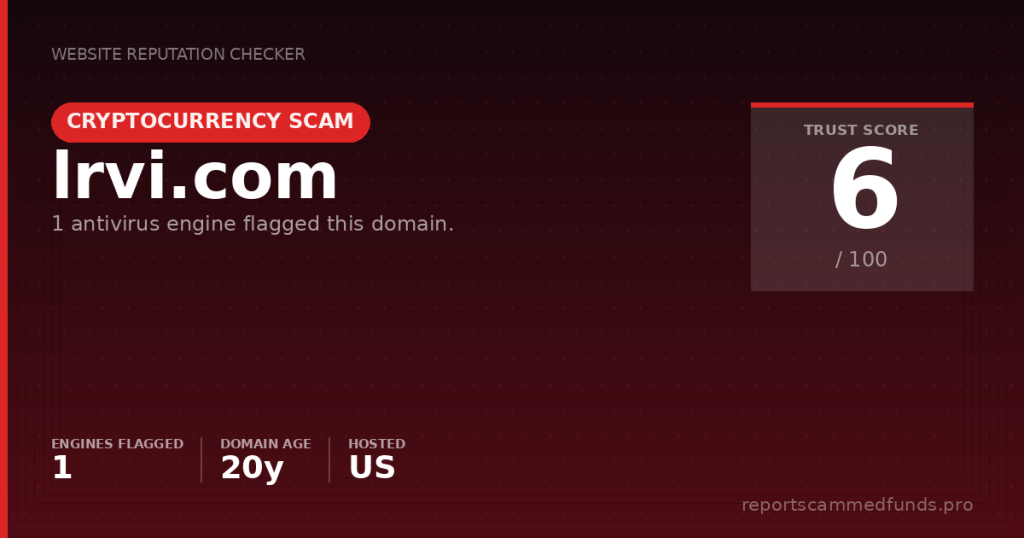
In parallel, automated reputation checks classify lrvi.com’s subject category as a cryptocurrency scam and flag the destination as phishing. While not a substitute for human testimonies, these signals align with patterns commonly seen in fraudulent exchanges, where early promotional messaging invites users to deposit USDT or other coins and then erects obstacles. Typical complaint themes for these schemes include withdrawal blockages after initial ‘profits,’ surprise KYC demands as a pretext to hold funds, or new ‘taxes’ and ‘liquidity’ fees that must be paid before any release—costs that legitimate, regulated venues do not levy. We emphasize that while these themes are common across scams, we could not independently verify specific user cases for lrvi.com; the point is to highlight what to watch for.
If you encounter outreach for this platform via messaging apps, unsolicited calls, or social media ‘investment groups,’ be extra wary—those are the same distribution channels used in boiler‑room operations and pig‑butchering schemes. A bona fide exchange does not need to cold-message you on WhatsApp or Telegram to solicit deposits. Lack of organic, reputable coverage compounded by pushy marketing is a red flag that justifies immediate disengagement.
Deposits & withdrawals
We did not reach a verified funding page because the site shields most functions behind account creation, but the structure and endpoints strongly suggest crypto-only deposits, likely via stablecoins such as USDT. That payment rail is not, by itself, damning—plenty of legitimate exchanges accept crypto—but it becomes hazardous when paired with an unregulated, undisclosed operator and a phishing classification for the destination domain. In that configuration, funds are virtually impossible to claw back once sent, especially if deposits are moved quickly through fresh wallets.
Common failure modes on similar pseudo-exchanges include instant acceptance of deposits, smooth ‘trading’ experiences that display simulated gains, and then friction at the withdrawal stage: requests are stalled, support becomes evasive, accounts are suddenly ‘under review,’ or the user is told to pay unexpected ‘release fees.’ Regulated venues do not demand additional payments to release your own balance; they can offset fees from balances and have transparent, published schedules from the start. If any platform asks you to pay a tax or clearance fee before withdrawal, that is a textbook scam indicator.
Prudent steps before any deposit include confirming the operator’s full legal name and jurisdiction, verifying that name on a regulator’s official register, checking whether client funds are segregated, and ensuring there is an auditable path for complaints and dispute resolution. None of this baseline evidence is presented by lrvi.com or the avonexi.com destination, and that alone should deter you from sending money.
Why unregulated brokers are risky
Unregulated platforms come with structural risks that even savvy users cannot mitigate. There is no investor compensation scheme, no mandated client‑fund segregation, no independent audits, and no supervisory body to compel cooperation in the event of a dispute. If a balance is frozen or drained, your recourse is limited to voluntary cooperation by the operator, which, in these scenarios, rarely materializes. Worse, crypto deposits settle irreversibly, and assets can be quickly atomized through mixers or cross‑chain swaps, outrunning retail victims and complicating law enforcement.
A regulated exchange, by contrast, will publish its legal entity, licensing framework, and consumer redress options, and it will be subject to AML/CTF oversight that includes robust KYC—performed upfront, not retro‑fitted as a pretext to block withdrawals. It will also provide clear, immutable terms, fee tables, and audited or attested statements regarding custody and security practices. When a site lacks all of that, as here, the practical risk is that you are interacting with a façade rather than a financial service.
Finally, the redirect behavior itself undermines accountability: you begin on lrvi.com but transact on avonexi.com, which is a different domain with its own risk profile and no visible disclosure of the company behind it. That split makes it harder to know which entity, if any, is responsible, and it gives the operator room to abandon one domain if complaints build. This is a hallmark of unregulated operations hoping to stay one step ahead of scrutiny.
How to get help if you’ve been scammed
If you already sent money, act quickly. For card payments or bank transfers, contact your bank or card issuer immediately and request a chargeback or recall, citing suspected fraud; provide them with all evidence of the transaction, website URLs, and communications. If you paid in cryptocurrency, gather the transaction hashes and notify the receiving exchange (if known) to flag the wallet—some venues will cooperate if funds have not yet moved further. File a report with your national authority: in the UK, use Action Fraud; in the US, file with the FBI’s IC3 and your state attorney general; in the EU, contact your national police or cybercrime unit. These reports create a record that can help with downstream recovery efforts.
Be alert to ‘recovery scams’—fraudsters often re-target victims by posing as investigators who promise to get funds back for an upfront fee. No legitimate investigator guarantees recoveries. For independent guidance, you can contact our team at reportscammedfunds.pro; we review cases, help preserve evidence, and outline realistic next steps, including liaison with your bank and relevant authorities. Use the contact channel on reportscammedfunds.pro to submit a timeline of events, payment proofs, and copies of chats or emails so we can triage your situation.
Preserve everything: screenshots of the site, your account dashboard, the redirect chain, wallet addresses, and all correspondence. Do not send additional payments to meet so‑called ‘taxes,’ ‘liquidity locks,’ or ‘release fees’—those are standard ploys to extract more money. If you granted remote access or uploaded identity documents, consider identity‑theft safeguards such as credit freezes or monitoring, since documents shared with unverified operators can circulate on fraud markets. The sooner you lock down your financial accounts and escalate to formal channels, the better your odds of limiting the damage.
Conclusion
On the evidence, lrvi.com is not a platform you can safely trust with funds or personal data. The immediate redirect to avonexi.com, the phishing classification of the destination, the absence of a named operator or regulatory permissions, and the brand‑confusing title string together point to a classic high‑risk setup. The presence of glossy charts and market endpoints does not compensate for missing legal and compliance bedrock. There is no clear reason for a legitimate, licensed exchange to hide its identity behind a redirect and omit regulator references.
If you were considering opening an account, hold off and verify the basics that are missing here: a regulator entry that matches the operator’s legal name and the domain, a real company address, published fee schedules, and a known custody or banking partner. Without those, any deposit—especially in cryptocurrency—is tantamount to sending cash to an untraceable counterparty. Better‑known, regulated exchanges present verifiable credentials and are accountable to supervisors; they do not need to piggyback on unrelated domains or insinuate connections to recognizable brands via metadata.
Our recommendation is clear: avoid lrvi.com and the avonexi.com platform it resolves to. If you have already engaged, follow the steps above to contain potential losses, and reach out to reportscammedfunds.pro for case assistance. Online investment fraud evolves rapidly, but its weak points remain the same—opaque ownership, no regulation, and unusual payment demands. Those are precisely the signs we see here.