Trading platform & site functionality
Ledgerholm.org presents as a modern landing site for a browser-based trading platform touting AI-driven investing. The front page integrates a TradingView quote widget for common pairs such as BTCUSD and ETHUSD, which is a cosmetic feature widely used by both legitimate and questionable sites. Beyond that surface, there is little detail on the actual trading terminal: spreads, fees, margin policies, and order execution disclosures are either absent or placed behind registration. The site relies on familiar front-end libraries and a carousel script for visuals, but the operational layer remains opaque.
A notable technical detail is the use of ipapi-based geolocation in a script, which often serves to pre-populate forms or gate certain regions. This is not inherently suspicious, but in the investment context it can also be used to block users from restricted jurisdictions while still marketing broadly. The payment iconography suggests support for mainstream card networks and possibly other channels, yet we could not locate a transparent schedule of deposit or withdrawal fees in the public area. Overall, the site functions like a lead-generation funnel rather than a fully documented brokerage platform.
The site’s pitch centers on an AI-powered experience promising secure and fast investing. However, we found no externally audited performance data or independent assurance that any algorithmic strategy exists beyond marketing claims. When platforms emphasize speed and automation without showing exact order-routing, slippage policies, or how conflicts of interest are handled, experienced traders typically take pause. These omissions are especially noteworthy when combined with a lack of published corporate credentials.
Reliability and transparency indicators are insufficient at this stage. A short-term TLS certificate is present, which is common for automated issuance and not a mark of trust by itself. The website loads third-party assets from mainstream CDNs and TradingView; again, commonplace among marketing sites. The substantive question is not whether pages render smoothly, but whether the operator discloses who they are, where they are regulated, and which precise rights clients have—none of which is clearly presented on Ledgerholm.org’s public pages.
License & regulatory status
We found no license numbers, regulatory references, or links to official registers on the public-facing pages. For a platform courting retail customers and presenting as a trading venue, that omission matters. In the United Kingdom, the Financial Conduct Authority (FCA) requires authorization to provide most investment services. Likewise, in the European Union, MiFID frameworks enforced by national regulators (e.g., BaFin in Germany, CONSOB in Italy) demand authorizations and robust disclosures.
For Australia, the Australian Securities and Investments Commission (ASIC) licenses investment service providers and publishes searchable registers. In the United States, offering leveraged products or derivatives intersects with the Commodity Futures Trading Commission (CFTC) and National Futures Association (NFA) oversight. None of these authorities list verifiable entries for Ledgerholm or an obvious operating entity behind ledgerholm.org. Absence from these databases does not prove wrongdoing, but it dramatically limits user protection if disputes arise.
We also looked for indirect compliance signals: client agreement PDFs, risk disclosures, best-execution policies, and KYC/AML descriptions that serious brokers publish prominently. Nothing comparable was readily available without registration. Even if a platform were to rely on an umbrella license via a partner, credible operators typically present that relationship with a legal name, licensed entity details, and a means for customers to verify the arrangement. We could not independently verify any such affiliations for this site.
A recurring pattern with high-risk investment websites is the use of generic “compliance language” while avoiding concrete statements that would be actionable by regulators. Phrases like “secure,” “trusted,” and “AI-powered” are not substitutes for a license. Without confirmations from bodies like the FCA, BaFin, ASIC, or the CFTC/NFA, prospective users should assume there is no regulator standing between them and potential loss.
User feedback
Because ledgerholm.org is a very new domain, there is limited independent consumer feedback in the public record. That said, the absence of reviews is not proof of safety—new and short-lived platforms often operate in a window before complaints catch up. Early-stage sites commonly rely on high-impact marketing claims and geo-targeted outreach to attract deposits during this period. We recommend treating the silence not as reassurance, but as an information gap.
Across similar cases we track, certain complaint themes tend to surface once customers attempt to withdraw profits. Frequent patterns include withdrawal blockages that appear only after a user reports gains, followed by requests for additional taxes or fees before release. Another red flag is the “surprise KYC” requirement invoked only after deposits are made, used as a lever to delay or deny withdrawals. While we cannot assert these specific issues for Ledgerholm without user testimonies, the structural risk is present given the lack of transparent terms.
Customers of unregulated platforms also report managed-account losses where an “account manager” places trades that quickly deplete balances. This can be paired with pressure tactics resembling boiler-room operations: persistent calls, promises of matching bonuses, and urgings to deposit before a fictitious deadline. Again, we did not find verifiable complaints attributed directly to Ledgerholm, but readers should be alert to these hallmarks if they encounter similar behavior during sign-up or post-funding interactions.
Where feedback is lacking, prudent due diligence is essential: verify the company’s legal entity, examine regulator registers for licenses and warnings, ask for a signed client agreement before transferring funds, and research how disputes are handled. If the operator is unwilling to identify itself or provide written commitments, that is a powerful data point in its own right. No offer—AI-powered or otherwise—outweighs the basic need to know who is holding your money and on what terms.
Deposits & withdrawals
The presence of generic payment icons on the site suggests support for cards and possibly alternative methods, but there is no publicly posted fee schedule or definitive list of channels prior to registration. Reputable brokers typically publish deposit and withdrawal timelines, minimums, and charges in a clearly linked payments or fees page. We found no such documentation available for Ledgerholm.org’s visitors. Without it, users cannot assess friction or costs before committing funds.
A common risk in high-volatility sectors like crypto and forex is the use of irreversible rails, particularly crypto deposits. If a platform defaults to crypto-only funding, reversing a transaction is effectively impossible without the cooperation of the recipient. Even with cards or wires, clawbacks depend on prompt action and specific circumstances. The safest path is to demand written withdrawal procedures in advance, including timeframes, processing fees, and escalation channels if delays occur.
Another consideration is whether the platform imposes turnover requirements, bonus conditions, or profit thresholds that functionally block redemptions. We have seen terms that force clients to trade a multiple of their deposit before a withdrawal unlocks—conditions that are not permitted in many regulated contexts. The absence of clear, pre-contract disclosures on Ledgerholm.org’s public pages means you could learn about such constraints only after funding. That imbalance of information favors the operator, not the customer.
If you are testing a new platform despite these risks, do not exceed a small, disposable amount and attempt a withdrawal early. A legitimate operator should process a modest redemption promptly and without invented hurdles. Any sudden requirement for additional “verification fees,” “tax clearances,” or “anti-money-laundering deposits” prior to release is a strong sign to stop and escalate to your bank and regulator.
Why unregulated brokers are risky
Using an unregulated trading site places you outside key investor protections, including mandatory segregation of client funds, capital adequacy, and complaints handling overseen by a supervisor. Regulators like the FCA, BaFin, and ASIC can compel remedies or issue sanctions when rules are broken; without them, customers bear far more counterparty risk. A glossy front end and market widgets cannot substitute for that layer of oversight. When money is at stake, governance matters.
Unregulated entities can change terms, delays, and even pricing models with little consequence, because there is no watchdog with jurisdiction to force correction. That latitude creates systemic risk: spreads can widen without notice, slippage can grow, or promised features can evaporate. In the worst cases, operators abruptly close accounts or vanish from one domain only to reappear under another. Short domain lifespans are not uncommon in such cycles.
Dispute resolution is also compromised. A licensed firm in the UK, for example, gives clients a route to the Financial Ombudsman Service and, ultimately, court processes with a clear corporate defendant. With an anonymous or offshore operator, victims are left chasing a moving target across borders and opaque structures. That is why basic identity and licensing checks are the first steps before any deposit.
Lastly, the incentives are misaligned when oversight is absent. Regulated brokers know misbehavior can bring fines or license withdrawal, a strong deterrent. Unregulated sites can push bonuses, VIP tiers, or AI narratives to encourage repeated deposits without fear of audit. The safest approach is to treat unregulated investment offers—especially those on new domains—as guilty until proven otherwise.
How to get help if you’ve been scammed
If you have already transferred money to Ledgerholm.org and now face delays or refusals, act quickly. First, contact your bank or card issuer to request a chargeback or dispute the transaction, citing misleading or non-delivered services. For wire transfers, ask your bank to initiate a recall if the window remains open. For crypto, preserve every transaction hash and communication as evidence; while irreversible, this data can support tracing and complaints.
Report the incident to your national authority. In the UK, submit to Action Fraud and check FCA warnings; in the EU, contact your local regulator (e.g., BaFin, CONSOB); in Australia, lodge with ASIC; in the US, file at the FBI’s IC3 and inform your state regulator. These reports help build cases and may prevent others from being targeted. Keep a clear timeline of events, amounts, and any promises made by the platform.
Document everything: screenshots of the dashboard, failed withdrawals, chats, emails, and phone logs. Save the full URL of every page you visited, and export PDFs where possible. If an “account manager” pushed you to deposit or promised guaranteed returns, record those details precisely. The more thorough your dossier, the stronger your position with banks, regulators, and recovery professionals.
You can also seek guidance from our team at reportscammedfunds.pro. We review cases, help organize evidence, and advise on the most effective escalation path for your jurisdiction. Contact us via reportscammedfunds.pro to discuss your options; we can coordinate with banks, payment providers, and relevant authorities to maximize your chances of recovery. Time matters—early action improves outcomes.
Conclusion
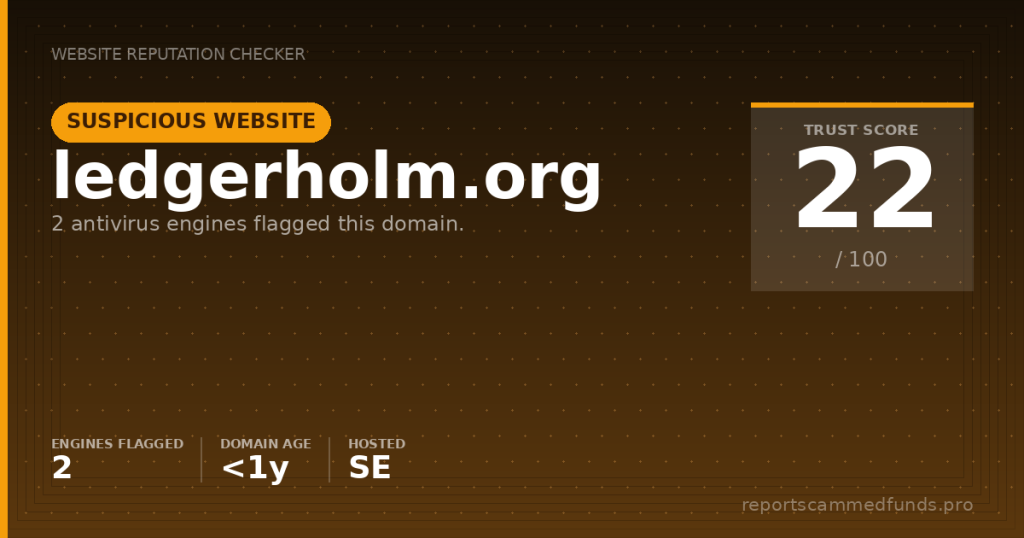
Ledgerholm.org is a newly minted trading site with assertive AI-marketing and thin disclosures. No regulator authorization was found, and automated reputation checks include suspicious and malicious flags from a subset of engines. Those facts, combined with anonymous ownership and unclear payment terms, create a risk profile that is difficult to justify for retail investors.
If you are evaluating the platform despite these concerns, do not fund an account before you can independently verify the operator’s legal entity and license in your country. Request written fee schedules, withdrawal timelines, and a signed client agreement beforehand. Test withdrawals early and resist any pressure tactics to increase deposits or share remote access to your device.
Better alternatives exist among licensed brokers that publish their regulatory numbers, segregate client funds, and undergo routine audits. These firms also provide transparent information on spreads, leverage, and conflicts of interest—essentials for informed decision-making. A trading opportunity should never hinge on secrecy or urgency.
Our stance is cautious: avoid depositing with Ledgerholm.org unless and until credible licensing, ownership, and operational controls are publicly substantiated. If you have already engaged and encounter obstacles, follow the help steps above and reach out to reportscammedfunds.pro. Protecting your capital starts with saying no to unclear terms and yes to verifiable safeguards.