
Trading platform & site functionality
Visiting kqa.cc redirects to a login portal at /index/index/home. There is no public homepage explaining the service, no detailed product pages, and no visible disclosures. The interface uses off‑the‑shelf front‑end libraries (WeUI, Bootstrap, jQuery/Zepto) and presents language toggles but few other clues. A prominent live‑chat module loads automatically and begins logging client data upon arrival. Overall, the site looks like a gate to an investment or wallet dashboard, not a transparent platform with published terms.
The build relies on a third‑party chat and engagement framework that fetches multiple external scripts, styles, and media, then fires tracking and logging endpoints. This kind of instrumentation is typical for sales‑driven lead capture rather than a mature, audited trading venue. We observed cookies for session management and language preference, but no visible branding assets, company identifiers, or compliance notices. The HTML metadata is sparse, and page titles or descriptive tags are missing—details that usually differentiate legitimate platforms from hastily assembled portals.
Crucially, we could not view any information on account tiers, deposit methods, custody, supported coins, spreads, fees, or risk management until after sign‑in. That opacity matters: regulated brokers and exchanges normally disclose a lot before asking for deposits. It is conceivable kqa.cc is a closed client area for a niche project, but the absence of a discoverable public site, lack of operator identity, and immediate push to chat are classic hallmarks we see in high‑risk crypto schemes. When a site asks for funds but offers no documentation, proceed as if you are on your own.
License & regulatory status
Cryptocurrency venues that handle client funds typically need to register or be authorized in their operating jurisdictions—examples include FCA registration in the UK for cryptoasset activity, BaFin licensing in Germany, various Money Services Business registrations in the US, and national authorizations across the EU under developing MiCA frameworks. On kqa.cc, there are no displayed license numbers, no references to a supervising authority, and no corporate entity to check. Without such basics, customers have no clear idea who is responsible for safeguarding deposits or resolving disputes.
We searched public registers and did not find kqa.cc or a named operator associated with this domain listed with major regulators such as the FCA, BaFin, ASIC, CONSOB, or the CFTC. We also did not see credible claims on the site itself that could be independently verified. While some small crypto services operate under exemptions, a platform that solicits deposits without any verifiable regulatory posture places users entirely out of the umbrella of investor protection and statutory complaint redress.
The domain registration is privacy‑redacted and uses a registrar with a generic abuse contact, which is common for anonymity but unhelpful if something goes wrong. None of this, on its own, proves malicious intent; however, taken together—the lack of licenses, no named company, no policies visible pre‑login, and multiple reputation flags—the regulatory risk picture is poor. Anyone considering an account here should assume there is no practical oversight, no compensation scheme, and limited avenues for recovery if disputes arise.
User feedback
We looked for independent, substantive user reviews of kqa.cc across mainstream complaint boards and social channels but found little that could be verified. The scarcity of credible feedback is not proof of wrongdoing, yet it leaves prospective users without the benefit of community experience—especially around withdrawals, slippage, or customer service quality. In this vacuum, it becomes even more important to weigh the objective risk markers on the site itself.
Based on patterns seen in many crypto‑investment complaints, the riskiest portals tend to share traits we see here: a login‑only front door, aggressive live‑chat prompts, and no published fee or withdrawal rules. In numerous cases documented elsewhere, victims report withdrawal blockages after profits, sudden and vague KYC demands only after requesting payouts, or invented ‘tax clearance’ and ‘account upgrade’ charges to release funds. We cannot say kqa.cc does these things; we can say that when sites are opaque, such tactics are easier to deploy without accountability.
If you are being engaged via messaging apps or the embedded chat by a ‘manager’ pushing time‑limited deposits or outsize returns, treat that as a red flag. Reputable platforms do not pressure users into funding accounts, and they do not hide key terms behind logins. Before sending any money, insist on written policies, legal entity details, and proof of regulatory status—and verify them independently rather than accepting screenshots or unsolicited PDFs.
Deposits & withdrawals
Because kqa.cc reveals nothing before sign‑in, accepted funding methods are unknown. High‑risk sites often steer users toward cryptocurrency deposits because crypto transfers are final and hard to reverse. If cards or bank wires are offered, examine the merchant descriptor or recipient name carefully: it should match a verifiable corporate entity, not a personal account or unrelated firm. Never follow remote desktop instructions or send funds based on chat prompts alone.
Withdrawal friction is a common complaint across dubious crypto portals. Typical hurdles include requiring fresh identity documents only after you request a payout, demanding extra payments labeled as ‘taxes’ or ‘release fees,’ or coercing users to top up to a threshold amount to ‘unlock’ balances. None of these practices are standard in legitimate finance. If a platform cannot state in writing how and when you can withdraw—along with fees, timeframes, and support contacts—assume you may not get your money back easily.
If you decide to test the waters despite the risks, limit exposure. Use new payment instruments, start with the smallest allowable deposit, and immediately try a partial withdrawal to validate procedures. Capture evidence of every promise: screenshots of chats, transaction IDs, and timestamps. If any step feels improvised or unsupported by published terms, stop and escalate to your bank or card issuer at once.
Why unregulated brokers are risky
Unregulated platforms can hold your funds without any of the protections that apply to authorized brokers or exchanges. There is usually no client‑fund segregation, no audited reporting, and no compensation scheme if the operator fails. Terms can change without notice, and internal ‘compliance’ decisions can be used to delay or deny withdrawals without external oversight. In short, you are depending entirely on the operator’s goodwill—and you often cannot even identify who that is.
Reactivation of older, generic domains is a known tactic in the crypto‑scam playbook. A long‑registered name can look reassuring, while a new certificate and fresh scripts conceal the fact that the operator is new and untested. If things go wrong, the site can disappear as quickly as it arrived, leaving victims with little to no recourse. Without a legal imprint and licensing, there is no clear path to formal dispute resolution.
Beyond financial loss, there is a data‑security angle. The chat and logging stack observed on kqa.cc collects device and interaction details by default. In hostile setups, those datasets can be reused for social‑engineering (for example, recovery scams) or traded between boiler‑room operations. Funding a site like this risks not only your capital but also your personal information.
How to get help if you’ve been scammed
If you have already deposited money and are facing withdrawal obstacles, act quickly. Contact your bank or card issuer, explain that you suspect fraud, and ask about a chargeback or recall. For wire transfers, request an urgent recall/SWIFT trace; for cards, file a dispute citing misleading or non‑delivered services. Freeze any compromised cards and revoke remote‑access permissions if you allowed screen‑sharing during onboarding.
For cryptocurrency transfers, immediately notify the exchange or wallet provider you used to send funds. Ask them to flag the transaction and beneficiary addresses and to note your case with any Travel Rule or AML teams. Gather all on‑chain transaction hashes and chat logs—you will need them for incident reports and any tracing work. Be wary of unsolicited ‘recovery agents’; many are secondary scams that simply target recent victims.
Report the incident to your national authority: in the UK use Action Fraud; in the US submit a complaint to IC3; in the EU contact your national regulator and police cybercrime unit. Documentation matters—export statements, screenshots, and emails to build a clear timeline. For hands‑on guidance with reporting, evidence packaging, and fund‑recovery options, reach our team at reportscammedfunds.pro. We can assess your case, help you contact the right institutions, and coordinate next steps.
Conclusion
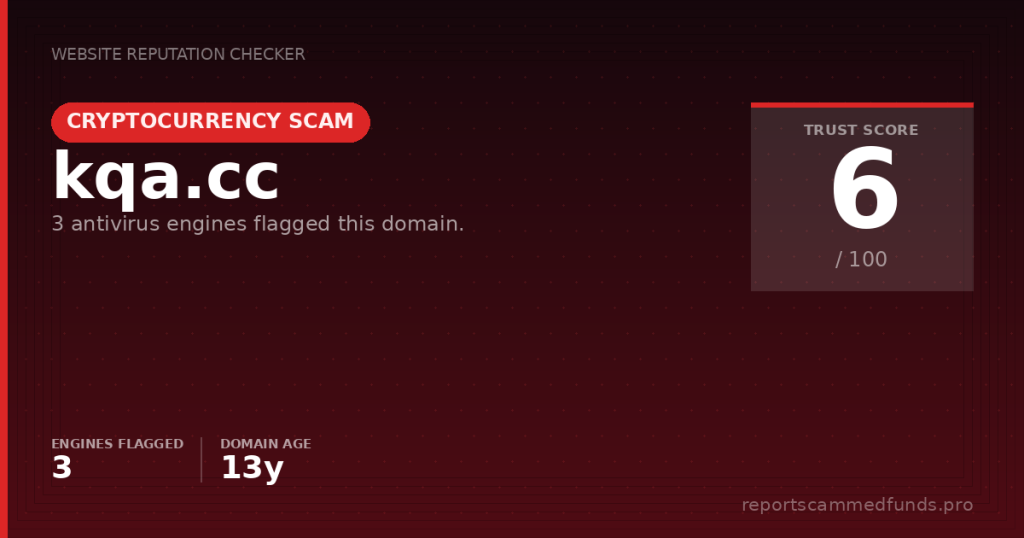
kqa.cc exhibits too many of the markers we associate with high‑risk crypto operations: no visible licensing, no company identity, login‑only content, and multiple third‑party reputation flags. While we leave room for unknowns—because the operator discloses almost nothing—our duty is to prioritize reader safety. Right now, the risk‑to‑reward tradeoff is not acceptable.
Our recommendation is straightforward: avoid depositing funds or sharing personal documents with this site. If you are determined to test it despite the warnings, cap your exposure to a nominal amount and demand written, verifiable terms before any payment. The moment you encounter improvised fees, blocked withdrawals, or pressure to ‘top up,’ stop and seek help.
Safer alternatives exist. Work only with platforms that publish a legal entity, show verifiable regulatory status with named authorities, and provide clear, pre‑login disclosures of fees and withdrawal rules. Until kqa.cc meets those basic standards—and until independent feedback confirms reliable payouts—it should remain on your do‑not‑fund list.