
Trading platform & site functionality
At first contact, interactivebrokers.com functions as the front door to a very large brokerage ecosystem. The homepage signposts direct access for individuals, advisors, and institutions, alongside asset coverage across stocks, options, futures, currencies, bonds, and funds. The emphasis is on global market access and transparent costs rather than promotional hype or unrealistic profit claims, which is a positive indicator. We also noted clear navigation to investor relations materials and policy pages, lending the site the documentation depth you would expect from a mainstream broker. In short, the site’s information architecture aligns with a firm that serves both sophisticated and new investors while meeting compliance documentation expectations.
In terms of platforms, you are steered toward the firm’s proprietary Trader Workstation (TWS) for desktop, alongside IBKR WebTrader and IBKR Mobile. Each platform is pitched to a slightly different user: TWS for power users needing advanced order types and analytics, WebTrader for browser‑based convenience, and mobile for placing and monitoring trades on the go. Nothing in the site flow looks like a generic white‑label front end; the branding, help resources, and cross‑links to platform guides are extensive and consistent. That said, TWS is historically feature‑rich to the point of being complex, which can be a learning curve for new users; the site acknowledges this with education links and tutorials. Overall, the platform menu and the way it is presented match a veteran broker rather than a boiler‑room fly‑by‑night.
Fee transparency is framed as a selling point. You are directed to tiered and fixed commission schedules, margin rate tables, and market‑specific cost pages, rather than a single vague statement. The company references low financing rates and aims to support best execution, but it does not promise zero‑cost trading as a catch‑all—fees vary by venue, order type, and jurisdiction. For a prospective customer, the documentation breadth is exactly what you want: it allows you to model costs in your own scenario instead of relying on slogans. We did not see any “bonus for deposit” hooks or time‑pressured offers that typically accompany higher‑risk broker websites.
From a technical and usability perspective, the site is multilingual, uses modern front‑end libraries, and loads a mixture of first‑party assets and performance beacons to monitor page health. Cookies and session identifiers are present, and there are scripts for analytics and basic A/B testing—which is common for large, consumer‑facing financial sites seeking to optimize navigation. The site also cross‑links out to official social channels and investor‑facing microsites under the broader IBKR brand families. While that increases surface area, the consistency of branding and the explicit regulatory links (discussed below) help anchor it as the authentic portal.
License & regulatory status
Interactive Brokers’ site prominently references major regulators and industry bodies. In the United States, the brand’s brokerage entity is typically described as a member of FINRA and SIPC, with the federal market regulator being the SEC; these links route users to brokercheck.finra.org and sipc.org. For the United Kingdom, the site references the Financial Conduct Authority with outbound links to fca.org.uk. We also noted references to other jurisdictions such as Canada (ciro.ca and cipf.ca), Australia (asic.gov.au), Hong Kong (via market links), and Ireland’s Central Bank (centralbank.ie) for EU servicing. We did not independently verify each license entry or FRN, but the presence of these cross‑references is consistent with a regulated group maintaining region‑specific authorizations.
Crucially, we found no warnings on the site that a casual reader might misinterpret as implied approval; instead, the outbound links direct the user to where verification can be performed. This is the correct pattern: a legitimate broker shows you the door to the official register rather than inventing or obscuring details. In the US, SIPC membership relates to brokerage account protections (subject to limits and scope), while in Canada CIPF is cited similarly for Canadian accounts; the site links to those bodies rather than paraphrasing their protections in an over‑promotional way. That tone matches compliance norms rather than hustling language.
For UK/EU access, the brand’s structure has historically involved separate regional entities supervised by the FCA or the Central Bank of Ireland, depending on the client’s location. The site includes outbound links to these authorities and makes clear that availability and product scope vary by country. This precision matters: unregulated sites tend to publish one‑size‑fits‑all promises, whereas a regulated multinational must caveat based on local rules. Again, we did not independently verify every authorization, but the pattern of disclosure is sound and the registries cited are the ones serious firms point to.
A final regulatory point is brand‑protection: high‑profile brokers are frequent targets of “clone firm” scams. The legitimate site warns users about jurisdictional differences and routes you through controlled login and funding paths; a clone will often try to bypass that by offering direct card deposits or asking you to message a “broker” on a chat app. If you are ever uncertain, use the official registers (for example, fca.org.uk or brokercheck.finra.org) to search Interactive Brokers, and cross‑match entity names and contact details with those on interactivebrokers.com and affiliated regional domains. Do not rely on screenshots or PDFs sent by cold‑callers.
User feedback
Public commentary about Interactive Brokers typically clusters around two themes: execution quality and platform complexity. Experienced traders often praise market access and order‑routing sophistication, while newcomers occasionally report being overwhelmed by TWS’s depth or by the number of fee variables. That pattern is consistent with a professional‑leaning broker rather than a consumer app optimized only for simplicity. In this context, occasional frustration with learning curves does not read as a scam red flag; instead, it speaks to the breadth of functionality on offer. The site’s extensive education hub and documentation seem intended to close that gap.
Regarding funding and withdrawals, complaints that we see with unregulated brokers—such as outright refusal to return money after profit or sudden new “taxes” demanded before release—are not a prevailing theme with Interactive Brokers. What you do see reported in forums are compliance holds when names, bank accounts, or source‑of‑funds checks do not reconcile cleanly, especially for first‑time withdrawals. These holds can feel like “blockages” to a user eager to move money quickly, but in regulated settings they are a normal AML/KYC control and usually resolve once documentation is provided. That distinction is important: controls are not the same thing as confiscation.
Support quality feedback is mixed, which is typical for a high‑volume global platform. Some users report quick chats and helpful callbacks; others report long queues at peak times or difficulty reaching a knowledgeable agent for a specialized question. The platform’s breadth means the front‑line agent may occasionally route you to documentation rather than solving a niche request in one call. Still, we did not find a credible wave of reports alleging systematic non‑payment or stealth account lockouts—hallmarks of fraud operations. As always, keep contemporaneous notes of any support case numbers and correspondence to speed resolution.
Finally, several community threads comment on fee nuances—such as market data subscriptions, exchange fees, or differences between fixed and tiered pricing—leading to unexpected line items when users do not configure settings carefully. This is not unique to Interactive Brokers; it is the reality of multi‑venue trading. The takeaway is to audit your account configuration and data subscriptions with the same care you would audit positions. Transparent fee tables are only helpful if you map them to your actual usage.
Deposits & withdrawals
Funding on interactivebrokers.com is oriented around bank transfers and established rails such as ACH, SEPA, and wire transfer, initiated through the secure account portal. We did not see a retail‑style card checkout or any invitation to deposit via crypto wallets—both of which are red flags on questionable broker sites. The portal steers you to name‑matched accounts and tracks status, aligning with standard AML practice. This reduces the risk that third‑parties can redirect your funds or that a clone site can capture card data.
Withdrawals follow the same controlled pathway: you request transfer out to a verified, name‑matched bank account and may encounter additional prompts if your profile or documents have changed. Expect standard banking settlement times—ACH and SEPA are typically slower than domestic wires—and be mindful that first‑time withdrawals sometimes take longer due to anti‑fraud checks. When two‑factor authentication and device approval are required, have your security device or app ready to avoid self‑inflicted delays. None of this reads like a frictionless consumer checkout, but that is by design in a regulated brokerage context.
If you are new to the platform, a pragmatic approach is to test with a small deposit and withdrawal cycle before scaling. Use the portal to track status, and keep PDF confirmations or screenshots for your records. Name mismatches, intermediary bank fees, or incomplete beneficiary details are the leading causes of delays in legitimate transfers, not hidden “release fees.” If anyone outside the portal asks you to send crypto, gift cards, or pay a tax to unlock funds, you are not dealing with the legitimate broker.
Why unregulated brokers are risky
While the website itself presents as regulated and authentic, the largest real‑world risk for readers is accidentally dealing with an unregulated clone that borrows the Interactive Brokers name. Clone firms often use domain look‑alikes with a missing or extra character, copy‑paste logos, and promise quick card deposits or guaranteed returns. They may also contact you via unsolicited calls, messaging apps, or social media and push you to bypass the official onboarding. If you ever see these patterns, stop immediately and independently navigate to interactivebrokers.com to compare contact details and funding paths.
Impersonation also extends to social channels. A verified IBKR presence exists, but scammers routinely create look‑alike accounts that DM users with “managed account” offers or miracle signals. The official site routes you through secure login, sets up funding in your name, and does not ask you to send money to a personal account or messaging handle. Always distrust any approach that tries to move the conversation off the official site, and verify social profiles through links posted on interactivebrokers.com rather than through search results alone.
Generalizing the lesson: when a platform is unregulated or unaffiliated, you lack investor protection schemes (such as SIPC or CIPF, within their specific mandates and limits), your legal recourse is weaker, and funds can be seized or rerouted with little trace. Unregulated operators also tend to add invented “compliance fees” or “tax clearances” to trap victims after deposits. By contrast, a regulated broker uses structured portals, documented fees, and auditable funding rails. If what you are seeing does not match that pattern, assume the worst and verify before sending money.
How to get help if you’ve been scammed
If you already sent funds to a party claiming to be Interactive Brokers and now face resistance or unusual demands, act quickly. Contact your bank or payment provider to request a chargeback or recall, citing suspected fraud or misdirection of funds; provide transaction references, account numbers, and any correspondence. Freeze further transfers and change passwords on your email and financial accounts, enabling two‑factor authentication where available. Time matters: banks may be able to claw back transfers if alerted early.
Next, file a report with the relevant authority in your jurisdiction. In the United States, submit a complaint to the FBI’s IC3 (ic3.gov) and your state securities regulator; in the United Kingdom, report to Action Fraud (actionfraud.police.uk) and notify the FCA if a clone firm is involved; in the EU, use your national cybercrime reporting portal and consult the central bank or securities regulator cited on the real site. Document everything, including screenshots of the fraudulent domain, emails, phone numbers, and payment instructions. These details help investigators and can support recovery attempts.
Finally, our publication can assist with triage and next steps. Reach our team via reportscammedfunds.pro to share your timeline, evidence, and any regulator case numbers; we prioritize cases involving brand impersonation and unauthorized investment solicitations. We can help you structure an effective paper trail, coordinate escalations, and identify whether other victims reported the same domain or wallet. Even if you recover funds, filing reports helps prevent repeat harm to others.
Conclusion
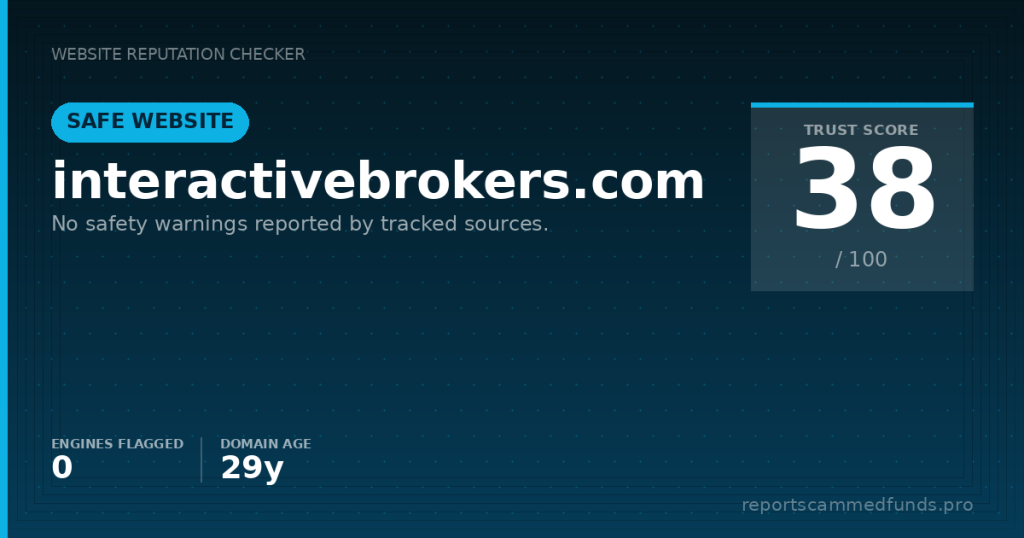
On balance, interactivebrokers.com presents as the genuine, long‑standing brokerage platform used by both professionals and retail clients across many countries. The site’s regulatory signposting, documentation depth, and lack of hard‑sell gimmicks are characteristic of a mature, compliant broker rather than a pop‑up scheme. Our automated checks found no malware flags and the domain exhibits enterprise‑grade TLS with a long operating history.
That said, caution is still warranted in today’s environment of clone‑firm fraud. Always confirm you are on interactivebrokers.com (or a regionally linked IBKR domain), verify entity details on regulator registers, and avoid any third party pushing you to fund by card, crypto, or messenger app. Use the official portal for onboarding and funding, and test small sums before scaling activity. If something deviates from the patterns described here, step back and verify rather than proceeding.
Our recommendation: treat interactivebrokers.com as a legitimate portal but continue to practice due diligence as you would with any financial service. Read fee pages carefully, configure your platform deliberately, and keep an audit trail of transfers. If you encounter anything inconsistent with regulated operations, disengage and consult both your bank and the resources listed above.