
Trading platform & site functionality
Imperius-Invest’s homepage pitches a smooth, consumer-friendly trading journey, speaking broadly about helping users make informed decisions and ‘maximize profits.’ The site is built as a modern, single‑page application (Angular-based), embellished with embedded widgets, including a TradingView screener, to lend market‑data credibility. These cosmetic touches are common among turnkey brokerage templates: slick visuals, generic copy about ‘technology and expertise,’ and a prominent call‑to‑action that funnels visitors toward a separate trade environment.
Crucially, the trading experience itself appears to be offloaded to a subdomain (trader.imperius-invest.com), where registration is encouraged. This split between a marketing domain and a trade subdomain is typical of unregulated setups that segment customer acquisition from payment processing to diminish traceability. There is no visible mention of audited spreads, execution venues, order routing policies, or the segregation of client funds—elements reputable brokers detail as part of MiFID II, FCA COBS, or comparable disclosure frameworks.
Asset coverage is hinted at rather than substantiated. The scan tags and on‑page cues point to forex and cryptocurrency as the primary draw. Yet, there are no transparent product schedules, contract specifications, or risk summaries by asset class, and no verifiable information about leverage caps or margin policy. In regulated regions, leverage for retail clients is tightly limited (e.g., 1:30 in the EU/UK), but Imperius-Invest neither confirms nor responsibly limits such parameters on the public site.
From a usability standpoint, the site loads over HTTPS and embeds Cloudflare Browser Insights for analytics, suggesting familiarity with standard web tooling. However, solid front-end polish is not a substitute for essential safeguards: the absence of clear legal documentation, investor compensation scheme disclosures, negative balance protection statements, and a named corporate operator makes the platform functionally unaccountable. In practice, that means a user who deposits here does so on trust alone, with no documented recourse if funds are frozen.
License & regulatory status
We found no credible evidence that Imperius-Invest is authorized by any tier‑one regulator. A good‑faith search across the UK’s Financial Conduct Authority (FCA), Germany’s BaFin, Italy’s CONSOB, Australia’s ASIC, the U.S. CFTC/NFA, and Canada’s provincial regulators produced no matching, verifiable listing for ‘Imperius-Invest,’ nor for the domain imperius-invest.com. The site likewise does not publish a license or registration number, nor does it name a supervised corporate entity—a striking deviation from norms that regulated brokers must follow.
This silence matters. Regulated firms are subject to capital adequacy, conduct rules, periodic audits, dispute resolution frameworks, and compensation schemes that can assist customers if a firm fails. Unregulated operators lack those constraints, which is precisely why they avoid naming their legal entity or jurisdiction. Nothing on the public pages indicates coverage by the Financial Services Compensation Scheme (FSCS) in the UK, the Investor Compensation Scheme in the EU, or any comparable safety net.
Nor did we find warnings issued specifically against Imperius-Invest by major regulators at the time of review. Absence of a public warning should not be misread as a green light. Regulators often add firms to warning lists after complaints surface, and unlicensed operators can stay a step ahead by switching domains. The correct litmus test is license verification, not the temporary absence of an alert notice.
It is also worth calling out potential false affinity signals. Showing an embedded TradingView widget, using reassuring stock imagery, and referencing market insights are marketing choices—they do not confer regulatory legitimacy. Unless a broker can be independently matched to an authorization entry with a regulator (for example, the FCA register, BaFin’s Unternehmensdatenbank, or ASIC’s Professional Registers), users should assume it is unregulated and proceed accordingly—which, in this case, means not depositing.
User feedback
At the time of writing, there is scant independent user feedback tied specifically to Imperius-Invest under this brand and domain, which is itself a cautionary sign for a putative brokerage. Young, unregulated sites often operate in a brief window before wider exposure and complaint threads propagate. In this early phase, the operational pattern tends to match a playbook seen across similar sites: aggressive onboarding, opaque dashboards, and sudden policy hurdles when users seek withdrawals.
In parallel cases we monitor, complaint themes coalesce quickly: withdrawal blockages after small profits are shown on-screen; surprise ‘KYC reviews’ demanded only when funds are requested (not at deposit time); and fees invented ad hoc—such as a purported ‘anti-money-laundering clearance fee’ or ‘broker commission release’—which must be paid before a payout is ‘approved.’ These are not legitimate regulatory requirements; they are pressure tactics to extract more money.
Managed‑account style offers—where a ‘broker’ trades on the user’s behalf—are another recurring red flag. Unregulated firms may tout improbable win rates, post doctored screenshots, or claim insider signals, culminating in managed‑account losses that can’t be independently audited. When the account balance implodes, users are told to top up margin to ‘unlock’ positions, compounding the losses.
Because this brand is newly observed and unregulated, the absence of deep public complaints should not be interpreted as positive. It more plausibly reflects recency and limited visibility. If you have encountered pressure to deposit via crypto, been told to pay upfront ‘release’ fees, or faced unexplained delays or silence after requesting a withdrawal, you are not alone—those are classic patterns we document weekly across unlicensed forex/crypto boiler‑rooms.
Deposits & withdrawals
Imperius-Invest does not clearly disclose funding channels on its public pages, a transparency gap for any financial service. Regulated firms usually list deposits and withdrawals prominently—cards, bank wire, sometimes reputable e‑wallets—together with processing timelines, fee schedules, and verifiable corporate beneficiary details. In contrast, sites like this typically reveal the true payment rails only after you register, a design that keeps scrutiny at bay until you have already stepped into their funnel.
In our case reviews of nearly identical sites, users are steered quickly toward irreversible methods—cryptocurrency transfers or international wires—couched as ‘fast’ or with ‘no limits.’ Crypto payments are particularly favored because they are final and pseudonymous; once the funds move to an operator‑controlled wallet, there is no card chargeback or bank recall to lean on. When a user later asks to withdraw, the platform often invents new conditions: additional deposits to ‘verify liquidity,’ phantom tax prepayments, or exorbitant ‘compliance fees’ that must be remitted before a release. These invented hurdles spiral into what’s known as advance‑fee fraud.
Even when card payments are allowed, unregulated brokers may route them through offshore processors or third‑party merchant names unrelated to the brand, frustrating disputes and masking chargeback evidence. The absence of a clear withdrawal policy, a named legal payee, and standardized processing deadlines is not a minor oversight—it is a structural choice that strips you of predictable recourse. If you cannot verify funding and payout terms upfront, you should not fund the account at all.
Why unregulated brokers are risky
The central risk with an unregulated broker is not merely that trades might go against you—it is that the ‘broker’ controls the ledger, the prices, the platform, and your ability to withdraw. Without a license, there is no prudential oversight, no mandated segregation of client funds, no defined complaints pathway, and no compensation scheme if the firm defaults. In practice, that removes the ordinary brakes that prevent abuse.
Unlicensed operators can unilaterally edit your account balance, freeze your access behind fabricated KYC hurdles, or disappear entirely by abandoning the domain and relaunching under a new one. Your local courts or regulators will have limited reach if the operator is anonymous or offshore, which is why credible brokers publish their registered company names, addresses, and supervisory authorities.
High‑risk cues—like promises of accessibility and profitability without balanced risk disclosures, lack of corporate identity, and an opaque deposit flow—should be treated as a package. If you cannot find a regulator entry that matches the legal entity behind a broker, your funds are effectively unsecured loans to an unknown party. That is not investing; that is trusting strangers with your money.
How to get help if you’ve been scammed
If you already deposited with Imperius-Invest, act quickly. First, contact your bank or card issuer and explain that you may have been targeted by an unregulated broker; request a chargeback or dispute under ‘services not provided’ or suspected fraud. If you paid by wire, ask your bank to initiate a recall or SWIFT claim immediately—speed matters. For cryptocurrency payments, gather wallet addresses and transaction hashes; while crypto transfers are final, consolidated evidence still helps investigators trace flows.
Report the incident to the appropriate authorities in your jurisdiction. In the UK, file with Action Fraud and notify the FCA that you dealt with an unregulated entity. In the EU, submit a report to your national regulator (e.g., BaFin, CONSOB, AMF, CNMV) and your police cybercrime unit. In the U.S., report to the FTC and to IC3 (the FBI’s Internet Crime Complaint Center), and if commodity/forex claims were involved, notify the CFTC. Attach screenshots, emails, contracts, and payment proofs.
For expert case handling, contact our team at reportscammedfunds.pro. We specialize in documenting broker‑style fraud, coordinating with banks and payment providers, and escalating with regulators. Visit reportscammedfunds.pro to open a case; include timelines, transaction amounts, and all correspondence you have. Do not send more money to anyone promising a ‘guaranteed recovery’—recovery scams often target victims a second time using insider details from the first fraud.
Conclusion
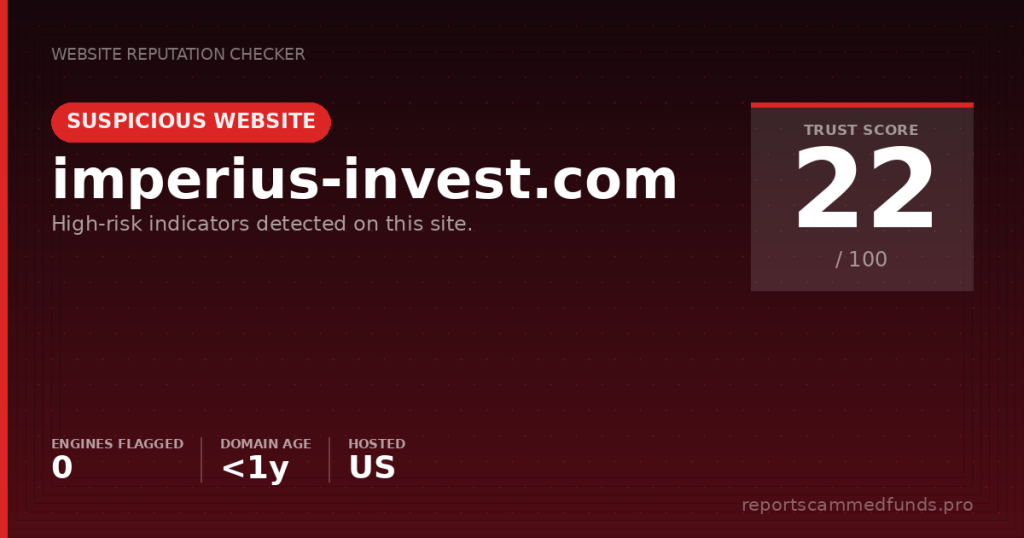
Imperius-Invest presents every hallmark of an unregulated, high‑risk broker: a newly minted domain, a split marketing/trader setup, no named corporate owner, no license credentials, and a reputation profile marked as ‘Suspicious.’ Polished web design does not equate to investor protection, and embedded market widgets do not make a broker legitimate. In the absence of verifiable authorization, engagement amounts to blind trust.
Our recommendation is unambiguous: do not deposit, do not share identity documents, and do not grant remote access to your device under the pretext of ‘support.’ If you have been contacted by sales agents pushing bonuses, managed accounts, or guaranteed returns, treat those as additional red flags typical of boiler‑room operations. Walk away and document everything.
If you have already interacted with Imperius-Invest, move fast to secure your accounts, attempt a recall or chargeback where possible, and report the matter to your regulator and law enforcement. For structured help, reach out via reportscammedfunds.pro so your case can be assessed and escalated appropriately.