
Trading platform & site functionality
On arrival, hfanyj.com loads as a modern single-page web application with a concise title, “HF Market,” and minimal public-facing content. The site relies on a JavaScript bundle and related static assets, indicating a framework-based front end rather than a traditional brochure site. There is no substantial home-page narrative, service description, or pricing grid available without registering or logging in. That design choice is not uncommon for fintech dashboards, but it does limit a prospective user’s ability to judge the service before handing over personal data.
We did not observe a clearly labeled About, Contact, or Legal section on the open pages. Instead, the visible experience resembles a restricted portal expecting visitors to sign up before learning how the platform operates. In the retail trading space, most regulated providers show a compliance footer identifying their regulator, license number, risk warnings, disclosures about leverage, and links to key documents like Terms, Privacy, Order Execution, and Conflicts of Interest policies. The absence of these on the surface of hfanyj.com creates information asymmetry that disadvantages the consumer.
There is also no upfront indication of platform capabilities, such as supported instruments, spreads, commissions, leverage ranges, margin requirements, or order types. Reputable brokers usually publish a product schedule and platform comparison (e.g., MT4, MT5, proprietary web trader), as well as a FAQs page addressing account tiers, KYC steps, and withdrawal timelines. Without these details, users cannot easily compare hfanyj.com against established peers or evaluate costs and risks. A login wall may be convenient for the operator, but it deprives potential clients of essential context.
From a technical perspective, the site uses a widely adopted CDN and analytics snippet, suggesting a standard deployment posture rather than a throwaway setup. That said, technical neatness does not equate to regulatory soundness. A polished app shell can still front an opaque operation if governance and disclosures are absent. Until hfanyj.com publishes fuller information about its services, fees, and oversight, the user experience remains largely indeterminate and should be treated as high risk for those who are not prepared to vet it in depth.
License & regulatory status
We looked for regulatory claims or license references on hfanyj.com and did not find any on the publicly accessible pages. No FCA, BaFin, ASIC, CONSOB, CySEC, CFTC, NFA, or other supervisory mentions or IDs were visible. Legitimate brokerages and investment firms normally make their oversight status easy to find on every page footer and in a dedicated legal section. The absence of visible licensing information is a key trust deficiency in a site that appears to solicit trading or investment activity.
Our review could not independently verify whether hfanyj.com is regulated anywhere. If the operator is authorized, it should state the full legal entity name, registered office, regulator, and license number, along with jurisdiction-specific risk warnings and investor protection statements. In the UK, for example, FCA-authorized firms provide an FRN; in the U.S. a derivatives intermediary must show CFTC/NFA details; in Australia, an AFSL number is published. Without those, users must assume they are dealing with either an unregulated entity or one that simply has not disclosed its status.
There is an additional point of potential confusion: the branding phrase “HF Market” resembles the name of HF Markets, a recognized broker that operates well-known official domains and publicly lists regulatory credentials in multiple jurisdictions. We found no independent confirmation tying hfanyj.com to that established brand. Similar-sounding names and brand collisions are a common technique in the gray market to piggyback on the goodwill of legitimate firms. Readers should verify the exact domain and corporate entity on a regulator’s register, rather than relying on name similarity.
Before engaging, we recommend using regulator search tools directly—FCA’s Register (UK), BaFin’s Company Database (Germany), ASIC Connect (Australia), CONSOB’s registers (Italy), FINMA’s lists (Switzerland), CySEC’s regulated firms list (Cyprus), and the NFA BASIC (U.S.)—to look up any entity name the site may disclose after registration. If you cannot find the operator, or if the regulator has issued warnings about the domain or a related brand, treat that as a stop sign. In financial services, verifiable licensing is not a luxury—it is the baseline obligation to protect investors.
User feedback
We searched for independent reviews linked specifically to hfanyj.com and did not encounter robust discussion on major consumer forums, watchdog sites, or mainstream social channels. That silence can have multiple explanations: the site may serve a closed, invite-only audience; it may be new in practice despite an older domain registration; or it has not reached enough users to generate a public footprint. While lack of complaints is better than a wall of negative posts, the absence of positive, verifiable testimonials or trusted third-party assessments also limits confidence.
In similar cases, early user experiences often converge around a few recurring themes when problems occur. These include withdrawal blockages after profitable trades, requests for unexpected “tax clearance” or “release fees,” sudden account freezes pending “enhanced KYC,” and pressure to deposit more capital to unlock supposed benefits. Some users report being steered into managed-account arrangements by off-platform chat contacts, only to see rapid drawdowns followed by restricted access. We are not asserting that hfanyj.com engages in any of these, but these patterns are worth watching in any opaque platform.
If you decide to test the waters, adopt a defensive posture. Document all communications, keep screenshots of balances and transaction IDs, and attempt a small same-day withdrawal before committing meaningful funds. Do not allow remote desktop control of your device, and never send identity documents until you confirm the firm’s regulatory standing and data practices. A measured trial approach can help you detect friction early and limit losses if the operator’s procedures are not fit for purpose.
Deposits & withdrawals
We could not verify which payment methods hfanyj.com accepts, nor any explicit fees, minimums, or processing times. In the absence of disclosures, assume that cards, bank wire, and cryptocurrency might be options—but recognize that each carries distinct recovery prospects. Credit and some debit card payments may allow chargebacks if you act quickly and can substantiate misrepresentation; bank wires are harder to reverse; and crypto transfers are effectively final and frequently used in higher-risk schemes. An unverified platform that leans on crypto only is a notable red flag.
Check whether the site, once logged in, provides a transparent schedule: deposit and withdrawal minimums, turnaround times, any intermediary bank fees, and whether identity verification is required before or after you fund the account. Surprise KYC only triggered at withdrawal is a common friction tactic in dubious operations. Also scrutinize “bonus” terms if they exist; some outfits use opaque bonus conditions to indefinitely defer or deny withdrawals under the guise that you have not met certain turnover thresholds.
Before committing funds, perform a small, reversible test. Deposit the bare minimum via a method that supports consumer protection, then immediately request a withdrawal back to the original funding source. Services that decline, stall, or redirect you to pay additional fees up front in order to ‘release’ your funds often evolve into classic advance-fee scenarios. Establish a personal rule: if a platform will not process a clean, small withdrawal promptly, do not escalate your exposure.
Why unregulated brokers are risky
Engaging with an unverified or unregulated trading site exposes you to structural risks that regulated environments are designed to mitigate. Regulated brokers segregate client money, maintain capital buffers, submit to audits, and publish complaints-handling procedures. They also provide recourse mechanisms, including access to ombudsman schemes and, in some jurisdictions, compensation funds. An opaque platform may not segregate funds, may pool deposits in undisclosed accounts, and can change rules without oversight.
Operationally, unregulated venues are more likely to deploy tactics that entrap users financially or psychologically. We track cases where users are told to pay a ‘tax’ or ‘liquidity fee’ before withdrawals, or to deposit additional collateral to ‘stabilize’ positions. These are hallmarks of advance-fee fraud and boiler-room operations, which thrive in low-transparency settings. Without a regulator, your ability to challenge unfair practices is limited to whatever the operator decides to provide—often very little.
There is also a data-security dimension. Uploading passports, driver’s licenses, and utility bills to an unvetted portal can lead to identity theft, synthetic identity creation, and ongoing credential compromise. Even if no money is lost initially, the long tail of data misuse can be costly. Treat KYC requests as high-privilege transactions: only comply after you have validated the operator’s legal entity, licensing status, and privacy commitments, and only share the minimum required.
How to get help if you’ve been scammed
If you have already sent money to hfanyj.com and now face withdrawal delays, act quickly. Contact your bank or card issuer to request a chargeback or dispute, citing any misleading statements or non-delivery of services, and ask for an immediate review of recent transactions. If you paid by bank transfer, ask your bank’s fraud team to initiate a recall or request for return of funds. For crypto payments, compile transaction hashes and wallet addresses; while reversals are unlikely, these details support investigations.
Report the matter to your relevant authority. In the UK, submit to Action Fraud and check the FCA’s reporting channels; in the EU, consult your national regulator and ESMA resources; in the U.S., file with the FTC and the FBI’s IC3; in Australia, report to ASIC and Scamwatch. A formal report creates a paper trail that can help banks, law enforcement, and other victims connect the dots. Keep copies of all correspondence, account statements, and screenshots for your case file.
You can also request direct assistance from our team. Visit reportscammedfunds.pro to outline your situation; we review cases, help structure evidence for banks and regulators, and advise on realistic recovery avenues. While no one can guarantee recovery, timely, well-documented action improves your odds—especially if card chargebacks or rapid bank interventions are still possible. If you suspect a parallel ‘recovery scam’ targeting you after the fact, report that to us as well before engaging with any third party.
Conclusion
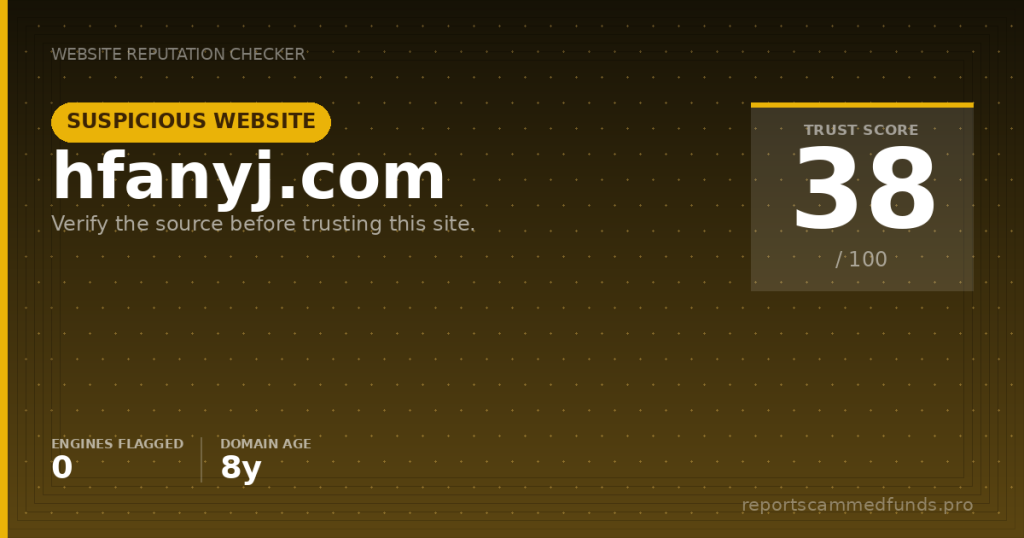
hfanyj.com sits in a gray zone: technically presentable and long-registered, but devoid of the public-facing transparency expected of a legitimate broker or investment platform. The lack of on-page licensing, the login-first model, the absence of clear ownership details, and the brand-name collision with an unrelated regulated firm together undermine trust. Nothing in our scan proves malicious behavior, yet the burden of proof lies with the operator to demonstrate lawful, regulated status and fair terms.
Until the site publishes verifiable corporate identity, regulator authorization, and full product disclosures—including fees, supported platforms, and withdrawal policies—prospective users should refrain from funding accounts. If you nonetheless proceed, do so with the smallest possible test transaction through a reversible payment method, attempt a same-day withdrawal, and pause immediately if you encounter excuses or fee demands. Transparency is not negotiable when your money and identity are at stake.
Our recommendation is cautious: avoid depositing funds into hfanyj.com until it documents who runs the operation and under which license, and until independent checks confirm those details. Compare any claims you see post-login against official registers from bodies like the FCA, BaFin, ASIC, CySEC, and the CFTC/NFA. If the facts do not line up, walk away and, if you have already engaged, move promptly to the remediation steps outlined above and contact reportscammedfunds.pro for help.