Trading platform & site functionality
What appears when you load globalmarket.co is not a merchant catalog, trading dashboard, or corporate homepage. Instead, the domain immediately redirects to a GoDaddy for-sale landing page (forsale.godaddy.com) that advertises the name as available to purchase. You will see common marketplace elements such as cookie-consent prompts, payment logos (Visa, Mastercard, American Express, PayPal, Alipay), and generic trust messaging about ‘secure transactions.’ Those elements belong to the domain marketplace interface, not to any business that might one day operate on this specific address.
There is no sign-up, no checkout cart tied to a product, and no pricing or service descriptions unique to globalmarket.co. The page does not publish company terms, privacy policy for a service, risk disclosures, fee schedules, or support contacts. In other words, nothing on the destination page suggests you are dealing with an actual shop or broker. The only thing you can ‘buy’ through that interface is the domain name itself, using GoDaddy’s escrowed transaction flow. That distinction matters because malicious actors often point to payment icons or a reputable marketplace wrapper to falsely imply there is a legitimate merchant behind a domain.
Technically, the domain’s DNS and hosting setup align with typical parked-domain infrastructure. Nameservers point to GoDaddy’s marketplace network, and hosting routes through a large cloud provider. The presence of analytics and tag manager scripts simply reflects the marketplace’s own telemetry, not any bespoke service built by ‘Global Market.’ Additionally, the domain presents a valid TLS certificate and a sender policy that rejects email from the root, which are ordinary hygiene signals for parked names. These technical artifacts do not change the practical reality: globalmarket.co is not operating as a customer-facing business at the time of this review.
License & regulatory status
Licensing analysis is straightforward when a domain is parked: there is no operating broker, exchange, bank, or merchant to license. We see no claims on the landing page that the domain owner is regulated by the FCA, BaFin, ASIC, CONSOB, the CFTC/NFA, or any other competent authority. If anyone approaches you off-site and asserts that ‘Global Market’ at globalmarket.co is regulated, that is a red flag that should trigger independent verification. Regulated entities publish their legal names, license numbers, and physical addresses and are easily searchable on the regulator’s official register.
Our review did not identify public warnings bearing directly on globalmarket.co by major regulators at the time of publication. That absence should not be read as an endorsement. It often simply means there is no active entity to scrutinize yet. Without corporate disclosures, we cannot tie this domain to a legal person or a jurisdiction, making jurisdictional recourse and consumer-rights analysis impossible. Until a real operator steps forward with verifiable details, consumers have nothing substantive to evaluate beyond the marketplace listing.
If the domain is later activated for financial services, the bar is clear and non-negotiable. A UK-facing broker must appear on the FCA register; an EU investment firm must hold authorization under MiFID II and comply with ESMA rules; a U.S. derivatives venue must be registered with the CFTC and overseen by the NFA; and Australian providers must have an ASIC license. Any future use of globalmarket.co for trading or investment without these approvals would be unregulated solicitation. In practice, that would expose users to the familiar hazards of boiler-room schemes, managed-account losses, and withdrawal denials with no supervisory backstop.
User feedback
Because the domain is not running a service, there is no credible, domain-specific user review trail to analyze. We did see marketplace elements that link out to broad reputation resources (for example, Trustpilot pages about GoDaddy itself), but those do not pertain to globalmarket.co as a business. There are no published customer testimonials, ticketing histories, or social media channels tied to this exact domain. As a result, we cannot corroborate positive experiences or verify complaints that would typically guide a safer decision.
Where we do see patterns—and urge caution—is in the way parked or dormant domains are sometimes cited in off-platform pitches. Victims report receiving cold contacts on WhatsApp or Telegram from personas claiming ties to a ‘Global Market’ team, then being steered to deposit funds on unrelated wallets or side apps under the promise of quick returns. When the ‘profits’ show up on a dashboard, the story often changes: surprise KYC hurdles appear, ‘tax prepayments’ are demanded, or withdrawal requests get stalled by vague compliance checks. These are classic playbooks of pig-butchering and advance-fee fraud, and a parked domain gives scammers an air of plausible branding without the accountability of a live site.
We also caution against job-offer or mentorship schemes that reference globalmarket.co as if it were an established brand. In such scams, targets are asked to ‘test’ trading systems or run small arbitrage tasks, required to deposit a starter sum, and later pressured to ‘unlock’ larger withdrawals with more fees. The problem is not specific to this domain; it is endemic across unverified brands and generic-sounding names. For now, there is simply no evidence-based user feedback—good or bad—about an actual service at globalmarket.co, which reinforces our recommendation to avoid any financial or personal-data engagement linked to this address.
Deposits & withdrawals
There is no deposit or withdrawal mechanism on globalmarket.co because there is no active merchant or broker behind it. The only legitimate transaction path associated with this address today is purchasing the domain via GoDaddy’s marketplace interface. If you intend to buy the domain name, use the platform’s official escrow or checkout flow, which supports mainstream payment methods like cards and vetted processors. Do not send cryptocurrency, gift cards, or wire transfers to an individual who claims to ‘own the domain’ and proposes an off-platform deal—those are common hallmarks of title-fraud and advance-fee traps.
If a party claims to accept ‘investments’ or customer deposits tied to globalmarket.co, assume a very high risk of loss. In typical boiler-room patterns, once a victim makes an initial deposit—often in USDT or Bitcoin—the operator fabricates trading activity and displays paper profits. When the victim tries to withdraw, they are hit with escalating pretexts: compliance hold fees, anti-money laundering certificates, tax prepayments, or VIP upgrades. Each add-on fee is designed to sink more money into a dead end, after which communication stops. None of this is part of the GoDaddy marketplace flow and would have nothing to do with acquiring the domain legitimately.
If money has already been sent to someone claiming a connection to globalmarket.co outside the official marketplace, move quickly. Save all messages, wallet addresses, receipts, and screenshots. Contact your bank or card issuer immediately to dispute the transaction and request a chargeback on the basis of fraud or goods/services not received. If the transfer was through a crypto exchange, open a support case asking the exchange to flag the destination address and provide any investigative support they can. Timeliness improves the odds of intervention, especially before funds are fully off-ramped.
Why unregulated brokers are risky
The central risk here is not what globalmarket.co does today—it is what a future, anonymous operator could do with it. Should the domain light up as a trading venue or high-yield scheme without a regulator’s license, users would have no investor protections, no negative-balance safeguards, and no compensation scheme to lean on. Unregulated operators can freeze accounts arbitrarily, void profits via obscure clauses, and block withdrawals with contrived compliance requests. When victims seek help, the lack of a named entity or jurisdiction becomes a dead end.
Another material risk is data handling. Unverified sites frequently request sensitive information—identity documents, selfies, proof of address—under the guise of KYC. Without a published privacy policy, data controller identity, or an applicable jurisdictional framework like the UK GDPR or EU GDPR, users have no clarity on where their documents go or how they are stored. That information can be misused for identity theft or sold downstream. Even on a domain-for-sale page, if a third party reaches out to collect personal data privately while citing this name, it is prudent to disengage.
Finally, the generic branding of ‘Global Market’ can lull users into tolerance. The name sounds established, while the absence of a real website creates a vacuum scammers can fill with screenshots and PDFs. Until a legitimate operator stands behind the domain with audited details and regulator recognition, the safe assumption is that any deposit request tied to this address is either irrelevant (because the domain is merely for sale) or outright fraud. The conservative choice is to wait for verifiable substance before entertaining any financial exposure.
How to get help if you’ve been scammed
If you have already paid someone who referenced globalmarket.co outside the GoDaddy marketplace, act fast. For card or bank transfers, call your issuing bank immediately and request a chargeback or recall, stating you were misled or the goods/services were not delivered. Freeze or replace any compromised cards and reset credentials that might have been shared. Document every interaction and save all evidence—receipts, chat logs, email headers, wallet addresses, and screenshots—since this material is crucial for both disputes and law-enforcement reporting.
Report the incident to the appropriate authorities in your jurisdiction. In the UK, file with Action Fraud and, if investments are involved, notify the FCA. In the United States, submit a complaint to the FBI’s IC3 and consider reporting to the FTC. In the EU, contact your national police cyber unit and consumer protection agency; if a financial instrument was marketed, check with the relevant securities regulator or ESMA-linked authority. These reports help establish patterns, enable potential asset freezes, and may support your bank’s chargeback review.
You can also seek case guidance from our team at reportscammedfunds.pro. We provide structured intake to help you assemble timelines, payment traces, and documentary evidence, and we can advise on avoiding secondary ‘recovery scam’ approaches that often target recent victims. Reach out via reportscammedfunds.pro if you need help assessing next steps, communicating with your bank or exchange, or preparing regulator submissions. Do not pay anyone who cold-contacts you promising guaranteed recovery for a fee; that is a common follow-on fraud.
Conclusion
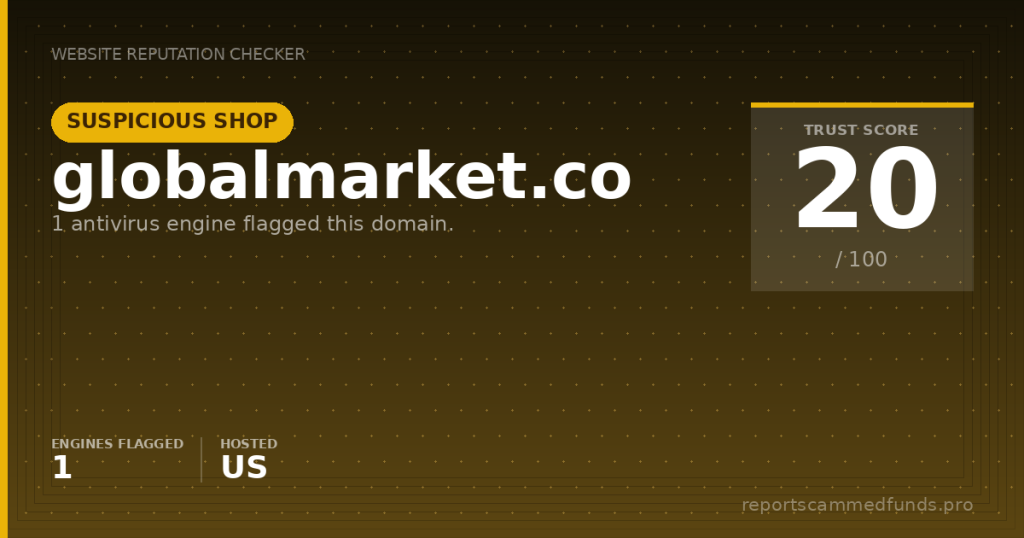
At the time of writing, globalmarket.co is not a functioning website for shopping, trading, or any other consumer service. It is a parked domain advertised for sale on GoDaddy’s marketplace. Automated reputation checks label it a ‘Suspicious Shop’ largely because there is no real storefront or operator to vet—and because such empty shells are often used as window dressing in off-platform pitches. We did not find malware, but we did not find a business either.
Our recommendation is simple: treat any solicitation tied to ‘Global Market’ at this address as unverified unless and until a real company discloses itself with full legal details and appears on the appropriate regulator’s register for the services it claims to offer. If you are approached to deposit funds—especially in cryptocurrency—or asked to pay fees off-platform, assume high risk and decline. If your interest is purely in acquiring the domain name, conduct that purchase exclusively through the official GoDaddy marketplace flow and ignore side offers.
Overall, we rate globalmarket.co as a Suspicious Website given its inactive status, lack of disclosures, and impersonation potential. There may be a legitimate future use if a vetted operator takes control and publishes verifiable credentials, but that is not the case today. Until then, avoid financial engagement, keep your personal information private, and verify any claims independently through regulator registers and reputational sources you trust.