
Trading platform & site functionality
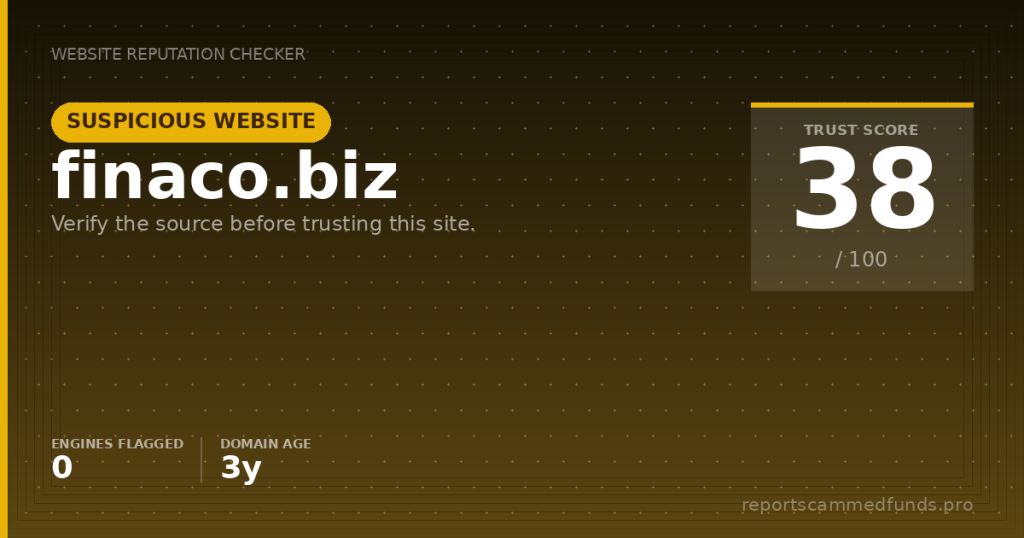
Finaco.biz loads as a simple, brochure‑style website with a title banner of “Finaco Securities.” Our technical crawl observed a single CSS stylesheet (finaco.css), legacy GIF image assets, and standard analytics scripts. We did not find a client login area, product catalogue, fee table, or a detailed description of any live trading or investment platform. The structure suggests a corporate profile page more than an active retail brokerage or investment portal. For visitors seeking to evaluate services, the current content provides too little substance to assess offerings or how any purported service actually works.
From a build perspective, the site runs over HTTPS with a valid domain‑validated certificate and includes Google Analytics and Google Tag Manager. Cookies for site analytics (_ga, _gid, _gat) are set, which is typical of a simple marketing site. We did not observe dynamic dashboards, order entry widgets, or integrations that would normally accompany an investment interface. In the absence of platform demonstrations, API references, or a named provider (such as MT4, MT5, or a proprietary WebTrader), prospective clients cannot infer anything concrete about execution quality, spreads, or reliability. This matters because a finance site without functional depth often precedes a high‑pressure off‑site sales process, rather than a transparent, self‑serve platform.
The copy and layout, based on the assets we could load, look dated and generic. There is no modern disclosures footer that would list the legal entity registered name, company number, regulator, and registered office, which compliant firms typically display. We also did not see a privacy policy, order execution policy, conflicts of interest statement, or a risk warning—documents that are industry‑standard for regulated securities or CFD brands in the EU/UK. That omission may reflect an early staging version of the site, a deliberate minimalism, or a lack of compliance design. Whatever the reason, it deprives readers of the reference points needed to judge credibility.
Finally, nothing on‑page clarifies who the platform is for (retail, professional, or institutional), whether cross‑border services are offered, or which jurisdictions are excluded. Without clear target‑market statements and suitability disclosures, visitors are left to guess whether they are even eligible to engage. Reputable firms normally lead with clarity: they outline the services, the entity behind them, relevant permissions, and the client protections that apply. Finaco.biz, as it stands today, does not.
License & regulatory status
The single biggest issue is the absence of verifiable licensing information on the site. A firm using the word "Securities" typically operates under permissions from a recognized authority—such as the FCA in the UK, BaFin in Germany, ASF in Romania, ASIC in Australia, or a comparable national regulator. We could not find a licence number or regulator logo on the pages we reviewed. That does not automatically mean the operator is unlicensed, but it removes the quickest way a prospective client can validate legitimacy.
We also did not see a named legal entity (for example, "Finaco Securities S.A."), a company number, or a registered address that could be cross‑referenced against public registries. Good‑faith operators usually include these details in the footer, within the terms of business, or on a compliance page. When those signals are missing, it becomes difficult for a prospective customer to check the firm in public company registers, ascertain directors, or understand the governing law and dispute forum. If the entity does operate in Romania, oversight would ordinarily involve ASF; if it solicits clients in the UK or EU, other permissions might be required.
We did not locate formal warnings against finaco.biz on leading regulator alert lists (e.g., FCA, CONSOB, BaFin) at the time of writing. However, the lack of a confirmed licence and the absence of disclosures mean there is also no evidence of investor compensation scheme coverage, best‑execution oversight, or complaint handling rules. For the public, this vacuum is functionally equivalent to dealing with an unregulated counterparty until the operator provides documentary proof otherwise.
If the company is legitimately licensed, it should prominently publish the licence number(s), legal entity name(s), and jurisdiction(s) of regulation and provide links to the official register entries. Until that occurs, the site should be approached as “not independently verified,” and readers should not assume the protections that accompany regulated status—such as conduct rules, capital requirements, segregated client funds, and access to an ombudsman.
User feedback
We did not find a meaningful corpus of independent user reviews tied specifically to finaco.biz on well‑known consumer platforms. The absence of credible third‑party feedback can be a neutral data point for a young site, but for a financial brand, it removes an essential reference: reports of successful onboarding, routine withdrawals, and responsive support. Mature, well‑run brokers and investment houses usually accrue a trail of client experiences—good and bad—that allows for trend analysis.
When similar‑sounding brands draw complaints, the recurring themes often include withdrawal blockages after profit, surprise KYC hurdles introduced only post‑deposit, or managed‑account losses following aggressive promises. We cannot assert those patterns apply to finaco.biz because there is not enough published, attributable feedback at this time. The problem is that without transparent ownership and regulation, users have no easy avenue to escalate in the event those patterns did emerge.
If current or former users of finaco.biz exist, we encourage them to publish verifiable reviews on consumer‑protection forums that require transaction proof. Specifics matter: timestamps, screenshots of account areas, ticket logs, bank proof for deposits and attempted withdrawals, and the outcome of any support interactions. That evidence not only educates the public but also gives regulators and banks something to evaluate if disputes arise.
Deposits & withdrawals
The site does not list accepted funding methods, minimum deposits, or withdrawal timeframes. For a finance‑branded domain, that omission makes it impossible to compare basic operational hygiene—such as whether the operator supports card payments with chargeback rights, conventional bank transfers to a named corporate account, or high‑risk channels like cryptocurrency wallets. Transparent firms clearly outline cut‑off times, processing windows, and any fees, and they publish a withdrawal policy that binds the operator.
In the absence of disclosures, a prudent baseline is to refuse any request to fund via irreversible rails (e.g., crypto to a private wallet or third‑party remitters) or to personal bank accounts. Reputable institutions accept client funds only into segregated corporate accounts in the same legal name as the regulated entity and reconcile those receipts under strict internal controls. If you are ever asked to bypass normal rails, cite urgency, or "avoid compliance delays" by sending funds to an alternative payee, treat that as a red flag.
If you decide to test the waters, protect yourself: start with the smallest possible amount, document every step, and request a withdrawal before adding more funds. Keep copies of all communications, confirmations, and bank statements. If the operator erects surprise KYC roadblocks only when you request a withdrawal, insists on additional deposits to “unlock” your money, or delays for weeks without cause, escalate immediately to your bank and relevant authorities.
Why unregulated brokers are risky
Engaging any unverified or unregulated financial website carries structural risks. Without a licence and named legal entity, there is no clear set of conduct rules, capital safeguards, or client‑money protections you can rely on. If a dispute arises, you may have no access to a recognized ombudsman, compensation scheme, or regulator‑mandated redress.
Unregulated operators can also change terms, pricing, or withdrawal conditions at will, leaving clients with little leverage beyond private negotiation. In the worst cases, we see boiler‑room tactics, aggressive upselling, and managed‑account scenarios where losses are written off as market risk while withdrawals are perpetually postponed. The common denominator is asymmetry: the operator holds your funds and all administrative control; you hold the risk.
In short, without transparent oversight, you are trusting a black box. That trust may be rewarded or abused—but there is no safety net. Only proceed if you can verify the licence, the entity, and the company officers behind the website; otherwise, assume your funds and personal data have limited recourse.
How to get help if you’ve been scammed
If you have already deposited money with finaco.biz and are now facing delays, blocks, or changing withdrawal terms, act quickly. First, contact your card issuer or bank to file a dispute or chargeback—provide a detailed timeline, screenshots, contracts, and any evidence of misleading representations. Second, report the matter to your national authority: for example, Action Fraud (UK), your state regulator or the CFTC/SEC complaint portals (US), ASF (Romania), or your local financial supervisory body. These reports establish a record and can help prevent further victimization.
Preserve all evidence: emails, call logs, transaction receipts, wallet addresses if crypto was used, and copies of any identity documents you provided. Do not send additional funds to “verify,” “unlock,” or “pay taxes/fees” on your own deposit—those are classic advance‑fee tactics layered on top of an initial loss. Consider freezing affected cards and enabling credit monitoring if you shared extensive personal information.
You are not alone, and you do not need to navigate recovery options without support. Our publication provides hands‑on guidance for victims and can coordinate with banks and investigators where appropriate. Visit reportscammedfunds.pro to request case assistance; we will help you triage options, prepare documentation, and avoid follow‑on recovery scams that target recent victims with false promises.
Conclusion
Finaco.biz shows some normal web hygiene—HTTPS, analytics, and no obvious malware—but it fails basic transparency checks expected of any finance‑facing brand. There is no visible licence, no legal entity detail, and no operational specifics about platforms, fees, or client protections. In finance, those are not small omissions; they are the foundation of trust.
Our recommendation is straightforward: do not deposit funds or share sensitive documents until the operator publicly discloses its regulated entity, jurisdiction, and licence number and you can independently confirm those details in the relevant public register. If the firm is legitimate, publishing that information should be trivial and immediate. Until then, you are relying on an unverified counterparty.
If you engage regardless, use the smallest possible test, document everything, and attempt a withdrawal early to gauge responsiveness. And if something feels off—pressure, secrecy, or shifting goalposts—stop and seek help. Your caution today can prevent losses tomorrow.