
Trading platform & site functionality
Evonni positions itself as a comfort‑led apparel boutique, with marketing copy that emphasizes breathable fabrics and flattering fits for everyday ease. Visually, the storefront presents a familiar Shopify layout with card-like grids, large hero images, and a standard cart workflow. Currency defaults to USD, and the page structure suggests a simple browse‑to‑checkout funnel that prioritizes quick conversions over deep brand storytelling or detailed supplier information.
Under the hood, the site is clearly built on Shopify’s stack, evidenced by calls to cdn.shopify.com and various Shop Pay and storefront assets. A cookie consent module loads, and a Klaviyo script is present for list capture and on‑site messaging, which are standard ecommerce practices. These integrations do not, by themselves, confer legitimacy; they simply indicate the store uses mainstream tooling many good and bad actors share.
One notable anomaly is the hotlinking of several product or testimonial images from another boutique domain (clairewardrobe.com). Established brands rarely serve assets from unrelated domains, both for performance and intellectual‑property reasons. Cross‑domain resource pulls can be a trace of networked storefronts that share themes and image libraries, which often coincides with short‑lived, discount‑driven shops.
We also observed locale hints referencing an Italian language code while the cart and payments target a US audience. Misaligned localization is not proof of wrongdoing, but in combination with a young domain and sparse disclosures, it points to a rushed build or template clone rather than a carefully assembled brand experience. In practical terms, that increases the odds of inconsistent customer service, messy size guides, and friction over returns.
License & regulatory status
For clarity, an online clothing store is not a financial services provider and therefore does not require a broker or investment license from authorities such as the FCA, BaFin, ASIC, CONSOB, CFTC, or ESMA. That said, serious merchants still disclose their legal entity, geographic address, and applicable company or VAT numbers where relevant, alongside a clear returns/refunds policy and terms of sale that comply with consumer‑protection law.
In our review of Evonni, we did not find an easily verifiable corporate identity or physical address prominently placed. The absence of basic trader information does not violate a financial rule—because none applies here—but it materially weakens consumer protections if an order goes wrong. By contrast, reputable EU‑facing shops often display VAT details, and UK‑facing stores typically surface a company number or a registered office. US‑facing merchants commonly disclose a legal name and postal address in their terms or returns interactions.
We did not observe claims of affiliation with investment regulators, which is good; false claims of authorization are a hallmark of boiler‑room operations in the trading world. Nevertheless, for retail e‑commerce the ‘regulatory’ bar is about consumer law compliance and transparent merchant identity. In plain terms: can you tell who you are paying, where they are based, and how you can pursue redress if goods are not delivered or arrive defective?
Because those answers are not straightforward on evonni.com, buyers must rely primarily on payment‑provider safeguards and jurisdictional consumer rights, not on any industry supervision. If you proceed, assess whether the returns policy is specific and fair, whether shipping timelines are realistic, and whether contact avenues are more than a webform. These are the practical equivalents of a ‘license check’ for non‑financial storefronts.
User feedback
At the time of review, we could not locate a critical mass of credible, third‑party reviews for Evonni across independent platforms. The brand’s youth partly explains the low signal, but it also means there is limited community data to corroborate claims about quality, shipping reliability, or post‑sale support. On‑site testimonials—when present—are not an independent source and can be curated or supplied by generic review widgets.
The store integrates a product‑review script consistent with Shopify’s ecosystem, but that does not establish authenticity. Newer boutiques commonly seed catalogs with a small number of high‑gloss images and then add generic review modules that look professional but say little about real‑world delivery. Absent external references, prospective buyers should assume they are early adopters with higher variance in outcomes.
Broader patterns we track across pop‑up apparel shops include delays beyond stated shipping windows, return addresses that route to low‑service mail drops, and partial refunds contingent on onerous restocking fees. None of these allegations has been independently verified for Evonni specifically, but the operational markers—young domain, cross‑domain imagery, thin disclosures—are consistent with that risk profile.
If you already see red‑flag themes—non‑delivery, repeated ‘backorder’ updates, or failed refund promises—capture screenshots and save all email headers, tracking pages, and receipts. Documentation later influences card‑issuer disputes and helps authorities aggregate cases. In a sparse‑feedback environment, your evidence is the most powerful data point.
Deposits & withdrawals
Checkout appears to be routed through Shopify’s standard cart, with references to Shop Pay that typically support major credit/debit cards and popular wallets. We did not independently complete a purchase, so we cannot confirm the specific methods enabled or whether any alternatives (such as PayPal) are offered at the time you read this. As always, avoid irreversible rails for a first‑time order—do not use cryptocurrency, direct bank wires, or gift cards.
Refunds in Shopify’s universe are merchant‑controlled: the platform provides the plumbing, but the seller chooses the policy and executes returns. That means your practical recourse is heavily dependent on the store’s responsiveness and the fine print in its terms. Vague return instructions, overseas return shipping at customer expense, and ‘final sale’ carve‑outs for many SKUs are classic frictions to watch for.
If you paid by card and experience non‑delivery, materially not‑as‑described goods, or a refused refund despite valid grounds, contact your issuer promptly to start a chargeback or dispute. Provide the order confirmation, all correspondence, screenshots of the policy as shown at purchase, and any tracking data. Fast, well‑documented action usually improves outcomes under card‑network rules.
Also beware of post‑purchase tactics that add friction, such as surprise ‘verification’ requests for ID to process a refund. That is atypical for a clothing return and can be a stalling move. Keep interactions in writing when possible, and decline to transmit sensitive identity documents to an unverified merchant.
Why unregulated brokers are risky
Because an online shop is not overseen by a market regulator, the core risks are operational and contractual. If a young, lightly disclosed merchant fails to deliver, you are reliant on payment‑rail protections and local consumer law—not on any supervisory authority that can force compliance. That is why we put so much emphasis on transparent identity and established feedback.
Another underappreciated risk is data handling. The site employs marketing integrations to capture email and browsing behavior; in principle, that is normal. In practice, tying your personal data to a low‑signal store with unclear stewardship can invite persistent promotional contact or resale to third parties, with no easy way to enforce erasure across systems.
Hotlinking assets from an unrelated domain may also reflect operational shortcuts or shared operators across multiple storefronts. If a retailer is reusing content infrastructure, the same pattern can extend to inventory, customer‑service teams, and refund queues. The result is inconsistency: sometimes orders arrive, sometimes they do not, and there is no strong brand equity at stake if the site disappears.
Finally, cross‑border fulfillment complicates remedies. If return shipping crosses customs lines or multiple carriers, evidence chains grow messy and deadlines slip. Without a verifiable company address and responsive support, that complexity becomes a lever against refunds. Assume you will need to document everything and escalate quickly.
How to get help if you’ve been scammed
If you already paid and suspect you have been misled or ignored, act now. Contact your card issuer or bank and file a dispute for non‑delivery, ‘not as described,’ or unauthorized/duplicate charges as applicable. Provide the order receipt, the merchant’s policy as displayed at purchase, emails or chats, and any tracking screenshots that show a stall or return‑to‑sender.
In parallel, submit a report to the appropriate authority in your jurisdiction. In the United States, report to the FTC and the FBI’s IC3; in the UK, report to Action Fraud; in the EU, engage your national consumer‑protection body or the European Consumer Centres Network. These filings establish a public record and can connect your case to related complaints.
If you paid via PayPal or a major wallet, open a dispute within the platform’s time limits and keep all messaging inside the resolution center. Should the merchant request sensitive ID for a routine refund, decline and cite your original proof of purchase and their own policy terms instead. Do not send passports or driver’s licenses to an unverified storefront.
For hands‑on guidance or if you are unsure how to document your case, reach out to our team at reportscammedfunds.pro. We review timelines, help organize evidence for banks and regulators, and warn you about secondary ‘recovery scam’ approaches that often target recent victims with promises of easy refunds for an upfront fee. The sooner you consult, the more options you typically retain.
Conclusion
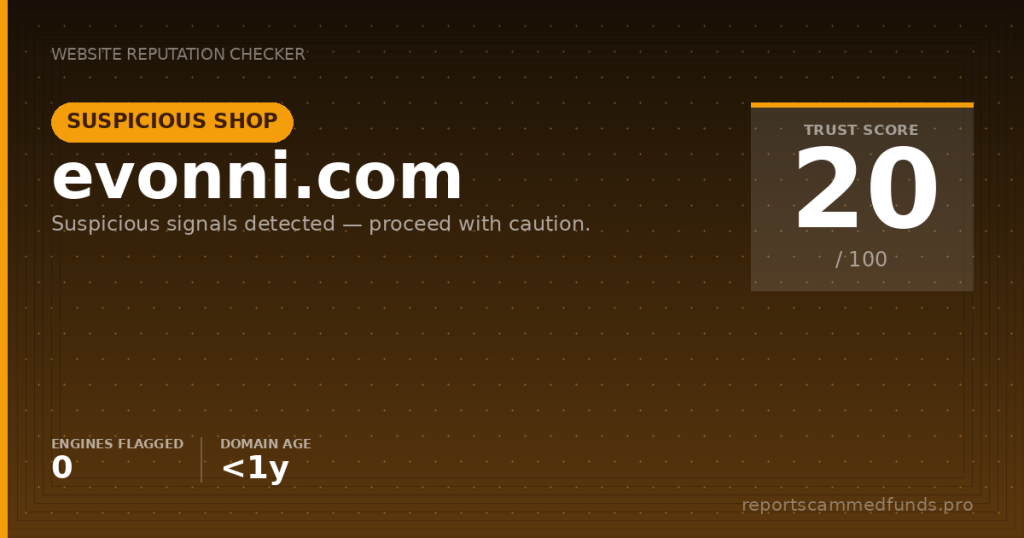
Evonni combines a recognizable Shopify checkout and valid HTTPS with several warning signs that experienced online shoppers will recognize. The domain is young, the brand footprint is thin, and cross‑domain imagery raises fair questions about originality and operator networks. None of this proves malice, but it shifts the burden of proof back to the merchant to demonstrate reliability.
If you decide to test the waters, favor a small, low‑risk order paid by a mainstream credit card, keep copies of all on‑page policies at the time of checkout, and monitor timelines closely. Avoid irreversible rails, and do not accept return instructions that erode your rights or make refunds practically impossible. Should anything deviate from expectation, escalate promptly with your issuer.
Better still, press for verifiable details before you buy: legal entity name, physical address, and a specific, fair returns pathway. Look for independent reviews that predate the current marketing push, and confirm that product images are original rather than mirrored from other storefronts. A responsive merchant will welcome those questions and provide evidence.
Our bottom line is cautious skepticism. We do not categorically label evonni.com a scam, but we see enough negative signals to advise careful due diligence and conservative purchasing behavior. If you encounter problems, move quickly on chargebacks and reporting, and consult reportscammedfunds.pro for support.