
Trading platform & site functionality
Ethereum.org functions as the canonical education and documentation hub for the Ethereum network. The site publishes beginner guides, wallet and security primers, developer documentation, and links to ecosystem tools. Navigation is laid out for multiple audiences—individuals, developers, and institutions—making it easier to find the right depth of information. We observed a multilingual interface with dozens of language options and localized routes, which is consistent with an education-first mission. Importantly, ethereum.org does not act as a broker, exchange, or wallet; it does not ask users to open trading accounts or transfer funds to the site.
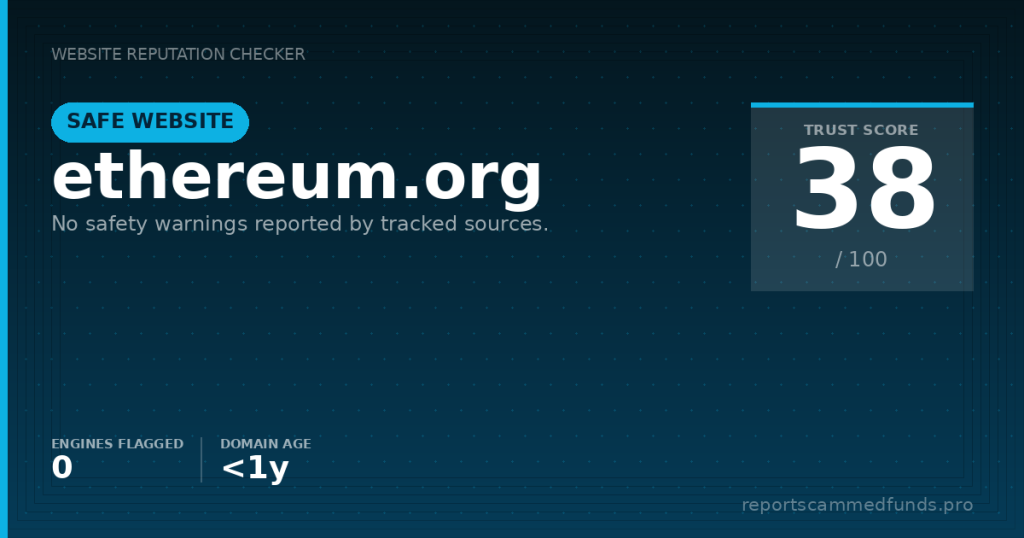
From a technical standpoint, the site appears to be built with a modern web stack (e.g., a component-based framework) and delivered behind a major CDN for performance and resilience. We saw evidence of Cloudflare and edge caching as well as client-side telemetry that is typical of high-traffic documentation portals. The site also loads first-party scripts for analytics and performance monitoring (e.g., Matomo and Sentry) with clear, limited purposes—page analytics, error tracking, and real user metrics. We did not see unsolicited downloads or browser warnings in our scan, and no antivirus engines flagged the domain. The overall user experience felt polished, with fast load times and structured documentation.
Content-wise, ethereum.org consolidates knowledge on core topics like gas fees, self-custody, smart contracts, rollups, staking concepts, and security best practices. Developer sections delve into standards (e.g., ERCs), tooling, and test networks, providing an on-ramp for building with Ethereum. Where the site links out—such as to ecosystem wallets, clients, or third-party documentation—it generally explains concepts first, then encourages users to research independently. We did not find proprietary trading features, fixed spreads, deposit buttons, or marketing claims about investment returns. The emphasis is on understanding and safe participation, rather than transacting through the website.
We also noted API endpoints like a gas/ETH price data feed used by the site’s own pages, which is common for displaying live metrics to visitors. That API is informational and not tied to user accounts or payments. Overall, the website behaves like a well-maintained knowledge base rather than a financial platform. Any transaction a user undertakes after leaving ethereum.org would occur with a separate service that has its own risk profile and terms, which the visitor must review independently.
License & regulatory status
Because ethereum.org is an informational portal and not a broker, exchange, or wallet service, financial licensing is not applicable to the site itself. There are no claims on the site suggesting it holds authorizations from regulators such as the FCA, BaFin, ASIC, CFTC, or CONSOB to provide investment services. The materials are education- and documentation-focused, and the website does not onboard users, take custody of funds, or intermediate trades. As such, typical brokerage requirements—client money rules, capital adequacy, conduct supervision—do not apply to this content resource.
It is worth remembering that cryptocurrency markets intersect with regulatory regimes in complex ways: in many jurisdictions, utility tokens and protocol-level participation may fall outside full-scope financial regulation, while certain activities (e.g., running a custodian, operating an exchange, marketing securities-tokens) do attract oversight. Reputable regulators—including the FCA in the UK, ASIC in Australia, and the CFTC/SEC framework in the US—routinely warn consumers that crypto-assets are high risk and often not covered by deposit insurance or investor compensation schemes. Ethereum.org’s educational tone aligns with that reality, consistently encouraging users to understand self-custody and carefully vet third-party services. We saw no evidence of the site misrepresenting its status, falsely claiming regulated permissions, or implying guaranteed returns.
In short, there is no mismatch between what the site does and how it presents itself: this is a documentation and learning hub, not a licensed investment intermediary. Any regulated activity a user might later engage with—such as opening an account on an exchange, staking through a custodian, or using a regulated on-ramp—would be governed by the licensing and controls of that separate provider. Users should therefore evaluate any off-site claims or services linked in ecosystem directories individually, verifying local authorizations and reading fine-print disclosures before committing funds.
User feedback
Public sentiment about ethereum.org generally trends positive in developer and user communities, where the site is viewed as a reference standard. Readers praise the clarity of beginner guides and the breadth of the developer documentation. We occasionally see confusion from newcomers who conflate the website with the Ethereum network itself—e.g., assuming ethereum.org controls gas fees or can reverse transactions—which is not accurate. The site provides explanations of those mechanisms but does not run the protocol or have the power to intervene in user funds. That kind of misconception is common in crypto and usually resolves once users distinguish protocol layers from educational resources.
Another recurring theme in community discussions is the prevalence of phishing clones that imitate the design or tone of ethereum.org while inserting fake wallet connect prompts or malicious download links. Those look‑alikes are not affiliated with this site, but they appear because Ethereum is a high-profile target. Complaints about lost funds typically trace back to look‑alike domains, social media impostors, or third-party services, not to ethereum.org itself. The official site stresses self-custody fundamentals and encourages source-verification—advice we echo strongly. If a site asks you to import seed phrases, sign blind transactions, or pay up-front ‘unlock’ fees, that’s a red flag unrelated to the genuine ethereum.org portal.
We did not find a pattern of platform-side issues you might see at unregulated brokers—such as withdrawal blockages after profits, surprise KYC demands after deposits, or manipulated prices. That’s expected because ethereum.org does not take custody or provide trade execution. The most constructive feedback request we see is simply for continuous updates to keep pace with fast-moving ecosystem changes, which the maintainers appear to handle through frequent content refreshes and open-source contributions. Readers should still double-check dates on pages discussing live policies or fee mechanics to ensure they are referencing the most current guidance.
Deposits & withdrawals
Ethereum.org does not accept deposits, process withdrawals, or operate as a payment gateway. There are no on-site buttons to fund accounts, set leverage, or move balances—because there are no accounts to begin with. Any action that involves value transfer (for example, buying ether through a regulated exchange, donating to a foundation entity, or connecting a wallet to a dApp) happens off-site, through separate parties with their own terms and risk controls. As a reader, you should treat every outbound link as the start of a new risk assessment: verify the URL, examine certificate details, read the provider’s disclosures, and confirm whether that provider is authorized (where relevant) in your jurisdiction.
If the site lists wallets or ecosystem tools, those are informational listings and not endorsements of custody practices, fee schedules, or security posture. Always download wallet software from the official vendor’s domain, never from pop-up ads or mirror sites. Never share seed phrases or private keys with anyone—even seemingly helpful ‘support’ agents in chat servers or direct messages. When connecting a wallet to third-party applications, carefully review permissions and revoke access you no longer need. And if you transact through an exchange or fiat on‑ramp, ensure you understand their onboarding, chargeback limitations, and withdrawal timeframes before committing funds.
If you choose to make donations to open-source projects or community initiatives referenced in documentation, apply the same discipline: confirm the correct address or payment rail using multiple, independent sources. Beware of last-minute address changes in forums, QR codes posted by unknown users, or unsolicited messages that request ‘urgent’ contributions. Scammers often piggyback on the credibility of well-known educational portals to funnel victims to their own addresses. Ethereum.org’s role is to inform, not to collect money or route your funds.
Why unregulated brokers are risky
In the broader crypto landscape, the single most important risk to keep in mind is that many services operate outside traditional investor-protection regimes. If you wire money to an unregulated exchange, sign an approval that drains your wallet, or send crypto to a scammer’s address, there is often no recourse. Unlike card networks with built-in dispute procedures, on-chain transfers are designed to be irreversible. That design has benefits for censorship resistance—but it also magnifies the consequences of a mistake. Education portals like ethereum.org try to reduce those risks by teaching self-custody, permission management, and verification practices.
Another unregulated-risk vector arises from impersonation and ‘pig butchering’ schemes that never touch a reputable portal at all. Fraud rings will contact victims via social apps, pretend to be official support, and slowly coerce them into connecting wallets or sending funds to ‘unlock’ fake profits. Boiler-room spin-ups may advertise look‑alike domains with minor typos or unusual TLDs. The only antidote is skepticism: type the address directly into your browser, verify the certificate, and cross-check multiple official channels for announcements. If an offer hinges on urgency, guaranteed returns, or secret investment models, step back and verify the source.
Finally, even legitimate third parties—wallets, bridges, and dApps—carry protocol, counterparty, and operational risks. Smart contract bugs, key mismanagement, and governance failures can surface without warning. When ethereum.org links to ecosystem resources, that’s not a risk transfer or guarantee; it’s a starting point for your own due diligence. Read audits, review permission scopes, maintain hardware-backed key storage if feasible, and keep your device security posture strong (updated OS, reputable browsers, phishing-resistant authentication).
How to get help if you’ve been scammed
If you have already sent money or granted wallet permissions to a fraudulent service that you found via a clone or social-media impostor, act quickly. For card or bank transfers, contact your issuing bank immediately and request a chargeback or recall, citing fraud; time is critical and success depends on rapid escalation. If your wallet was compromised, revoke malicious approvals using trusted tools and move remaining assets to a new, uncompromised address controlled by fresh keys. Document all transaction IDs, correspondence, and domain names involved—these records will support any reports you file.
Next, report the incident to the appropriate national authority. In the UK, file with Action Fraud; in the US, submit a complaint with the FBI’s IC3; in the EU, consult your national cybercrime reporting portal; in Australia, use ReportCyber. If a specific regulated entity is involved (for example, a fiat on‑ramp or exchange), also submit a complaint to your financial regulator—such as the FCA (UK), BaFin (Germany), ASIC (Australia), or your local securities/consumer authority—and notify the platform’s own compliance team. These actions help authorities track patterns and may aid recovery in rare cases.
For hands-on guidance with case triage, documentation, and escalation pathways, you can contact our team at reportscammedfunds.pro. We review the circumstances, help you prioritize immediate containment steps, and organize the evidence you’ll need for banks, platforms, and regulators. While no service can guarantee fund recovery—particularly with on-chain transfers—we can help you avoid common missteps, steer clear of ‘recovery scam’ outfits, and ensure your reports land with the right teams. The sooner you involve your bank and relevant authorities, the better your odds.
Conclusion
Our assessment is that ethereum.org is a legitimate, well-established information hub for the Ethereum ecosystem, not a broker or wallet, and not a venue that handles user deposits. The automated reputation checks showed no security red flags, and the site’s behavior aligns with an education-first mission. Used correctly, it is a valuable resource for learning about protocols, wallets, and safety practices. The primary risk for readers is not the site itself but the wider crypto environment—especially look‑alike domains and third-party services reached via outbound links.
We recommend using ethereum.org for background learning and documentation while maintaining strict verification habits whenever you step off the site. Type the domain directly, bookmark the correct URL, and scrutinize any site that asks you to connect a wallet or import a seed. Treat ecosystem listings as starting points, not endorsements, and verify service authorizations in your jurisdiction where relevant. If anything pushes urgency or promises fixed returns, walk away and validate through official channels.
Bottom line: ethereum.org checks out as safe and reputable within its role as an educational portal. Stay alert to impersonators, research third-party tools independently, and apply self-custody best practices. Good security hygiene—plus a habit of independent verification—will do more for your safety than any single website can.