
Trading platform & site functionality
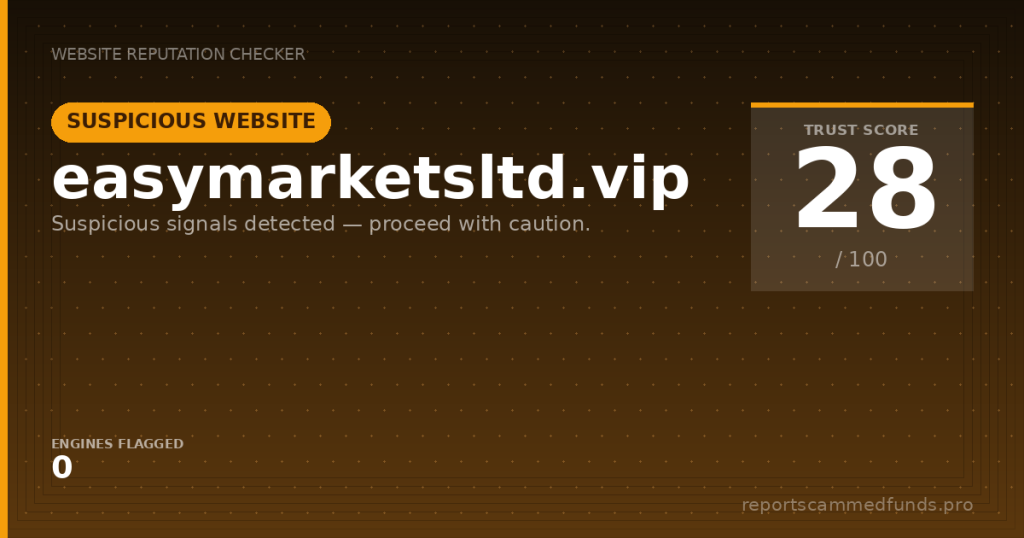
In our technical checks, easymarketsltd.vip did not load consistently, returning connection failures across different networks and time windows. That alone is a significant operational concern; reputable brokers typically maintain enterprise-grade hosting, content delivery networks, and backup domains to ensure continuous client access. A site that cannot reliably load during business hours leaves investors without access to their accounts, balances, or support. The unreliability also prevents any fair evaluation of platform quality, spreads, or fees, which are the core of any trading proposition.
The domain’s naming suggests an intention to be perceived as a trading venue, likely invoking familiarity with the well-known broker easyMarkets. While we could not see live content at the time of review, clone broker sites often deploy generic landing pages that promise tight spreads, “zero-commission” trading, and high leverage alongside buzzwords like STP/ECN. They sometimes advertise access to MT4 or MT5 or feature a browser-based WebTrader, yet the actual execution environment may be a basic white-label front end or even a purely simulated interface. Without real uptime and verified disclosures, users cannot confirm whether any claimed platform exists, let alone whether it connects to genuine liquidity.
Quality problems, when present, tend to show up as vague fee schedules, inconsistent asset listings, and a lack of standardized disclosure documents such as Key Information Documents or order execution policies. Clone operations frequently omit or bury sections like Terms and Conditions, Client Agreement, and Risk Disclosures, or populate them with boilerplate that offers no enforceable rights. It is also common to see excessive sales prompts—bright deposit buttons, pop-ups encouraging “account upgrades,” or promises of one-on-one “account management”—instead of transparent fee and execution detail. These design cues reflect selling rather than service, and they are warning signs in a trading context.
Another hallmark of questionable operations is the overuse of instant-messaging handles, unclear ticketing systems, or Telegram/WhatsApp channels for “premium support,” especially when no corporate phone number with geographic context is provided. A credible financial platform should offer auditable communication channels and dispute pathways, with service-level commitments that correspond to the risk and complexity of trading. In the absence of clear, functioning site components, would-be users of easymarketsltd.vip are left guessing about the most basic aspects: how to open and verify an account, how orders are routed, how fees and swaps are calculated, and how withdrawals are processed.
License & regulatory status
The name “easyMarkets” is associated with a long-established broker that publicly lists its regulated entities and approved domains, such as easymarkets.com, and has authorizations in jurisdictions including Cyprus (CySEC) and Australia (ASIC). We emphasize that the presence of those regulated entities does not automatically extend to every domain using a similar name. In fact, authorized firms typically publish their official domain names on their regulator’s register or their corporate disclosures, and clients are advised to cross-check before engaging. A .vip domain that appends “ltd” is not a known official address of the regulated broker—raising immediate concerns.
We found no verifiable evidence that easymarketsltd.vip is authorized by the FCA, BaFin, ASIC, CySEC, CONSOB, or any comparable authority. When a site suggests ties to a regulated brand but operates on an unrecognized domain, the risk of a clone increases substantially. Clone websites often copy branding and even executive bios to appear genuine, yet they will not appear in the regulator’s register and will typically lack a valid reference number that matches the firm’s official domain list. Investors can and should search the relevant regulator’s database, and look for the precise domain name in any authorized-website listing.
If you encounter badges or logos from regulators on a website, treat them as unverified marketing until you check the primary source. In the UK, the FCA maintains a Warning List and a firm register at fca.org.uk; in Cyprus, CySEC keeps its public register and investor alerts at cysec.gov.cy; in Australia, ASIC Connect can be searched via asic.gov.au. Many clone sites display EU flags, MiFID/ESMA references, or “FCA-regulated” captions while offering leverage or bonuses that are illegal under those rules. A mismatch between claimed regulatory benefits and the site’s offers—such as leverage over 1:30 for retail EU/UK clients—should immediately stop you from depositing.
The presence of “Ltd” in the domain name is itself an indicator worth scrutiny. Legitimate companies certainly incorporate as limited companies, but consumer-facing broker domains rarely include “Ltd” in the URL—and when they do, they typically pair it with full legal disclosures, physical addresses, and regulator links that can be independently confirmed. Absent those elements and with the site not reliably accessible, any representation that easymarketsltd.vip is licensed or connected to a licensed entity must be treated as unproven. Regulators worldwide have warned repeatedly about clone-site scams that do exactly this: borrow a famous name but operate from a different, unregulated address.
User feedback
We searched for reliable, dated user accounts tied specifically to easymarketsltd.vip and did not find credible, verifiable feedback at the time of writing. The lack of a public footprint is not a positive sign in this industry; real brokers accumulate years of forum threads, service reviews, and documented case resolutions. When a domain appears with no traceable history—especially one echoing an established brand name—it suggests a temporary setup that can be abandoned if problems arise. That is consistent with a clone strategy designed to cycle through domains as complaints mount.
Because clone and high-risk brokers exhibit predictable behavior, we believe prospective users should watch for the most common patterns if any contact is established. These include withdrawal blockages after initial profits are shown on the platform; “surprise” KYC demands that follow deposits rather than precede them; claims that additional deposits are needed to unlock or “verify” funds; and pressure from so-called account managers who offer managed trades or guarantees. Reports from other, similar operations often describe platform values that rise until a client asks to withdraw, followed by sudden losses, opaque margin calls, or new fee requirements. Every one of those hallmarks is inconsistent with transparent, regulated practice.
If you have been in touch with anyone tied to easymarketsltd.vip and encountered these issues, preserve all communication logs, bank receipts, wallet transaction IDs, and screenshots of the platform interface. Do not be swayed by messages offering to “recover” funds for an upfront fee; that is a separate recovery-scam ecosystem that preys on already harmed investors. Instead, escalate with your payment provider promptly and contact your national authorities, then consult an independent case-assistance service to structure your evidence. Time matters when chargebacks or transfer recalls are still possible.
Deposits & withdrawals
Given that the site would not load reliably, we could not confirm what funding methods—if any—are accepted by easymarketsltd.vip. In the broader landscape, questionable brokers lean heavily on crypto payments or third-country payment processors because those channels are hard to reverse. If cards or bank transfers are offered, users often discover that the name on the receiving account does not match the brand they thought they were dealing with—a mismatch that should halt any transfer immediately. Absent clear disclosures and reconcilable beneficiary details, depositing is a risk with poor odds of remedy.
Withdrawal friction is the recurring theme in client reports across clone sites. Tactics include asking clients to pay “release fees,” “taxes,” or “anti-money-laundering compliance deposits” before withdrawals can be processed—none of which legitimate brokers require. Another gambit is evoking Know Your Customer obligations only after funds arrive, then declaring documents insufficient and demanding resubmissions for weeks while balances remain in limbo. If you encounter any of these obstacles, do not pay additional fees; that money is almost never returned, and it compounds losses.
A safe workflow for any trading account is to verify identity upfront, confirm the firm’s regulatory status and official domain, deposit a small amount only after those steps, and test a partial withdrawal before committing larger sums. If a site is unavailable, lacks contact clarity, or refuses to provide compliant documentation, step away. Should you have already transferred funds, initiate a dispute with your bank or card issuer and document every interaction; for crypto, move quickly to notify the originating exchange. Do not install remote support tools at the request of any representative, as they are sometimes used to tamper with banking sessions or take screenshots of sensitive data.
Why unregulated brokers are risky
Trading with an unregulated or unverified platform exposes you to uncompensated counterparty risk. Unlike authorized brokers, which must segregate client money and are subject to prudential oversight, unregulated venues can commingle funds and dissolve without consequence. There is no investor-compensation scheme to turn to, no ombudsman with binding authority, and often no identifiable entity to sue. Even if terms exist on the site, they may choose a jurisdiction that renders consumer enforcement prohibitively expensive or practically impossible.
The trading environment itself can be opaque in unregulated setups. Prices may be derived from ill-defined sources, slippage and requotes can be manipulated at will, and conflict-of-interest disclosures—if present—are unenforceable. Promises of negative balance protection or guaranteed stop-loss execution carry no weight absent a regulator to test and enforce them. Some operators even simulate trading via demo-like interfaces that show profits to encourage deposits, then reverse those gains or block withdrawals the moment clients ask for their money back.
There is also a data and identity risk when a site is unstable or unverifiable. KYC document uploads can feed identity theft; phone and email information can be sold to third parties; and device fingerprints can be used to target further fraud. If a domain like easymarketsltd.vip cannot demonstrate control, compliance, and continuity, any sensitive information you submit could be misused. That risk persists even if you never fund an account, which is why avoiding sign-up forms on such sites is prudent.
How to get help if you’ve been scammed
If you already transferred money connected to easymarketsltd.vip, act immediately. For card payments, contact your issuing bank and request a chargeback, citing misrepresentation or non-delivery of services; provide statements, screenshots, emails, and any chat transcripts. For bank wires, ask your bank to initiate a recall or SWIFT trace, noting that speed is vital and success depends on the recipient bank’s cooperation. For crypto transfers, notify the exchange you used and provide transaction hashes; while blockchains are irreversible, exchanges can sometimes flag receiving wallets, and specialized tracing may help build a case.
Report the incident to your national authorities to establish an official record. In the UK, file with Action Fraud at actionfraud.police.uk and notify the FCA if a financial service is claimed; in the United States, submit to the FBI’s IC3 at ic3.gov and consider reporting to the CFTC or SEC if derivatives or securities were involved. In the EU, contact your national regulator and consider econsumer.gov for cross-border complaints. Clear, chronological documentation increases the chances of successful chargebacks and enhances regulator intelligence on emerging clone operations.
For structured guidance, you can request a case assessment from our team at reportscammedfunds.pro. We assist victims in organizing evidence, drafting dispute narratives for banks, and preparing regulator-ready submissions, and we can advise on next steps to avoid recovery scams. We will never cold call you or ask for an upfront fee to “unlock” funds—common tactics of secondary fraudsters. Use only the contact methods published at reportscammedfunds.pro to ensure you are speaking to the right people.
Conclusion
easymarketsltd.vip presents multiple reasons to stand back: a brand-evoking name that does not match the official domains of the regulated broker, an unstable or unreachable website, absent corporate identification, and no verifiable regulatory standing. Those factors, taken together, align with a known pattern used by clone operations in the forex and CFD space. While it is theoretically possible that the domain belongs to an unrelated project or an in-development site, no prudent trader should deposit funds under these conditions.
If you still contemplate engagement, demand hard proof before any transaction: confirm the legal entity name, check the regulator’s register for that entity’s approved domains, and contact the regulator directly if necessary to verify the website’s legitimacy. Call the verified corporate number from the official site of the known broker—such as easymarkets.com if you are specifically researching easyMarkets—and ask whether easymarketsltd.vip is theirs. Only after successful independent verification should you consider risk-limited actions like testing a tiny deposit and immediate partial withdrawal, and even then only if all compliance documents are in order.
Our recommendation is straightforward: avoid sending money or personal documents to easymarketsltd.vip. The current signals are not consistent with a trustworthy trading platform, and better, fully regulated alternatives exist with transparent histories and audited oversight. We will continue to monitor this domain and update our assessment if verifiable information emerges, but for now, caution is strongly advised.