Trading platform & site functionality
Our visit to cryptosz.com surfaced a notably minimal landing experience. The page loads over HTTPS, sets a secure HttpOnly session cookie, and appears to present little or no outward-facing content. There is no obvious menu, no public product explainer, and no detailed terms. The lack of an on-page title and description, coupled with the absence of visible platform screens or pricing tables, suggests either a work-in-progress site or a closed portal only meant for users arriving via direct invitations or private links. That structure, by itself, is not proof of fraud, but it is atypical for a consumer-facing financial service looking to build public trust.
Despite the cryptocurrency-themed domain name, cryptosz.com does not publicly explain what services it provides. There are no stated lists of supported coins or tokens, no fee schedules, no references to liquidity partners, and no information about spreads or slippage controls. Reputable crypto exchanges and brokerages typically disclose at least the basics: supported assets, account tiers, deposit and withdrawal methods, and compliance documents. The absence of those materials prevents meaningful pre-engagement due diligence. For potential clients, this vacuum means there is no way to understand the commercial model or even confirm whether this is an exchange, a brokerage, a wallet service, or a managed-investment pitch.
From a technical perspective, the site is cloud-hosted, uses share-dns nameservers, and serves a small favicon file alongside the main document. We observed no third-party analytics or script bundles loading at the time of capture, which keeps the footprint lean but also deprives users of common trust anchors such as known payment processors or recognized compliance widgets. The certificate was issued very recently and is valid only for a short period, which is common for automated issuance but stands out here given the broader opacity. Put together, these signals point more toward a private portal or placeholder presence than a complete, consumer-ready trading venue.
Some sites intentionally limit public content when they are under development, which can explain sparse pages. However, serious financial services usually keep a basic marketing shell online: company biography, legal entities, risk warnings, KYC/AML summary, customer support contacts, and a link to verifiable licenses. Cryptosz.com offered no such scaffolding when we reviewed it. That absence limits prospective users’ ability to assess platform reliability, learn about platform uptime, or even validate that support teams exist and respond. In our experience, legitimate operators understand that trust is fragile and typically work to earn it with transparent, easily accessible information.
License & regulatory status
We found no explicit claim of authorization by any recognized financial regulator on cryptosz.com’s public-facing page. In many jurisdictions, depending on the precise services offered, a crypto exchange, broker, or custodian must register or be supervised in some form. For example, the UK’s FCA maintains a Cryptoasset Register for firms meeting anti-money-laundering obligations, the EU is rolling out MiCA frameworks via national competent authorities, and the US requires certain activities to be registered or compliant with the SEC, CFTC, FinCEN, or relevant state regulators. A website that omits regulator references or fails to provide a license or registration number makes independent verification impossible.
We checked our tracked sources for public warnings or blacklists and did not find official regulator alerts related to cryptosz.com at the time of writing. This neutrality should not be read as an endorsement: the domain is simply too new for patterns to emerge or for agencies to have conducted investigations. When firms are brand new and lightly documented, they often exist in a gray zone where neither user complaints nor enforcement actions have accumulated. That uncertainty amplifies the importance of operator transparency and verifiable licensing—elements we could not locate here.
If cryptosz.com later publishes a specific license claim (for example, an FCA FRN, a BaFin register entry, an ASIC ACN/AFS license, or CFTC/NFA identifiers), users should independently validate it on the regulator’s official website. Many scam operations either misuse the name of an unrelated regulated entity or present fabricated numbers. Efficient checks include searching the FCA Register (FCA), BaFin’s Company Database (Germany), ASIC’s Professional Registers (Australia), CONSOB’s warnings (Italy), FINMA’s lists (Switzerland), and the NFA BASIC database (US). Absent a clear, verifiable entry in such registers, any solicitation to deposit money should be regarded as higher risk.
User feedback
Because cryptosz.com is an extremely new domain, there is little to no credible public feedback to analyze. We did not identify established review histories on industry forums, reputable review platforms, or mainstream social channels that could corroborate real user experiences. In practical terms, this means prospective customers cannot lean on the community’s track record to gauge trustworthiness. Newness alone is not guilt, but it leaves users without the consumer protection that crowdsourced feedback can provide when a service has been operating for years.
While we cannot attribute specific complaints to this domain, we can outline the most common red-flag themes we see across unverified crypto sites. These include withdrawal blockages after initial profits are shown on-screen, sudden requests for extra tax or compliance payments before releasing funds, surprise KYC obstacles that appear only after deposits, and unresponsive support once users attempt to cash out. Other patterns are boiler-room style pressure tactics over messaging apps, requests to install remote desktop tools, and managed-account pitches that rapidly generate losses. Any appearance of these behaviors should be considered a major warning sign.
If you decide to test an unproven platform despite the risks, insist on a documented, small, reversible trial. Attempt a micro-withdrawal immediately after your first deposit to verify cash-out functionality before adding more funds. Keep all communication in writing and capture full-page screenshots of balances, transaction IDs, and chat transcripts. Legitimate operators will not object to this level of prudence. Conversely, evasive behavior, pressure to switch to crypto-only funding, or demands for unconventional fees to process withdrawals should prompt you to stop further engagement and begin a recovery plan.
Deposits & withdrawals
We did not find clear disclosures of accepted funding methods on cryptosz.com’s public page—no card logos, no wire instructions, and no on-page crypto wallet addresses were visible at the time of review. That opacity makes it impossible to assess the reversibility of potential payments. The funding method matters: card payments can sometimes be disputed, bank wires may be recalled early if your bank acts quickly, and crypto transfers are irreversible once confirmed on-chain. Without published terms on fees, processing times, and withdrawal conditions, users cannot forecast the real cost or reliability of moving money in and out.
Legitimate platforms typically publish a structured payments page: minimum deposits, daily withdrawal limits, fee schedules by method, and identity requirements. They also provide a predictable KYC sequence before accepting funds to avoid post-deposit surprises. If a site accepts a deposit without verifying your identity and later springs sudden KYC obstacles when you request a withdrawal, that is a classic stall tactic. Another recurring theme is the appearance of unexpected ‘tax’ or ‘compliance’ levies claimed to be necessary before releasing funds. Real taxes are not collected by a private platform via ad hoc transfers; they are remitted through formal channels.
Before sending any money, demand the basics in writing: a copy of the terms and conditions, a clear privacy policy, and a help page disclosing contact options and turnaround times. Try support channels with pre-sales questions to test responsiveness. If the only funding option presented is cryptocurrency, be extra cautious—irreversibility is a fraudster’s friend. Should you proceed, use a small amount and prioritize methods with the possibility of a chargeback. Finally, never grant remote access to your device or share one-time passcodes with anyone claiming to be ‘support’ or ‘compliance.’
Why unregulated brokers are risky
Unregulated or unverifiable platforms pose structural risks that go beyond day-to-day price volatility. Without a supervisory authority, there is no obligation for the operator to segregate client funds, maintain minimum capital, or submit to external audits. If something goes wrong, users typically discover there is no ombudsman, no compensation scheme, and no formal path to dispute resolution. Even a well-intentioned startup can fail operationally, and without regulation, customers often become unsecured creditors with little recourse.
In contrast, firms overseen by regulators like the FCA, BaFin, ASIC, or the CFTC/NFA must meet ongoing compliance checks and provide a paper trail that can be audited. While regulation does not eliminate risk, it compels a baseline of accountability: transparent ownership, conflict-of-interest controls, disclosure of risks, and clear client-money handling rules. When a platform provides no licensing pathway and no corporate identity, you are relying entirely on trust with no safety net. That imbalance is especially dangerous in crypto, where transfers are final and pseudonymous.
There are also data protection and identity-theft angles to consider. Unverified platforms may request copies of passports, utility bills, and selfies, claiming KYC needs, yet store them without proper safeguards. If an untrusted operator controls both your funds and your identity documents, the downside multiplies: financial loss plus potential misuse of your personal data. Given the minimal transparency we observed on cryptosz.com, users should assume a conservative stance until the operator offers robust, verifiable assurances and a credible regulatory standing.
How to get help if you’ve been scammed
If you have already deposited money and suspect a problem, act quickly. For card payments, contact your issuing bank immediately to request a chargeback, citing deceptive practices or non-delivery of services if appropriate. For bank transfers, ask your bank to initiate a recall or a fraud report; speed is critical as funds may still be within correspondent banking channels. For cryptocurrency transfers, contact the exchange or wallet provider you used to send funds and ask whether they can flag the receiving address or assist with a compliance hold, though success varies.
Document everything before accounts are closed or content is deleted: download transaction histories, take full-page screenshots of balances and chat logs, and save email headers. Report the incident to your national authority—examples include Action Fraud (UK), the FBI’s IC3 (US), your local police or consumer protection agency, and, where relevant, your financial regulator (FCA, BaFin, ASIC, CONSOB, CFTC/NFA). The more contemporaneous evidence you provide, the better your chances of alerts being shared across institutions and of halting additional losses.
You can also request case assistance from our team at reportscammedfunds.pro. We help victims triage their situation, structure evidence, and coordinate with banks, exchanges, and regulators to maximize recovery prospects. Be wary of ‘recovery scam’ operators who cold-contact you promising guaranteed refunds for upfront fees—this is a common second-wave fraud. Instead, initiate contact yourself via reportscammedfunds.pro, and consider getting an incident reference number from law enforcement to anchor future correspondence.
Conclusion
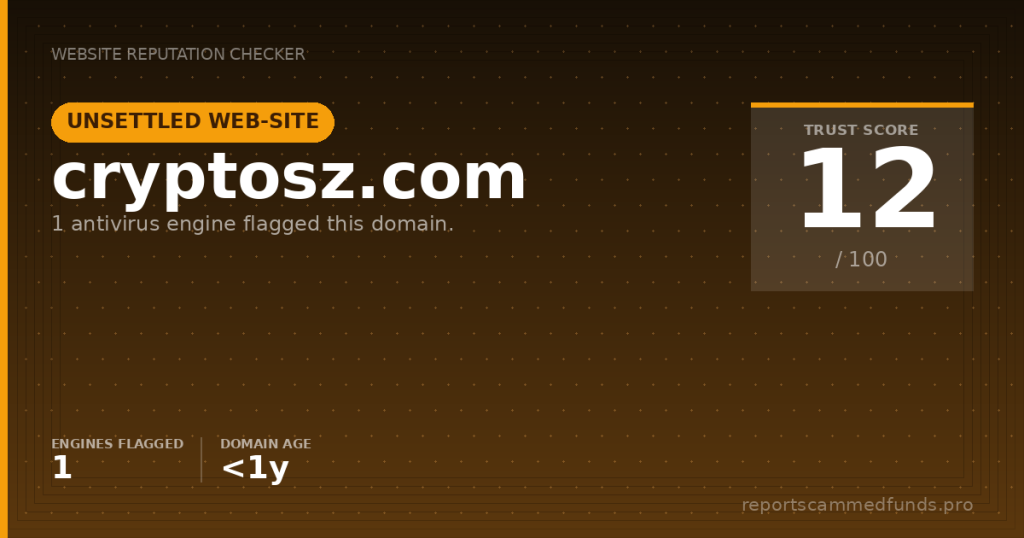
Cryptosz.com is, at best, an underdeveloped and opaque website, and at worst, a vehicle for risk transfer onto unsuspecting users. The domain is brand new, the site discloses no operator identity or licensing, and at least one reputation engine has already marked it as suspicious. Nothing here demonstrates the transparency expected of a platform that could handle client money. Until verifiable details are provided and a public track record emerges, we recommend you do not deposit funds or share personal information.
If you are exploring crypto services, look to established operators with visible leadership, long-standing domains, and verifiable regulatory standings. A legitimate site will publish clear terms, risk warnings, fee schedules, and multiple support channels. It will also withstand basic stress tests such as micro-withdrawal trials and timely support responses. The absence of these fundamentals, as seen on cryptosz.com, is reason enough to stand down.
We will continue to monitor this domain for updates or regulator actions. Should cryptosz.com publish credible compliance credentials and earn a positive user record over time, this assessment may change. For now, the prudent course is to avoid engagement, keep your funds on platforms with meaningful investor protections, and report any suspicious approaches or losses through the appropriate authorities and via reportscammedfunds.pro.