
Trading platform & site functionality
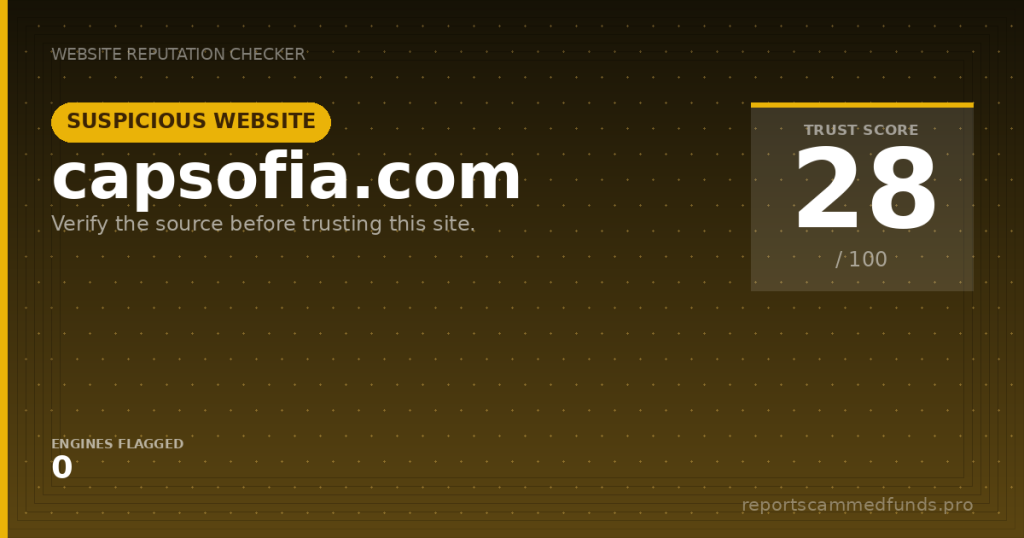
Capsofia.com appears to present itself as an online investing or trading portal, with cues typical of multi-asset brokers. What stands out immediately, however, is the absence of concrete, verifiable details that a serious operator would publish up front—such as a legal entity name, a regulator license number, and a clear summary of trading conditions. The pages we could reference did not provide a comprehensive product disclosure statement or a schedule of fees, spreads, and overnight financing rates. That information matters because it allows prospective clients to compare services and spot predatory pricing or hidden costs before sending money.
A trustworthy trading website generally specifies its platform stack—such as MT4, MT5, cTrader, or a proprietary WebTrader—along with platform versioning, uptime guarantees, and links to download or access the terminal. In CapSofia’s case, we did not find a transparent explanation of the technology, order-execution model (market vs. instant execution), or liquidity providers. Without these details, users cannot determine whether the environment is a true trading venue or a closed simulation that merely mirrors market prices. Legitimate firms also tend to list instrument specifications, contract sizes, margin requirements, and stop-out levels; those key references were not evidently accessible here.
Even if spreads or fees look competitive in promotional copy, the platform’s reliability and operational transparency matter more in practice. We saw no standalone status page, no detailed incident history, and no independent service audits that would help an investor evaluate technical resilience. These gaps make it impossible to assess latency, slippage patterns, and downtime frequency—factors that directly impact trade outcomes and withdrawal timing. When a site expects deposits but offers no auditable service metrics, that imbalance alone should make readers slow down and demand better documentation.
License & regulatory status
Regulatory clarity is the central test for platforms that invite deposits and purport to offer trading or investment returns. CapSofia provides no regulator license number on-page, no Financial Services Register reference, and no specific corporate registration. In our review, we searched for entries in major public registers—FCA (UK), CySEC (Cyprus), BaFin (Germany), ASIC (Australia), CONSOB (Italy), and the NFA/CFTC (US). We did not find a matching listing for “CapSofia,” which suggests that if the firm is operating, it is doing so without transparent authorization or under a different, undisclosed corporate name.
Why does this matter? In the EU and UK, firms that market CFDs, forex, or crypto-derivatives to retail clients must be authorized by a recognized regulator and comply with rules such as client money segregation, negative balance protection, leverage caps, and strict disclosure standards. The absence of a stated license typically means those safeguards are not independently supervised. It also strips clients of recourse mechanisms—such as the UK’s Financial Ombudsman Service or the Financial Services Compensation Scheme—that can be vital when a platform freezes withdrawals or becomes insolvent.
We also looked for any direct warnings by well-known regulators, including the FCA’s unauthorized firms list, BaFin’s consumer warnings, and ASIC media releases, and we did not see an explicit advisory naming capsofia.com at the time of writing. That should not be interpreted as a clean bill of health. Many unregulated sites fly below the radar until complaints accumulate. The burden remains on the operator to publish verifiable licensing details and on prospective customers to confirm them in the regulator’s official database before transacting.
User feedback
A durable way to assess risk is to study long-run user feedback across independent forums and complaint boards, not just the curated testimonials that many sites feature. With CapSofia, there is no visible, consistent trail of verified client reviews on established, third-party venues. That vacuum can simply mean the domain is new or lightly trafficked, but it also removes a critical source of real-world insight. When no pattern of customer experiences is available, prospective users are left with only marketing claims and must assume a higher baseline risk.
Across the industry, common complaints around lightly documented platforms follow recurring themes: surprise KYC requests triggered only after profits are shown, withdrawal blockages citing “compliance checks” that never conclude, and pressure from so-called account managers to deposit more to “unlock” faster processing or bonus conditions. We are not asserting that these issues have occurred at CapSofia specifically; rather, we are underscoring the behaviors that tend to surface when companies operate without clear oversight. If you encounter any of these patterns—especially requests to pay upfront “taxes” or “release fees”—treat them as red flags and stop funding the account.
Another caution point is the manipulation of communications to keep customers engaged and prevent decisive action. Boiler-room style approaches include frequent calls, insistent messaging, and appeals to urgency tied to “limited-time” market opportunities. Users should document every interaction, retain all emails, chat logs, and call records, and avoid giving remote desktop access to any representative. Should a dispute arise, having a detailed record can be decisive when seeking chargebacks or filing reports with regulators and law enforcement.
Deposits & withdrawals
Transparent platforms publish a thorough payments schedule that outlines accepted funding methods, processing times, intermediary fees, and withdrawal conditions, including identification requirements and any limits. We did not find a clear, itemized payments policy on capsofia.com that explains whether they accept cards, bank wires, e-wallets, or crypto transfers. Lack of such disclosure is not just an inconvenience; it can conceal riskier funding channels. Crypto-only deposits, for example, are effectively irreversible, which is why many unregulated operations push customers toward them.
Before making any deposit, request the full withdrawal protocol in writing, including typical timelines, documentary requirements, fee schedules, and the escalation path when deadlines are missed. Be wary of terms that create one-sided hurdles—like vague “security reviews,” undefined “liquidity provider” delays, or clauses that let the company alter fees at will. Good providers specify exact windows (e.g., requests processed within 1–3 business days), name the licensed payment processors they use, and clarify how they authenticate identity in line with data protection laws. Anything less leaves you guessing at critical steps when trying to retrieve your money.
Another industry pitfall is the abuse of “bonuses” or “promotions” to tie up client funds. Some high-risk sites advertise deposit matches, then impose trading volume targets that are almost impossible to meet, using that as grounds to reject withdrawals. If any bonus is mentioned, insist on the full terms before acceptance and consider declining it. Finally, never share copies of sensitive ID documents over unsecured channels, and never consent to remote-device control software—those are often used to initiate transactions or move funds under the guise of “assistance.”
Why unregulated brokers are risky
When a platform is unregulated, your funds sit outside the protective perimeter of financial law. There is no mandated segregation of client money, no capital adequacy requirements, and no licensed compliance officer accountable to a supervisory authority. If the firm decides to freeze your account, impose unexpected fees, or stop communicating, you have limited leverage beyond standard contract law. Even then, pursuing remedies across borders, especially if the operator is offshore, becomes costly and time-consuming.
Unregulated operations also remove the guardrails around sales conduct. Without a regulator’s rules, aggressive upselling and promises of steady, outsized returns can proliferate, often couched in the language of “exclusive signals” or “AI-driven strategies.” This environment is fertile ground for boiler-room tactics and, in the worst cases, pig-butchering schemes—multi-week grooming that culminates in large deposits to opaque platforms. The more a website leans on urgency and insider narratives rather than transparent disclosures and education, the higher the risk to consumers.
Even if a site uses familiar trading interfaces or references market data, that does not ensure fair execution. Trade displays can be simulated, back-end prices can be skewed, and account balances can be modified without independent audit. Licensed brokers undergo periodic checks, adhere to best execution policies, and risk severe penalties for misrepresentation. Without that system, you are effectively relying on trust alone—an approach that rarely ends well in financial services.
How to get help if you’ve been scammed
If you have already deposited with capsofia.com and are facing delays or refusals to withdraw, act quickly. First, contact your bank or card issuer and request a chargeback or dispute, citing the lack of transparent terms and any misleading claims. If you sent a wire, ask your bank about a recall; speed matters here, and results vary. Change passwords reused elsewhere, enable two-factor authentication where possible, and do not send additional funds to “unlock” withdrawals or pay supposed taxes or customs—those are classic advance-fee tactics.
Next, file reports with the relevant authority in your jurisdiction. In the UK, report to Action Fraud and alert the FCA if financial services are implicated. In the US, submit a complaint to the FTC and IC3, and consider contacting your state securities regulator as well as the CFTC/NFA if derivatives were solicited. In the EU, escalate to your national authority under ESMA’s umbrella and, for Germany, BaFin; for Italy, CONSOB; for Australia, ASIC. The more documentation you provide—statements, emails, call recordings—the stronger your case will be with both financial institutions and regulators.
Finally, if you need structured support, our team at reportscammedfunds.pro can review your case, help you map the payment trail, and guide you through next steps. We also warn readers to be extremely cautious of so-called recovery services that contact you unsolicited, claim to have insider access, and demand upfront fees—those are often recovery scams layered on top of the initial loss. Reach us directly at reportscammedfunds.pro, and we will advise on the safest, regulator-aligned recovery routes available in your region.
Conclusion
Capsofia.com currently presents more questions than answers: no public license, no disclosed legal entity, and a thin track record that fails to establish trust. Without transparent trading conditions or a verified regulator standing behind the operation, any deposit would be a leap of faith. We recognize that new businesses can be legitimate but under-documented; even so, the burden lies with the operator to provide the basics that responsible firms publish by default.
Our recommendation is to avoid funding an account until the operator publishes verifiable details and those details are confirmed in official registers. If you remain interested, demand the legal entity name, registration number, and regulator license, then cross-check them on the FCA, ASIC, BaFin, or your local authority’s website. Test with a minimal deposit only after receiving written withdrawal procedures, and validate that a small, same-day withdrawal actually settles to your bank account before increasing exposure.
Safer alternatives exist. Established, duly authorized brokers and investment platforms provide full company profiles, regulator license numbers, audited financials, and robust fee disclosures, along with clear customer support channels. Until capsofia.com reaches that bar, we categorize it as a high-risk proposition and advise readers to proceed, if at all, with extreme caution.