
Trading platform & site functionality
Bityara’s homepage pitches a binary options trading experience for cryptocurrencies, blending gamified elements like tournaments with the promise of auto-trade bots and copy trading. The message emphasizes low entry thresholds (such as small trade sizes) and a roster of mainstream crypto tickers, including Bitcoin and Solana. This presentation aligns with many retail-oriented options websites that prefer a fast, browser-based interface over downloadable terminals. It is important to stress that, unlike spot exchanges, binary options payouts are typically fixed-odds outcomes rather than market-based fills, which demands absolute clarity on the platform’s payout rules and counterparties.
From a technical standpoint, the site loads over HTTPS and is fronted by a CDN, with common third-party assets such as Google Fonts and analytics beacons. The interface appears to be a proprietary web platform rather than a standardized terminal like MT4/MT5, which means execution, charting, and order routing are solely controlled by the operator. That model is not inherently problematic, but it concentrates power and data in one opaque stack. As a result, independent verification of execution quality, pricing sources, and any slippage or latency policy becomes more difficult for a new user to assess.
We searched for openly published details on payout percentages, fee schedules, spread or margin policies, and any maker/taker differentiation, but did not see these set out on public pages before account creation. In the binary options world, the effective ‘fee’ is often the spread between the fixed payout and the true probability of the outcome, and operators frequently act as the counterparty. Without transparent odds, historical payout tables, or proof of external price feeds, it is hard for a retail trader to quantify their expected value. Lack of clear pre-registration disclosures is a notable quality issue when evaluating platform fairness.
The platform also highlights auto-trade bots and copy trading, both highly attractive features to inexperienced users seeking shortcuts. These features can increase behavioral risk—users may over-rely on opaque algorithms or unknown ‘leader’ accounts whose incentives are not disclosed. In mature, regulated environments, social trading comes with explicit disclaimers, risk scoring, and stringent controls, but we did not see equivalent guardrails on Bityara’s public-facing materials. If such policies exist behind a login, their absence on landing pages still represents a transparency gap for first-time visitors.
License & regulatory status
Regulatory context matters greatly here. In the European Union, the ESMA product intervention has imposed a permanent ban on the marketing, distribution, or sale of binary options to retail clients, a position mirrored by several national regulators like the FCA in the UK and CONSOB in Italy. Australia’s ASIC has also restricted binary options for retail clients through product intervention orders. In the United States, the CFTC permits binary options exclusively on regulated designated contract markets, not on offshore websites, which means any retail-facing platform must either be a regulated exchange or refrain from soliciting US clients.
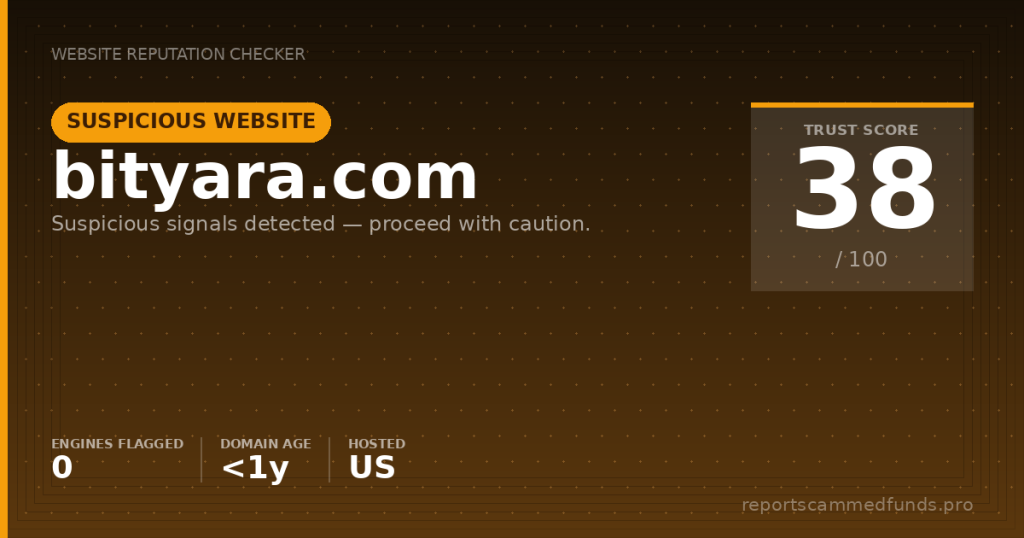
Against that backdrop, we attempted to identify Bityara’s licensing footprint. On the site’s open pages during our review, we did not find a license number, regulator logo, or named legal entity that could be verified on an official register. We searched public registers of the FCA, ASIC, BaFin, and CONSOB, as well as the CFTC’s resources, and found no listing for Bityara. A WHOIS record showed obfuscated registrant fields and indicated South Africa as the country, but these details were masked and could not be independently verified as a regulated corporate entity or authorized provider.
Why this matters is straightforward: if a platform offers binary options to retail users in regions where the product is banned or restricted, the operator could be running afoul of local law and leaving clients without regulatory recourse. It is common for offshore platforms to include small-print statements about excluded jurisdictions while still allowing unrestricted website access or sign-ups from those countries. We did not see a robust, geofenced compliance approach on the public pages, which would typically prevent prohibited users from onboarding in the first place. In the absence of clear, jurisdiction-specific controls, the compliance posture appears weak.
To be precise, we found no official warnings naming Bityara from the FCA, BaFin, ASIC, or other major agencies at the time of writing. However, the absence of an explicit warning should not be interpreted as approval or authorization. Regulators often issue warnings reactively, long after consumer harm manifests. Given the product class (binary options), the lack of disclosed licensing, and the very young domain, the regulatory risk profile remains high regardless of the current visibility of formal notices.
User feedback
Public user feedback is thin, which is not surprising for a domain registered only in 2026. We did not find a sizable body of trustworthy third-party reviews, independent audits, or comprehensive comparisons by established trading communities. Early-stage platforms sometimes lack broad coverage simply because they are new, but the silence also deprives prospective users of the usual red flags and patterns that surface through collective experience. The net effect is an evidence gap that forces you to rely heavily on the operator’s own marketing claims.
Based on recurring themes we track across similar offshore binary options sites, the biggest complaint clusters tend to involve withdrawal blockages after profit, surprise KYC requests only after gains are reported, aggressive ‘account manager’ upselling, and ‘bonus terms’ that impose steep turnover requirements before any withdrawals are permitted. Manipulated price feeds or platform ‘re-quotes’ just before expiry are another frequent allegation among retail traders dealing with unregulated binaries, though those claims are hard to prove without independent tick data and audit trails. We are not asserting that Bityara engages in these behaviors; we are noting the patterns that are common in this sector and should influence your due diligence.
Until there is a track record of timely withdrawals and an audit-ready trail of pricing and settlement data, the prudent approach is to test with the smallest possible sums and scrutinize each step of the funding and withdrawal pipeline. Verify whether identity checks are requested upfront (a positive sign) or only after you have gains (often used to stall payouts). Archive all chats and emails, capture screenshots of trade IDs and timestamps, and do not accept ‘bonuses’ or ‘competitions’ whose terms could later be weaponized to deny withdrawals. In the absence of robust public feedback, your own meticulous documentation becomes your safety net.
Deposits & withdrawals
Bityara’s public-facing materials emphasize crypto trading, and many such platforms default to crypto deposits for speed and lower friction. We did not find a clearly presented list of payment rails (cards, bank wire, e-wallets) on the open pages at the time of review. If crypto is the primary or only funding method, that introduces a substantial consumer-protection gap: blockchain transfers are irreversible, and the operator controls the release of funds unilaterally. Recovery avenues in the event of a dispute are limited compared to card chargebacks or bank transfer recalls.
Another funding risk relates to ‘bonuses,’ tournaments, or promotional credits. On unregulated binary options sites, bonuses frequently come with turnover requirements—sometimes 20–40 times the deposit and bonus combined—that block withdrawals until unrealistic thresholds are met. The terms may also give the platform the discretion to void profits attributed to auto-trade bots or copy-trading signals. If Bityara offers such incentives, be sure to obtain the exact terms in writing and decline them unless you fully understand how they affect withdrawals.
Be mindful, too, of the timing and process for identity verification. Legitimate platforms conduct KYC before allowing deposits or immediately after onboarding, with predictable documentation lists and clear service-level times. Fraud-prone operators often wait until you request a withdrawal—especially after a profitable run—to ask for additional documents piecemeal, prolonging the process until the customer gives up. If you decide to test Bityara, insist on completing all KYC steps early, confirm whether fees apply to withdrawals, and perform a small test withdrawal before committing any meaningful capital.
Why unregulated brokers are risky
Using an unregulated binary options site exposes you to a well-defined class of risks: there is no investor-compensation scheme, no prudential supervision, and no ombudsman process akin to those available for regulated brokers in the UK or EU. If a dispute arises over execution quality or payouts, your leverage is limited to whatever the operator is willing to entertain. In the US, EU, and Australia, authorities have taken strong positions against retail binary options because of these structural risks and persistent consumer harm.
Binary options also embed a structural conflict of interest when the platform is your counterparty, which is often the case offshore. The operator’s economic incentive is to calibrate payouts and house rules so that, over time, the house captures a predictable edge. In regulated markets, exchanges and clearing setups are designed to mitigate these conflicts and require transparent disclosures, surveillance, and complaint handling. In the unregulated space, you have to assume that the house has wide latitude to alter payout schedules, expiry processing, or promotion terms without your consent.
Add to that the risk of boiler-room style tactics—unsolicited outreach, urgent calls to ‘top up’ before special events, and the assignment of an ‘account manager’ whose real incentive is deposits rather than risk management. We routinely see these tactics in complaint files, along with ‘advance-fee fraud’ requests for supposed tax or compliance releases right before a big payout. Even if Bityara is not engaging in those behaviors, the lack of a credible regulator and the marketing of high-risk instruments compound the odds that a retail user faces asymmetric downside.
How to get help if you’ve been scammed
If you have already deposited and are facing withdrawal delays or account blocks, act promptly. Contact your card issuer or bank to request a chargeback or recall if you funded via card or wire, citing misrepresentation or non-delivery of services where appropriate. File a report with your national authority: UK users should notify Action Fraud and the FCA; EU users should contact their national regulator (for example, BaFin in Germany or CONSOB in Italy); US users should report to the CFTC and the FBI’s IC3; Australian users should contact ASIC and ReportCyber. Preserve all evidence—emails, chats, on-platform notifications, wallet addresses, and transaction hashes.
Be extremely cautious with unsolicited ‘fund recovery’ approaches you may receive after complaining publicly. Recovery scams are rampant: the pitch often asks for upfront fees, cryptocurrency ‘retainers,’ or remote desktop access to your computer, then disappears. No legitimate regulator or bank will charge you to file a complaint or to process a dispute. Use only trusted dispute channels and avoid handing over more money to anyone promising guaranteed results.
For specialist guidance, you can reach our team at reportscammedfunds.pro. We triage cases, help you structure your evidence for banks and regulators, and advise on next steps tailored to your jurisdiction and funding method. While no one can promise outcomes, engaging early, avoiding recovery scams, and aligning your documentation to what banks and regulators actually require significantly increases your chances of a successful resolution.
Conclusion
Bityara blends a sleek web interface with marketing that emphasizes crypto binary options, bots, and copy trading, but it lacks the one thing that matters most in this category: verifiable regulatory authorization. The domain is very new, corporate transparency is thin, and key economic terms such as payout schedules and fee conditions are not clearly presented on public pages. Those factors, combined with the regulatory stance against retail binary options in major jurisdictions, position this site firmly in the high-risk bucket.
Our recommendation is to avoid committing funds unless and until the operator publishes verifiable licensing details, lists a real corporate entity you can confirm on an official register, and demonstrates a clean, auditable withdrawal track record. If you still decide to test it, use the smallest possible amount, refuse bonuses, complete KYC early, keep meticulous records, and attempt a small withdrawal first. Treat any profits as unrealized until they settle back to your own bank or wallet.
We will continue to monitor this domain for regulatory updates, user reports, and changes in ownership or disclosures. If you encounter issues, document everything and escalate quickly to your bank, your national regulator, and reportscammedfunds.pro. In environments like this, caution and disciplined verification are not just advisable—they are essential.