Trading platform & site functionality
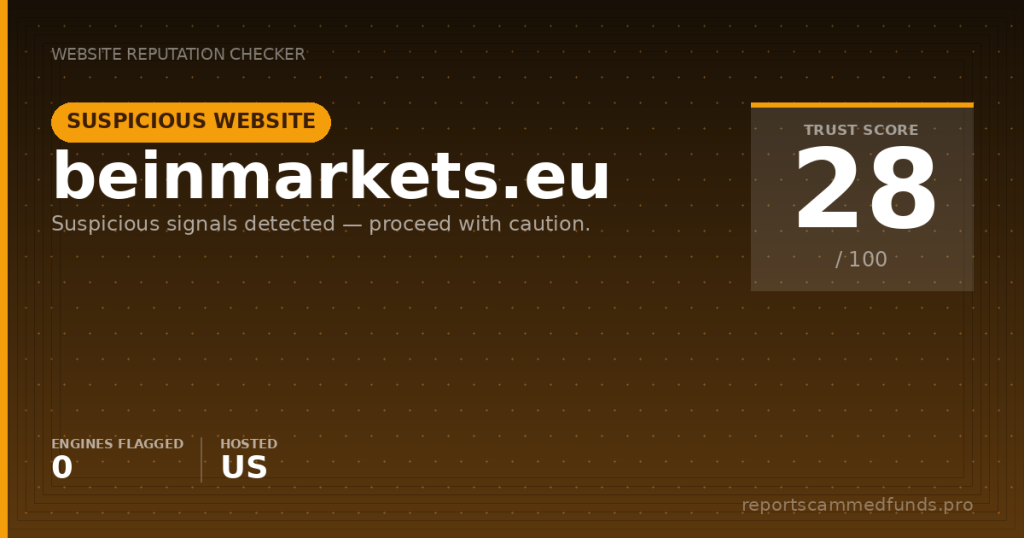
At the time of our visit, beinmarkets.eu did not present a functioning homepage. Instead, it redirected to a standard Account Suspended page (a common cPanel template) that indicates hosting has been disabled by the provider. This sort of disruption might stem from billing problems, migration, abuse complaints, or administrative actions, but whatever the reason, it deprives prospective users of essential facts: what the service is, who runs it, and how the business handles money and data. For a domain whose name implies financial services, that lack of visibility is a critical operational red flag.
The page still loads through a mainstream CDN and includes a small set of static resources, but that doesn’t change the core picture: there is no navigable product, no FAQs, no legal pages, and no pricing or platform information to test. Without live content, we cannot evaluate any platform claims such as spreads, fees, supported instruments, leverage, or execution quality. We also cannot determine whether it intended to offer MetaTrader (MT4/MT5), a web-based platform, or any proprietary interface. That absence matters, because differences in platform controls and order-handling can directly affect pricing integrity and client outcomes.
Critically, the lack of a live site forecloses normal quality checks like latency observations, chart accuracy comparisons, and order-entry reliability tests. In a functioning review, we would compare quotes against multiple independent feeds, open and close micro trades to probe slippage and rejection patterns, and read the legal framework to see how client assets are treated. None of that is possible here. If the operator brings the site back online, they should prioritise clear disclosures: legal entity name and address, regulator licence details, platform documentation, and a transparent schedule of fees and conditions. Until then, the operational picture remains incomplete and risky.
License & regulatory status
If beinmarkets.eu is or was intended to onboard retail clients in the European Economic Area or the UK, it would ordinarily require authorisation by a national regulator (for example, CySEC in Cyprus, BaFin in Germany, or the FCA in the UK) and comply with ESMA rules on leverage, marketing, and client protections. Because the domain is suspended, we cannot view any licence numbers, passporting statements, or the legal name that would allow a precise registry search. We also could not independently verify the operator’s authorisation status from the site itself, which is a material gap for a service that appears markets-related.
We caution that false or ambiguous licensing claims are a known tactic among high-risk broker schemes. Common patterns include using the name of an unrelated, legitimately licensed firm, citing “registration” that is not actually a trading licence, or listing an offshore company while marketing to EEA/UK clients. Legitimate brokers publish a regulator reference number and the exact corporate entity name that corresponds to the regulator’s public register. Absent those specifics, prospective clients have little more than a brand name, which is not sufficient for trust.
As a general rule, investors should verify any authorisation directly on the regulator’s database before depositing. For example, check the FCA Register for a Financial Services Register number (FRN), BaFin’s Unternehmensdatenbank for German entities, CySEC’s list for Cyprus Investment Firms, CONSOB’s registers for Italy, and ASIC’s Professional Registers for Australia. In the United States, retail derivatives activity often intersects with CFTC and NFA oversight; in Canada, check provincial securities commissions. Because the site is offline, none of these regulator cross-checks can be tied to a disclosed legal entity, which leaves a verification vacuum.
We emphasise that our inability to locate verifiable licensing does not by itself prove misconduct, but in regulated finance the burden is on the operator to make those credentials easy to confirm. A suspended site with no visible licence details is the opposite of that standard. Until the operator restores content with clear legal and regulatory disclosures that can be matched on official registers, users should assume they lack the protections afforded by properly overseen firms.
User feedback
With the domain suspended, we could not gather on-site testimonials or review links, and off-site commentary appears limited and inconsistent. That means there is no broad, reliable body of user feedback to weigh against the operational risks. Absence of credible feedback is not proof of bad intent, but in high-risk financial categories it typically shifts the burden toward independent verification and small, controlled testing only after licensing and ownership are confirmed.
Across the wider landscape of questionable trading sites, there are recurring complaint themes that warrant vigilance. These include withdrawal blockages after small accounts show a profit, surprise KYC hurdles that appear after deposit but before payout, unexplained spreads or “overnight fees” that drain balances, and “managed account” schemes in which an assigned agent executes trades that swiftly lead to losses. Some operators also demand prepayment of taxes, insurance, or “unlock fees” before releasing funds — a hallmark of advance-fee fraud that legitimate brokers do not practice.
Another pattern we frequently document is the high-pressure sales cycle: initial contact through social media or messaging apps, promises of unusually high or “risk-free” returns, and increasingly aggressive deposit solicitations once a prospect engages. This can evolve into a boiler-room environment where the caller rotates, urgency is manufactured, and clients are told to ignore banks’ fraud warnings as mere “routine.” If you encounter any of these tactics while dealing with a site related to this brand name, treat them as red flags and pause immediately. These patterns do not accuse a specific operator in this case; they are risk markers repeatedly seen in our casework.
Deposits & withdrawals
Because beinmarkets.eu is not operational, we cannot confirm what payment methods it accepts or how withdrawals are processed. In the retail trading sector, legitimate firms typically accept cards and bank wires under a clearly disclosed withdrawal policy that ties payouts to the original funding method and performs KYC/AML checks. Crypto-only deposit options are a well-known danger sign, because they eliminate standard consumer protections and are difficult to reverse if something goes wrong. If this operator reappears and only offers crypto deposits, that alone should trigger extreme caution.
Even when cards and wires are offered, the fine print matters. Look for explicit time frames for withdrawal processing, fee schedules, and identity verification requirements that mirror those of regulated brokers. Avoid platforms that add invented barriers after you request a payout, such as insisting on upfront “tax” payments to third-party wallets or extra “compliance fees” to be paid outside the normal withdrawal channel. These are classic advance-fee traps that have no place in bona fide brokerage operations.
If you ever test a new, little-known platform following successful licence verification, use the smallest viable deposit and attempt a partial withdrawal immediately after a few low-risk transactions. Document every interaction, save screenshots of dashboards and balances, and keep copies of terms as they appeared at the time of signup. If a withdrawal is rejected or stalled without a valid, contractually stated reason, stop further funding and reassess. Escalate to your card issuer or bank quickly if you suspect misrepresentation or non-delivery.
Why unregulated brokers are risky
Unregulated or unclearly regulated trading platforms expose users to outsized risks that go beyond market volatility. Without a recognised regulator’s oversight, there is no assurance of segregated client accounts, best execution standards, or transparent dispute resolution. Price feeds can be manipulated, orders can be re-routed or rejected without cause, and account closures can occur with little recourse. If something goes wrong, the absence of a supervisory authority leaves clients relying on private negotiation, which is rarely successful once funds have left the banking channel.
Regulation also touches leverage, marketing claims, and capital adequacy — all guardrails designed to prevent the worst behaviours. In the EEA, ESMA rules sharply limit retail leverage and require clear risk warnings precisely because excessive leverage and opaque fees have historically harmed consumers. A platform operating outside these constraints may promise exciting returns, but the cost is the loss of critical protections like negative balance safeguards and supervised complaint handling.
Finally, regulated status is not just about a badge; it is about enforceability. If a broker misuses funds under a recognised regime, clients can escalate to bodies such as the FCA, BaFin, CySEC, or national ombudsman services, and in some jurisdictions limited compensation schemes (like the UK’s FSCS in certain contexts) may apply. With unregulated or unverifiable firms, those routes are either closed or far weaker. That asymmetry is why transparency about licensing and legal identity is a non-negotiable prerequisite for trust.
How to get help if you’ve been scammed
If you have already deposited money tied to beinmarkets.eu or a similarly named operator and suspect wrongdoing, act quickly. For card payments, contact your issuing bank immediately and request a chargeback citing non-delivery of services or misrepresentation; ask that the card be frozen to prevent further debits. For bank transfers, ask your bank’s fraud team to initiate a recall or trace and to file a fraud report on your behalf. Speed matters: the sooner you involve your bank, the better the chance funds can be intercepted upstream.
If you funded via a crypto exchange, open a support ticket with that exchange to flag the transaction as potentially fraudulent and request any available mitigation steps, such as account-level warnings or freezing if the recipient address is known to them. Gather all evidence: emails, chat logs, wallet addresses, transaction hashes, screenshots of the dashboard, and copies of terms at the time of deposit. Do not pay any additional “tax,” “verification,” or “unlock” fees to release funds — those are almost always part of an advance-fee or recovery scam.
Report the incident to the appropriate authority in your jurisdiction. In the UK, file with Action Fraud; in the US, submit a complaint to the FBI’s IC3 and to your State regulator; in the EU, contact your national financial regulator and local police. If the operator claimed a particular regulator’s oversight, include that detail and any licence numbers they provided (even if later found to be false), along with your supporting documents. Official case numbers can assist banks and exchanges in prioritising assistance.
For guided help, you can also reach our publication’s team at reportscammedfunds.pro. We provide case reviews, documentation triage, and reporting guidance and can liaise with your bank or card issuer to frame the dispute based on the strongest available grounds. While no recovery path is guaranteed, organised, timely action significantly improves your odds. Avoid unsolicited “asset recovery” pitches that demand upfront fees — these are common follow-on scams that target victims a second time.
Conclusion
Beinmarkets.eu presents too many unanswered questions to be trusted at this time. The site is suspended, there are no accessible legal or regulatory disclosures, and no reliable body of user feedback to offset those gaps. For a brand that appears to sit in a regulated financial niche, opacity is itself a decisive red flag. Until the operator restores the site and presents verifiable credentials that match official registers, prospective users should steer clear.
If you still encounter the brand elsewhere, do not engage until you can confirm the exact legal entity and regulator reference number on an official database such as the FCA Register, BaFin’s database, or CySEC’s list. Ask for the latest client agreement, the full withdrawal policy, and proof of segregated accounts; verify the published address and directors through independent company registries. If any answer is evasive or contradictory, walk away. No promotion or promised return compensates for the lack of enforceable protections.
We will revisit this verdict if the operator re-establishes service with the necessary documentation and transparent operations. For now, the combination of a suspended domain, missing disclosures, and no verified oversight fits the profile of a high-risk proposition. Treat it accordingly and prioritise your safety by using only clearly regulated, well-documented providers.