
Trading platform & site functionality
On function, algotrading-investment.com operates as a storefront for downloadable trading tools aimed at Forex, stocks, and crypto traders. Product imagery and filenames observed during our visit reference widely known technical analysis concepts such as Elliott Wave, Harmonic Pattern, Volume Spread, Fibonacci analysis, and chart-pattern scanners. We also saw specific product labels (for example, X3 Chart Pattern Scanner, Elliott Wave Trend, Pair Trading Station, and Price Breakout Pattern Scanner) that imply compatibility with MetaTrader (MT4/MT5) and a focus on algorithmic or rule-based approaches. This is a content and software sales site, not a broker: you are buying indicators, expert advisors (EAs), or educational resources rather than accessing a trading account.
Technically, the site runs on WordPress with WooCommerce powering the cart and checkout flow; we could see references to the Enfold theme, the Ivory Search plugin, and the Ultimate Member plugin for user accounts. The site serves assets over HTTPS via a valid Sectigo domain-validated certificate and loads common third-party resources like Google Fonts. The stack is conventional and not inherently risky; countless legitimate businesses use the same architecture. Still, a generic CMS also means due diligence shifts to the operator’s identity, fulfillment history, and the clarity of purchase terms because the technology alone does not confer trust.
From a buyer’s perspective, there are a few functional considerations to weigh. Because this is not a broker, there are no spreads, leverage, or platform fees to compare; instead, the key questions are documentation quality, installation support, compatibility across MT4/MT5 builds, and update cadence when MetaTrader or operating systems change. We did not see version changelogs or a support knowledge base front-and-center on the landing view; these might exist deeper in the site, but they were not prominent. Before any purchase, verify whether the vendor provides post-sale updates, how licensing works (e.g., per account or device), and whether you can test on a demo environment without risking capital. The practical reliability of such tools hinges as much on maintenance and support as on the claimed strategy logic.
License & regulatory status
Regulatory context matters, but it must be applied correctly to the business model. AlgoTrading‑Investment appears to be a software and content vendor, not a broker or an investment firm handling client funds. We did not see claims of FCA, BaFin, ASIC, CONSOB, or CFTC registration, and for a pure software storefront such regulation would typically not apply. Selling a trading indicator or EA does not require a brokerage license, although any implied financial advice or managed-account offering would raise very different compliance requirements.
At the time of our review, we did not find formal warnings about this domain on major regulator portals we routinely check. Absence of a warning is not an endorsement; it often just reflects limited regulator engagement with software-only vendors. If the site targets users in the UK or EU, certain marketing statements could still fall under financial promotions rules overseen by authorities like the FCA or, at an EU level, within ESMA’s guidance framework. Buyers should expect to see standard risk disclaimers such as “past performance is not indicative of future results,” and if those are missing or minimized, it is prudent to ask for them.
We noted imagery referring to the MQL5 ecosystem, which is a third-party marketplace known for MetaTrader tools. If a seller offers the option to purchase through a reputable marketplace account with visible ratings and a transaction trail, it can add a layer of accountability compared to a self-run checkout. That said, marketplace purchases also come with platform-specific terms (including strict refund rules), so you should check where the transaction will occur and what buyer protections apply. If you are pushed to pay off-platform via bank transfer or crypto, treat that as a higher-risk path and step back.
User feedback
Public feedback for niche trading-tool vendors is often fragmented, and that appears to be the case here as well. We did not find a large volume of credible, third-party user reviews that could be independently verified across mainstream review hubs. Self-hosted testimonials on a vendor’s site are common in this segment but cannot be treated as impartial. The relative scarcity of off-site reviews is not proof of wrongdoing, yet it does reduce your ability to triangulate quality and post-sale support.
Typical complaint patterns in this category—speaking generally about trading-indicator vendors—include results not matching backtests or marketing examples, refunds being denied after download on the basis of “digital product delivered,” and slow or template-based support responses when a platform update breaks compatibility. We did not verify these issues for this specific site; rather, we flag them as the most frequent friction points reported elsewhere for similar offerings. If a vendor promises hands-off profits or “guaranteed” outcomes, that is an especially stark warning sign, and you should challenge such claims with requests for verified, broker-stamped statements or at least detailed forward-testing protocols.
Proactive buyers will want to roadmap their own proof steps. Ask for technical documentation and installation guides before purchase, clarify whether the license is locked to a specific MT4/MT5 account number, and confirm how many activations are allowed. Inquire about update timelines when MetaTrader releases new builds, because even small changes in terminal behavior can disrupt EAs or indicators. Finally, test any tool on a demo account first: if a seller discourages demo testing or pressures you into live deployment, that is a practical red flag regardless of how polished the website appears.
Deposits & withdrawals
Because this is a software storefront, you are not making a trading deposit and you are not requesting trading withdrawals. Instead, you pay for a digital download or license and expect delivery, updates, and possibly activation support. We did not see a pre-checkout disclosure of accepted payment methods; WooCommerce setups commonly support cards, PayPal, and Stripe, but you should verify at checkout. If the seller steers you to bank transfer or crypto, keep in mind those rails are harder or impossible to reverse, which tilts risk against the buyer.
Digital-goods refund norms differ from physical retail. Many vendors state no refunds after download or license activation; this is not unusual but it needs to be clearly disclosed before you pay. Look for a published returns policy that covers defective delivery (e.g., corrupted files, nonworking keys) and timelines for support responses. Also check whether download links expire, whether there is a customer portal to re-access purchases, and what happens if you change your MT4/MT5 account or computing environment and need to reauthorize.
Use payment methods with dispute rights wherever possible. Credit cards typically allow chargebacks if a product is not delivered as described, and PayPal has buyer protection subject to its policies. Document everything: save invoices, order confirmations, product pages, and any support correspondence about activation or malfunction. If you cannot get clear answers to basic questions about delivery, licensing, and refund terms before checkout, postpone the purchase until you have written clarity.
Why unregulated brokers are risky
Even though a trading-software vendor is not a broker, the lack of formal oversight still creates practical risk. There is no investor-compensation scheme, no mandated complaint process, and no prudential supervision comparable to what brokers face under regulators like the FCA, BaFin, or ASIC. If the site were to disappear or stop issuing updates, your recourse would depend largely on your payment provider’s dispute rules and any contractual terms on the site itself. This power imbalance is why clear policies, visible identities, and third-party reputations matter.
Another risk dimension in this niche is claims inflation. Some vendors showcase backtests or highly curated forward trades that do not reflect slippage, latency, broker differences, or live-order execution realities. Regulators globally reiterate that “past performance is not indicative” for a reason. Treat marketing charts and screenshots as hypotheses to test, not as evidence you should deploy capital; insist on demo testing and be wary of phrases like “guaranteed,” “risk-free,” or “set-and-forget profits,” which echo boiler-room tropes even when used by otherwise legitimate sellers.
Finally, be mindful of post-purchase pressure. If, after buying a tool, you are urged to buy add-on settings, sign up for a “managed account,” or send funds to an affiliate broker to unlock special parameters, the risk profile escalates quickly. Such upsells can shade into advance-fee tactics or create conflicts of interest. The safest path is to compartmentalize: evaluate the software on its merits in a sandboxed demo environment, decline remote desktop access requests, and never transfer trading funds to entities you have not independently verified.
How to get help if you’ve been scammed
If you already paid and the product was not delivered as described, move quickly. First, contact the site through its published support or contact form and request resolution in writing with a clear deadline. If you paid by card, speak to your issuing bank about a chargeback; if you used PayPal, initiate a dispute within the allowed time window and attach screenshots, invoices, and any correspondence showing non-delivery or misrepresentation. Keep a dated log of every attempt to resolve the issue.
Report the incident to the relevant authority if you believe you were misled or if you suspect fraud. In the UK, file with Action Fraud and, if a financial promotion was involved, notify the FCA; in the US, use the FTC’s complaint portal and the FBI’s IC3; in the EU, contact your national regulator (e.g., BaFin in Germany, CONSOB in Italy) or consumer protection office. These reports help authorities spot patterns across cases even if they do not intervene on individual losses.
For structured guidance and case handling, you can reach our team at reportscammedfunds.pro. We assist readers in organizing evidence, mapping the best chargeback or recovery path, and avoiding secondary “recovery scam” approaches that often target recent victims. Contact us through reportscammedfunds.pro with a concise timeline, proof of payment, and copies of all messages exchanged with the merchant; we will advise on next steps and realistic outcomes based on your jurisdiction and payment method.
Conclusion
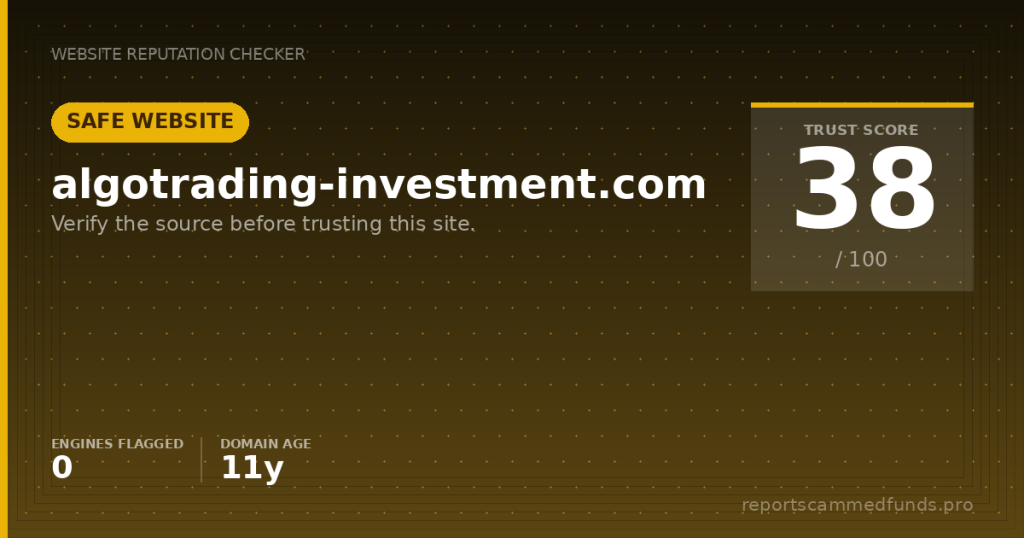
AlgoTrading‑Investment presents as a long-running, malware-free WordPress storefront in a specialized niche: technical analysis indicators and EAs for MetaTrader. The domain has been registered since 2015, HTTPS is in place, and the site’s architecture is consistent with many small vendors. At the same time, company identity is not prominently disclosed, social proof is weak, and refund details for digital goods were not obvious from the landing view. That combination does not equal fraud, but it does call for deliberate buyer caution.
If you choose to proceed, do so on terms that preserve your leverage as a consumer. Pay with methods that allow disputes, insist on seeing refund and support policies before checkout, and test any tool in a demo account before deploying live capital. Consider buying via a reputable third-party marketplace if available, where seller histories and platform-mediated dispute processes can offer an extra layer of accountability. Avoid any request for crypto or bank transfer unless you fully trust the counterparty and are willing to forgo reversibility.
Our bottom line: we do not classify algotrading-investment.com as a scam, but neither do we endorse it unreservedly. Treat it as a moderate-trust, software-only vendor in a high-variance corner of retail trading. If anything about the purchase path feels rushed or opaque, step back and verify independently before you spend.