
Trading platform & site functionality
From the front page, 8xtrade.com behaves like a marketing-led portal for a trading ecosystem built around a browser WebTrader and downloadable desktop applications. A language selector points to a multi-lingual approach (English, Thai, Turkish, Indonesian, Russian, Chinese, and Korean are apparent), and a prominent “Trade” entry routes to a dedicated subdomain that exposes API endpoints. The site uses Google Tag Manager and a Facebook Pixel, which is typical for commercial funnels focused on acquisition and retargeting. The design is modern and responsive, with an emphasis on quick calls-to-action rather than granular disclosures about fees, order types, or risk management tools. For a retail trading venue, this emphasis on marketing over method is a relevant cautionary sign.
Technically, the platform infrastructure indicates a split between a public-facing marketing layer and a separate trading service hosted at trade.8xtrade.com. We observed JSON and GraphQL endpoints referencing assets, features, and countries lists, which suggests the presence of a proprietary backend rather than a pure white-label of MetaTrader. There are also direct update links for Windows and Mac packages from the updates subdomain, a pattern consistent with custom clients. While bespoke platforms can be perfectly fine, they demand higher scrutiny because the defenses and audit trails that come with widely used terminals (e.g., MT4/MT5) are absent or unproven.
The content makes broad claims about asset access—implying CFDs across forex, indices, commodities, and possibly crypto—but it defers key operational details until after registration. We could not locate a public table of spreads, financing (swap) rates, or an execution policy, all of which are essential for evaluating trading cost and slippage risk. Without posted benchmarks, prospective users must accept opaque pricing and hope the in-app terms are fair. In our experience, that asymmetry benefits the broker and leaves the trader to discover adverse terms post-deposit.
Another notable design choice is the strong integration of paid-media tracking, including Facebook remarketing and Google Tag Manager, and external media assets delivered via third-party CDNs. That hints at a performance-marketing strategy rather than an institutionally oriented brokerage model. There is also a link to a marketing-oriented property (fintechfuel.com), reinforcing the sense that acquisition and funnel conversion are priorities. None of this alone makes a business illegitimate—but when combined with the absence of a named, licensed entity and an over-reliance on broad exclusions, it suggests a commercial operation deliberately avoiding regulated markets.
License & regulatory status
On regulatory status, the signals are not encouraging. We found no credible license number or claim to authorization by core retail-investor regulators such as the UK’s FCA, Germany’s BaFin, Australia’s ASIC, Cyprus’s CySEC, Italy’s CONSOB, the U.S. CFTC/NFA, or Canada’s provincial commissions. Instead, the site posts an unusually long list of restricted locations, including the entire European Economic Area (EEA), USA, Canada, Japan, Australia, Israel, and several other jurisdictions. This self-exclusion effectively carves out the majority of regulated retail markets—exactly where a licensed broker would normally be allowed to solicit and service clients.
We conducted registry lookups and cross-checked for the brand or domain in major regulator databases and public warning lists. Our searches did not surface an explicit warning against this exact domain at the time of review, but the absence of a warning is not an endorsement; many unlicensed platforms operate for extended periods before being flagged, and some never are. More importantly, we could not locate an entry in any regulator’s register that ties 8xtrade to a licensed corporate entity, nor did the website provide a company number or corporate registry link that could be verified.
The decision to bar EEA residents aligns with the tighter protections these markets enforce. ESMA product intervention measures cap leverage and mandate risk warnings for CFDs; licensed providers must conform to these standards and publish structured disclosures. When a platform broadly declares it does not serve EEA residents, it is often because it is not authorized to meet those obligations. The same logic applies to the USA, where retail off-exchange leveraged trading is tightly regulated; cutting out the U.S. altogether is common for offshore venues avoiding CFTC/NFA oversight.
Readers should keep in mind that genuinely regulated brokers are explicit about who supervises them. They name the legal entity, provide a license or FRN/AFSL number, and link directly to the regulator’s public record. 8xtrade does none of this on its public pages. Unless and until the operator discloses a verifiable corporate identity and a current, valid authorization from a recognized financial authority, our position remains that it is an unregulated provider and should be treated as such.
User feedback
We looked for credible third-party user feedback across independent forums, consumer-protection boards, and long-running trading communities. There is limited public discussion that we could verify, and no broad consensus from reputable sources that would meaningfully de-risk the platform. A Facebook page exists, but social-media presence and ad campaigns are not reliable substitutes for regulated status, audited performance, or robust client-service metrics. In particular, we could not locate consistent, detailed reviews from experienced traders that validated pricing fairness, execution quality, or withdrawal turnaround times.
The absence of persistent, high-quality feedback does not prove wrongdoing, but it leaves prospective clients without the triangulation necessary to balance the marketing narrative. In cases similar to this—where licensing is absent and marketing is heavy—common complaint themes we have documented elsewhere include withdrawal blockages after profit, sudden KYC escalations post-deposit, requests for additional “tax” or “liquidity” payments before releases, and refusal to honor advertised bonuses unless unrealistic turnover hurdles are met. We are not asserting that 8xtrade specifically has engaged in such practices; we are noting that the risk envelope overlaps with patterns we see repeatedly when authorization and disclosures are missing.
If readers do uncover concrete experiences—positive or negative—we encourage them to preserve evidence. Save chat transcripts, emails, payment confirmations, platform screenshots, and any pop-up or in-app notices with timestamps. That material becomes crucial if disputes arise and can be the difference between a successful chargeback or case escalation and a dead end.
Deposits & withdrawals
Before funding any account, traders should know exactly which payment methods are supported and on what terms. 8xtrade’s public pages do not clearly disclose the accepted options, fees, or expected timelines for deposits and withdrawals. In the retail CFD space, cards, bank wires, and cryptocurrency are common, but each carries different rights and recourse. Without published terms, you are effectively blind to whether there are administrative fees, payout queues, minimum withdrawal thresholds, dormancy penalties, or turnover requirements attached to promotions.
A recurring risk pattern in unregulated environments is the appearance of “surprise KYC” only after a user requests their first withdrawal. That is, identity and source-of-funds checks that should be completed before trading are instead invoked later as a gating mechanism to slow or refuse payouts. Another is the imposition of ad-hoc charges—purported tax clearances or anti-money-laundering certificates—that must be paid prior to release, which legitimate brokers do not demand from retail clients. Because 8xtrade does not publish a transparent withdrawal policy, traders cannot preempt these pitfalls.
If you do proceed, apply strict defensive hygiene. Fund minimally at first, avoid bonuses that create ambiguous turnover obligations, and attempt a small withdrawal early to test the pipeline. Keep all bank descriptors and merchant IDs from your statements. If a platform makes it difficult to remove your own money, treat that as a hard stop rather than a temporary inconvenience.
Why unregulated brokers are risky
Placing funds with an unregulated provider means there is no recognized authority acting as a backstop for mis-selling, platform failures, or custodial misconduct. You lose access to the complaint and compensation frameworks that regulated brokers must honor, such as the UK’s Financial Ombudsman Service or deposit-segregation audits supervised by the FCA. If disputes arise, you are left to the operator’s internal processes—if any exist—and private civil remedies that can be impractical across borders.
CFDs and leveraged crypto products further magnify this exposure. High leverage cuts both ways: it increases your potential for gain but accelerates drawdowns and margin calls, and it demands strict conflicts-of-interest controls so the broker cannot profit from your losses. Licensed brokers are obliged to publish risk statistics, display standardized warnings, and limit leverage; unregulated venues can ignore those guardrails entirely. That asymmetry often translates into poor pricing transparency, aggressive liquidation policies, and one-sided fine print.
Lastly, unregulated platforms are more likely to change terms rapidly—altering margin requirements mid-trade, restricting instruments during volatility, or introducing new fees without sufficient notice. In regulated markets, such changes would trigger supervision and client-notification standards. Without that oversight, your only protection is the initial due diligence you perform before depositing.
How to get help if you’ve been scammed
If you have already deposited and are facing withdrawal delays or pressure to pay unexpected fees, act quickly and document everything. Contact your bank or card issuer to explain the situation and request a chargeback or dispute under the appropriate scheme (e.g., Visa or Mastercard). If you sent funds by bank transfer, ask your bank to initiate a recall or trace and file a fraud report immediately; time is critical for recalls.
Report the incident to your national authority. In the UK, file with Action Fraud; in the EU, contact your local financial regulator or the police cybercrime unit; in the U.S., submit a complaint to the FBI’s IC3 and your State Attorney General; in Australia, report to Scamwatch and, if relevant, ASIC. Include URLs, transaction IDs, wallet addresses if crypto was used, and all correspondence.
For additional help with evidence packaging, escalation strategy, and case preparation, our team can assist. Visit reportscammedfunds.pro to submit your case details; we review documentation, help prioritize next steps, and point you toward the most effective remedy channels in your jurisdiction. The earlier you engage, the better your chances of containing losses and blocking further debits.
Conclusion
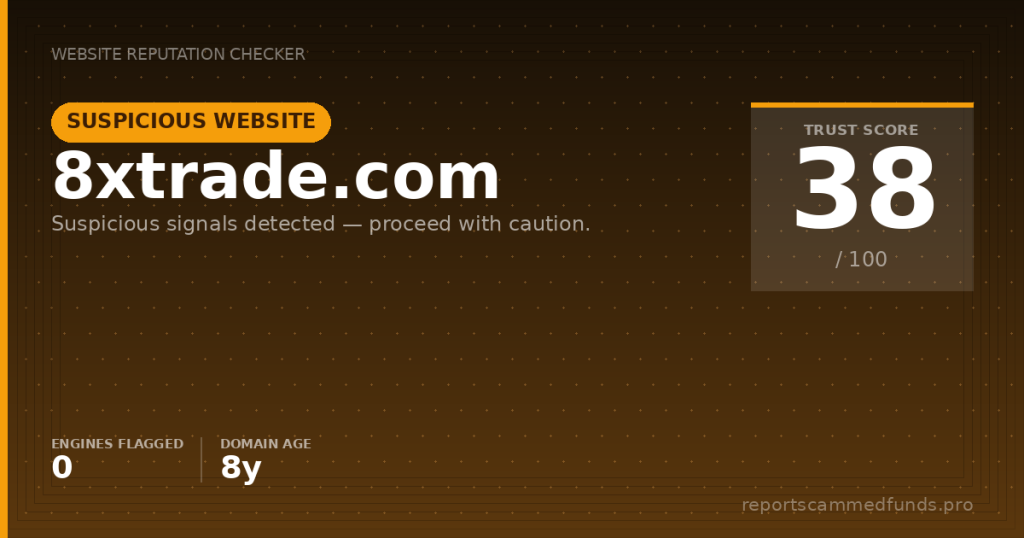
8xtrade.com exhibits some hallmarks of an active operation—TLS, API-driven platform components, and a marketing engine—but it does not meet the baseline transparency standards that a safe broker should. There is no verifiable corporate identity or regulator license, essential trading terms are not posted, and the site self-excludes virtually all tightly supervised markets. Those are not small oversights; they speak to the operating model.
We are not declaring this specific website a confirmed scam. We are stating that, on the evidence available, it is a high-risk venue for retail traders and should be treated accordingly until independently verified licensing and full disclosures are provided. If you are evaluating it despite these concerns, proceed with extreme caution: no bonuses, minimal funding, and a very early withdrawal test.
Safer alternatives exist. Choose a provider that openly names its legal entity, is searchable in the FCA, BaFin, ASIC, or CySEC registers, and publishes spreads, leverage caps, execution policies, and documented client-money protections on its website. Until 8xtrade reaches that standard, our recommendation is to avoid funding accounts here.