Trading platform & site functionality
At first glance, AquilaFX looks like a contemporary fintech landing page. It runs on WordPress and uses Elementor and UiCore Framework components, with embedded TradingView tickers and market screeners for a veneer of real-time data. Navigation leads you through sections on forex, commodities, indices, and a set of account tiers that suggest growing benefits as you pay more. There is also language hinting at MT4 and mobile trading availability, but the site never provides verifiable broker integrations, server details, or a regulated custodian relationship.
A striking piece of marketing copy is placed front and center: “Deposit Now and Get 10% credit cash back directly to your e-wallet in BITCOIN.” That sort of crypto-first incentive is not normal among regulated brokers in jurisdictions overseen by FCA, ASIC, BaFin, or the CFTC, where inducements and bonuses are heavily restricted or outright prohibited. It signals an emphasis on fast funding and reduced friction for withdrawals—reduced, that is, from the operator’s point of view, since crypto deposits are hard to reverse. Importantly, the site never provides a full fee table, clear spreads, or a transparent breakdown of slippage and financing costs across products.
Content breadth is another point worth scrutiny. The site promotes “specialized automatic trading software for all world markets including cryptocurrencies,” a claim both sweeping and vague. We found pages about algo trading, segregated funds, refund policies, and withdrawals, but no independent audit reports, third-party custody attestations, or downloadable policy PDFs signed by an identifiable corporate officer. It feels more like a generalized sales deck built on a standard theme than a fully documented financial service.
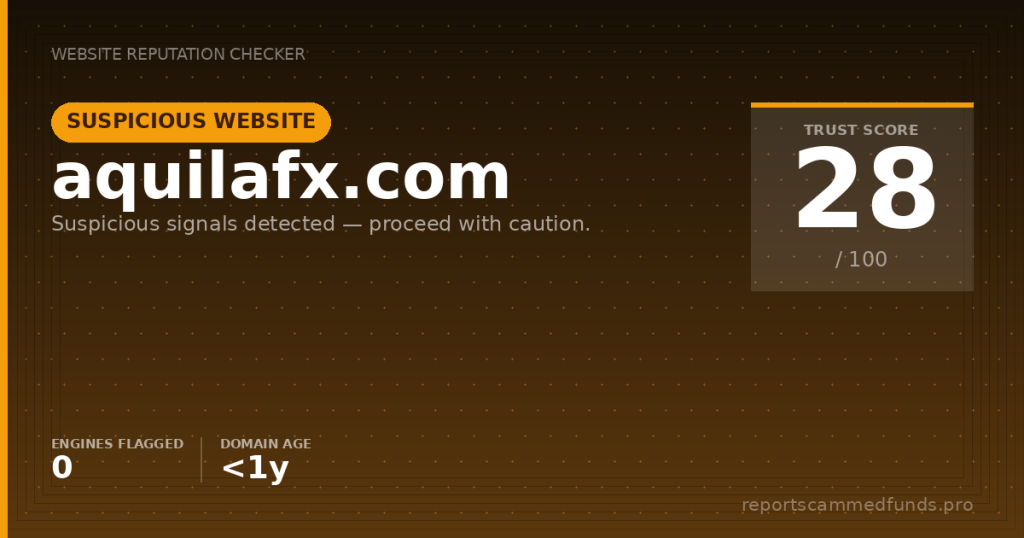
Finally, while the site design is competent, the operational cues are thin. Links reveal a client portal subdomain (client.aquilafx.com), but we could not verify the underlying broker, clearing arrangements, or execution venue disclosures that serious platforms publish. Several assets carry 2022 timestamps even though the domain itself is only from 2025, an inconsistency we see when templates are repurposed or an operator relaunches under a fresh domain. There is no obvious knowledgebase or in-depth legal section—the kind of detail you expect from a genuine, regulated provider.
License & regulatory status
A compliant broker or investment firm will show its regulator’s name, license number, and a link to the regulator’s register. On aquilafx.com, we found no license numbers for the FCA (UK), ASIC (Australia), BaFin (Germany), CONSOB (Italy), FINMA (Switzerland), or any other major oversight body. We also could not find AquilaFX listed in the NFA BASIC database (CFTC oversight in the United States) or any ESMA‑aligned European registers. The omission is critical: if a platform is taking deposits, offering leveraged products, or providing investment services without a recognized license, the legal protections available to clients are drastically reduced.
We note references to “segregated funds” and policy pages that imply best practices. However, a claim on a website is not the same as an audited control environment or a regulator’s sign‑off. Without a specific license identifier, audited financials, and custodian details, there is no reliable way to tie these statements to a real, supervised entity. In properly regulated settings, client‑money protections, reconciliation processes, and capital adequacy are set out in public filings and can be independently confirmed.
In jurisdictions like the UK and EU, inducements such as deposit bonuses or promotions that distort risk-taking are restricted under rules enforced by the FCA and ESMA. A crypto‑based “10% cash back” would likely run afoul of these standards if a firm were under such oversight. The fact that AquilaFX is marketing that incentive while lacking any visible regulator affiliation is telling: it suggests the operator is choosing to work outside those frameworks.
We also saw no regulator warnings specifically naming AquilaFX at the time of review; absence of a warning is not an endorsement. Operators can function under the radar for a time, particularly if they make cross‑border solicitations without local licensing. The safer rule of thumb is simple: if a website promotes leveraged trading or managed/algo solutions and cannot reference a current, verifiable license record on a major regulator’s site, you should treat it as unregulated and factor that into your risk calculus.
User feedback
We searched for credible, large‑sample public reviews of AquilaFX on mainstream platforms and did not find independently verifiable bodies of feedback. That silence on reputable, high‑traffic review venues is a weak signal in itself for a platform purporting to serve global markets. Many legitimate providers have lengthy customer discussions in public forums, transparent social channels, and a track record across multiple review ecosystems.
Patterns in consumer complaints around similarly structured sites often include withdrawal blockages after profitable trades, sudden requests for additional documentation (surprise KYC) only after a withdrawal is requested, the appearance of “maintenance” or “verification” fees that must be paid first, or the migration of conversations to encrypted messaging apps. We cannot assert those specific issues occurred with AquilaFX without direct evidence, but the risk pattern is relevant because the site shares several characteristics—crypto‑first incentives, automation promises, thin licensing—commonly associated with such outcomes.
If you have encountered issues with AquilaFX—missing withdrawals, pushed “upgrade” requests, or contact going silent after deposits—document everything now. Save emails, chat logs, wallet transaction IDs, bank receipts, and screenshots of the account dashboard and T&Cs as they appeared on the dates you acted. A detailed paper trail is essential to maximize recovery avenues and to assist any regulator or bank investigation.
Deposits & withdrawals
AquilaFX’s most explicit funding message is the 10% credit cash back “directly to your e-wallet in BITCOIN,” which strongly suggests that crypto is at least a preferred method, if not the principal one. The site references a “fund your account” page and policy sections, but stops short of publishing a granular list of accepted methods, processing times, and fee tables. That lack of specificity is a problem for consumers who need to understand the chargeback rights (or lack thereof) tied to each method.
Crypto deposits are fast and borderless, but they are also final. Unlike card payments, which can be disputed under card scheme rules, sending Bitcoin or another coin to a wallet address is functionally irreversible without the recipient’s cooperation. If a site then adds layers—like requiring unexpected “release” or “compliance” fees before it will process a payout—the consumer has very little leverage.
A best‑practice platform will publish exact withdrawal steps, maximum timelines, applicable fees, and KYC requirements in one place, together with verifiable corporate identifiers. AquilaFX does not provide that level of operational clarity on‑page. If you cannot confirm withdrawal mechanisms, test a small amount first, and never escalate deposits until you have successfully withdrawn capital and profits multiple times under stated timelines.
Why unregulated brokers are risky
Unregulated trading websites pose structural risks that go beyond everyday market volatility. Without a supervisor like the FCA, ASIC, BaFin, or the CFTC, there is no external check on how client money is held, whether leverage is capped, or whether your orders are executed fairly. Claimed safeguards such as “segregated funds” are unenforceable marketing lines if they are not embedded in a licensed, audited framework.
If an unregulated operator closes accounts, delays withdrawals indefinitely, or introduces invented fees, your recourse is limited. You will not have access to statutory schemes such as the UK’s Financial Ombudsman Service or the Financial Services Compensation Scheme, nor will a regulator compel the firm to remedy mishandling. You are left with private civil avenues, bank disputes if card funding was used, or law‑enforcement reports if there is clear fraud.
The risk amplifies when crypto is the default rail. Because blockchains do not support consumer chargebacks, crypto funding makes it easy for the operator to accept money and hard for you to recover it in a dispute. That is why many scammers push victims onto coins rather than bank cards—once the funds move, they are beyond the protections built into traditional payments.
How to get help if you’ve been scammed
If you have already sent money to AquilaFX and are encountering withdrawal problems or pressure to pay new fees, act quickly. If you paid by card, contact your issuing bank immediately and request a chargeback, citing misleading or unauthorized services as appropriate to your case. Be concise, provide evidence (screenshots, timelines, transaction receipts), and ask your bank for the correct reason codes to maximize your chance of reversal.
If you paid by bank transfer, notify your bank’s fraud team; in some jurisdictions, they can attempt a recall if the funds have not yet been moved on. For crypto payments, gather the wallet addresses, TXIDs, and any communication indicating inducements or misrepresentation. File a report with your national online fraud authority—Action Fraud (UK), IC3 (US), your local police/cybercrime unit—and preserve a case number.
You can also seek tailored guidance through our reporting and recovery desk at reportscammedfunds.pro. We review documentation, help you structure regulator and bank submissions, and advise on next steps to reduce exposure to secondary scams (such as “recovery agents” who ask for upfront fees). Do not pay any “release,” “tax,” or “compliance” fee to an online platform to unlock your own balance—this is a hallmark of advance‑fee fraud.
Conclusion
AquilaFX’s pitch—automated trading across world markets plus a Bitcoin cash‑back bonus—may appeal to newcomers hunting for quick returns. But in regulated markets, inducements like this are curtailed for a reason: they steer users toward risks they do not fully understand. In the absence of a verifiable license, corporate identity, and an auditable operations footprint, the offer is not matched by accountability.
We therefore view aquilafx.com as a high‑risk destination that should be avoided unless and until the operator publicly discloses regulator‑issued authorization that can be confirmed on a major register (FCA, ASIC, BaFin, etc.) and provides transparent, verifiable withdrawal procedures. Even then, test with the smallest possible amount and confirm successful withdrawals before escalating funding.
If you are weighing options today, consider only well‑known, regulated brokers with clear license numbers, published legal entities, and independently reviewed client‑fund protections. Anything less is a bet not just on markets, but on the goodwill of an anonymous website operator.