Trading platform & site functionality
S-group.io is a polished, JavaScript-heavy website that markets itself as a British investment fund. Technically, it runs on a modern front-end stack (Next.js and Webpack) with several third-party analytics and user-observation tools embedded. The site’s public pages emphasize brand identity and high-level “directions” rather than concrete investment documentation, and we observed images referencing Companies House and GLEIF to imply formality. None of that substitutes for verifiable authorisation, audited financials, or independent trustee/custodian arrangements.
The site funnels updates through an in-house “media center” subdomain that returns curated news and events to the main pages. This kind of internal feed can create the appearance of momentum without external validation. There is no independent press coverage linked that would allow a reader to check claims against neutral sources, nor are there named auditors, depositories, or prime service providers disclosed on-page.
A Cloudflare challenge frequently appears before content loads, and the site places multiple tracking cookies, including analytics and behavior-capture scripts. This is common in marketing-heavy funnels, but problematic when paired with a finance pitch that omits regulatory status, PDF disclosures, and fee transparency. Real investment firms typically provide downloadable offering documents, risk factors, and the identities of directors and regulated entities.
On the usability front, there is a lot of aesthetic emphasis—swooping graphics, icons, and skimmable blocks—but little investor-grade substance. We did not find a visible prospectus, terms defining the investment vehicle, performance methodologies, or auditable financial statements. The gap between sleek design and missing governance detail is exactly what we flag in risk assessments of unregulated promoters.
License & regulatory status
In the UK, any firm marketing investments to the public generally requires authorisation by the Financial Conduct Authority (FCA) and must adhere to strict disclosure, conduct, and safeguarding rules. S-group.io does not display an FCA licence number, nor does it link to a specific FCA entry that matches the operating entity behind the website. Our checks did not locate a clearly corresponding firm on the FCA Register associated with this domain. That strongly suggests the operation is unregulated for the services it appears to promote.
It is common for unlicensed promoters to reference Companies House filings or display the GLEIF (Legal Entity Identifier) logo to appear “official.” However, Companies House is a corporate registry, not a financial regulator, and LEI assignments are an identity convention—neither is a permit to solicit or manage investments. A genuine UK investment manager will be authoritatively searchable on the FCA Register and will typically present its FRN (Firm Reference Number), permissions, and ongoing supervisory status.
Across the EU, EEA, and major jurisdictions like the United States or Australia, regulators such as BaFin, CONSOB, AMF, CNMV, FINMA, the SEC, CFTC, and ASIC require authorisation for offering investment products to retail clients. We saw no credible cross-border passporting claims, no MiFID notifications, and no regulator links that could be independently confirmed. If you cannot reconcile a promoter’s claims with a regulator’s official database, the safest conclusion is that there is no licence—and thus no meaningful investor protections.
Finally, authorized funds and managers share essential artefacts: audited reports, depository arrangements, KIDs/KIIDs, and detailed policies for valuation, conflicts, best execution, and complaints. S-group.io’s public pages do not surface any of these core investor documents. The mismatch between the gravity of the claim (“British investment fund”) and the absence of verifiable regulatory underpinnings is a decisive red flag.
User feedback
We could not locate credible, regulator-linked complaints portals or independent ombuds references tied to S-group.io, which itself is instructive: regulated firms must make their complaint handling and escalation routes clear. Public commentary about similarly branded schemes online has alleged pyramid-style structures, blocked cashouts after gains, and “KYC-on-withdrawal” hurdles that appear only when investors ask for their money back. While we cannot verify each anecdote for this specific domain, the themes match what we repeatedly see in unlicensed investment sales.
Other common patterns in unregulated online funds include aggressive referral marketing, promises of above-market stability or returns with little downside narrative, and vague references to bots, quant strategies, or arbitrage that never arrive with third-party audit trails. Users who post skepticism often claim they are met with deflection, selective screenshot “proof,” or conditions that shift once deposits clear. The lack of regulated complaints mechanisms tends to amplify these problems, because there is no mandatory, independent escalation channel.
If you have direct experience with S-group.io—especially around withdrawals, identity-verification demands appearing only post-deposit, or any “upgrade fee” or “tax” required to release funds—document everything immediately. Capture emails, on-site messages, transaction IDs, and full wallet or bank transfer details. Time-stamped evidence is vital both for dispute resolution and, if needed, for reporting to your local financial authority and law-enforcement agencies.
Deposits & withdrawals
The website’s public areas do not clearly state deposit rails, custodial arrangements, or withdrawal timelines. Regulated firms typically disclose where client money is held, under what protections (e.g., FCA CASS, trust accounts), and the exact steps for redemption, including timeframes and fees. By contrast, high-risk promoters often obscure these details until you are inside a dashboard—at which point they may steer clients to irreversible rails such as crypto transfers, or to international wires that are hard to reverse.
A persistent complaint in unregulated schemes is that the rules change at the point of withdrawal. Users report surprise identity checks only after profit, new “release fees,” or claims of “tax” that must be paid up front before any funds are returned—classic advance-fee patterns. None of those demands align with how regulated firms process redemptions, where fees and tax treatments are outlined in formal documents and never require ad-hoc top-ups to unlock your own balance.
If you have deposited, move swiftly. Freeze further payments, record the transaction paths, and contact your bank or card issuer to request a chargeback or recall if eligible. For crypto, contact your exchange immediately to flag the counterparty and request that their compliance unit mark addresses as high risk. The faster you escalate, the better your odds of interrupting the flow to cash-out points.
Why unregulated brokers are risky
When you give money to an unregulated website, you relinquish the core protections that make investment markets survivable for retail clients: audited financials, client asset segregation, conduct supervision, and binding complaint escalation to an ombuds or compensation scheme. You also lose transparency about conflicts, valuation policies, and who truly controls the funds day-to-day. If something goes wrong, there is no mandated cushion between your deposit and the operator’s operating cash.
Regulatory supervision is not just a bureaucratic hoop; it compels firms to document what they do and how they do it, to engage independent auditors, and to answer to a supervisor with sanctioning power. Unregulated promoters can say whatever converts best on landing pages, and then rewrite the rules later. As soon as a withdrawal turns into a maze of new fees and forms, you’re negotiating with a website—not with a supervised financial firm bound by enforceable standards.
Finally, unregulated outfits frequently mix marketing trappings (official logos, charts, buzzwords) with omission—the key facts that would allow you to price risk are simply not there. This asymmetry is the point: the less you can verify, the easier it is to promise anything. The safest posture is to avoid depositing altogether unless the firm appears on the relevant regulator’s register with permissions that match the offer you are reading.
How to get help if you’ve been scammed
If you have already paid S-group.io, act immediately. Contact your bank or card issuer to file a dispute/chargeback and ask whether a recall is possible if it was a recent wire. For crypto, notify your exchange and request that they flag the receiving addresses; some exchanges will liaise with law enforcement if downstream accounts are identified. Preserve every piece of evidence: emails, transaction hashes, screenshots of balances, and chat logs.
Report the incident to your national authority: in the UK use Action Fraud; in the EU contact your national regulator (e.g., BaFin, AMF, CONSOB); in the US report via the FTC and IC3; in Australia alert ASIC. Be clear that you suspect an unregulated investment solicitation and provide the domain, dates, flow of funds, and any correspondence. Serial complaints help regulators identify patterns and trigger warnings or enforcement.
You can also reach out to our team at reportscammedfunds.pro. We assist readers with case triage, documentation structuring, and regulator-aligned reporting steps, and can help you spot and avoid secondary “recovery” scams that often target recent victims. Do not pay anyone who approaches you unsolicited promising instant retrieval; that is a separate fraud category (recovery scam) that preys on urgency and loss aversion.
Conclusion
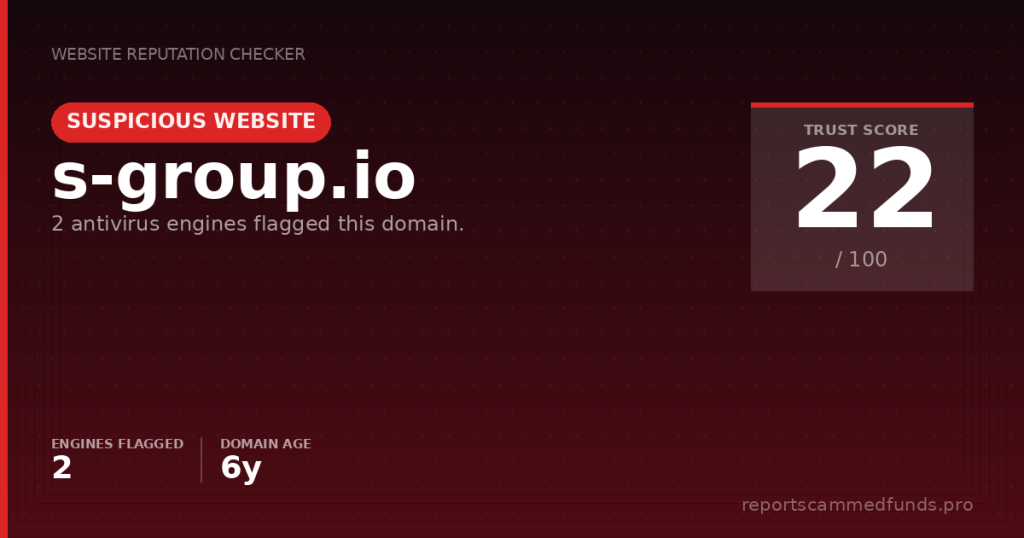
S-group.io checks nearly every box we associate with a high-risk, unregulated investment solicitation: absence of a regulator licence, reliance on official-looking logos, curated internal news, and suspicious reputational signals. The gap between the grand claim (“British investment fund”) and the public evidence-base is too wide to ignore. With no FCA number and no independently verifiable governance documentation, your money would be exposed to uncontrolled counterparty risk.
Our recommendation is straightforward: do not deposit, do not share identity documents, and disengage. If you are still considering involvement, require the operator to provide a regulator’s reference (for the UK, an FCA FRN) and verify it yourself on the relevant register. If the firm resists or tries to divert you with screenshots and slogans, that is your answer.
There is no shortage of regulated, transparent investment options. Reward the firms that do the work of compliance and put real documents on the table. S-group.io does not meet that standard, and the prudent course is to steer well clear.