
Trading platform & site functionality
Visiting quopi.app does not reveal a typical, transparent homepage. Instead, it drops you into a generic “Just a moment…” security screen, which is a Cloudflare challenge page. While large, legitimate services sometimes use this protection to deter bots, reputable financial platforms do not hide basic disclosures, risk statements, or corporate details behind an obstacle course. The net effect is that prospective users cannot openly verify who runs the site, how it operates, or what protections exist before handing over money or identity documents.
The limited code we could observe indicates common web tooling and Cloudflare Turnstile for gating, but little else of substance is accessible without passing the challenge. In practice, this means legal pages, fee schedules, or platform features are not readily reviewable by the public or by independent researchers. That kind of opacity matters; if a firm were regulated, it would typically showcase its license, company number, registered office, and complaints procedures in clear sight. Here, those essentials are either not present or not viewable.
Public references to the Quopi brand elsewhere online frame it as an AI-driven trading or investment tool, often implying hands-off profit generation. We could not independently verify any of those claims, and none were supported by audited statements or named counterparties. When a site that appears to solicit investments refuses to show performance methodology, risk factors, or who is controlling client funds, it becomes impossible for users to assess real-world execution quality. That informational vacuum is not a minor design flaw—it is the central risk.
Quality-conscious and compliant brokers disclose spreads, fees, asset coverage, and execution policies upfront because they are obligated to do so. At quopi.app, none of that is publicly confirmable without first breaching the challenge wall and possibly creating an account. Hiding these fundamentals increases the likelihood of unpleasant surprises later—surprise KYC only after deposit, withdrawal throttling, or punitive fees that were never clearly stated. Taken together, the website’s functionality serves to conceal rather than inform, which is a hallmark caution sign.
License & regulatory status
A cornerstone of user protection is verifiable regulation. We searched for any credible reference to licensing for Quopi across major public registers—FCA in the United Kingdom, BaFin in Germany, ASIC in Australia, and the CFTC/NFA in the United States. We found no listing or license number for a firm named Quopi or a clearly related legal entity. That absence, combined with the website’s refusal to show corporate identity, strongly suggests this is an unregulated operation.
If the site is pitching investments, portfolio management, or trading signals to retail customers, it would generally require authorization in the jurisdictions where it solicits. Under regimes such as the FCA’s in the UK or within the EU’s ESMA framework, marketing high-risk investment products without authorization can trigger enforcement actions and warnings. Unregulated entities frequently migrate between domains, add protective layers to avoid archiving, and withhold basic information—exactly what we are observing here.
We did not see any regulator warnings specific to quopi.app at the time of review; however, the absence of a warning does not equal legitimacy. Supervisors like the FCA, CONSOB, and ASIC routinely remind the public to avoid unlicensed platforms, particularly those dangling automated or “AI” profit claims. Without a clear license, named directors, a registered office, and recognized consumer redress mechanisms, users are left completely exposed should funds be frozen or lost.
User feedback
Because quopi.app itself reveals almost no public content, we analyzed third-party discussions to identify recurring themes. Posts and reviews we observed reference classic pain points: withdrawals becoming difficult after initial profits, sudden KYC demands only after deposits, and support that turns unresponsive once users ask for their money back. While we cannot independently verify each claim, the consistency across separate anecdotes reflects a pattern seen in many unregulated investment sites.
Another repeating storyline involves “account managers” or “advisors” urging larger top-ups to unlock alleged higher-tier returns. Users describe being offered unspecified bonuses that later morph into turnover requirements—conditions that were never foregrounded at the start. This results in an artificial barrier to withdrawals because the user is told they haven’t met the hidden criteria, a tactic routinely documented in boiler-room and high-yield crypto schemes.
We also encountered references to domain-switching and multiple brand surfaces, a common tactic to dilute negative feedback trails. Whether those mentions concern previous iterations of the Quopi brand or simply lookalike sites is not always clear, but the confusion itself benefits the operator. When legitimate firms change domains, they typically announce it formally, update regulatory filings, and maintain continuity of service and complaints handling—none of which is visible in this case.
Deposits & withdrawals
Because the public-facing site is gated and sparse, deposit and withdrawal information is not available for ordinary scrutiny. Unregulated “AI trading” offerings commonly lean on cryptocurrencies for funding, as blockchain transfers are fast, global, and—crucially for scammers—irreversible. When bank cards are accepted via obscure processors, disputes can be more challenging, and users often report that refunds become impossible once the window for chargebacks closes.
Withdrawal friction typically arrives after the user first sees paper profits on a dashboard. Requests sit in “pending” status for days or weeks, then the user is told to pay additional fees, “network upgrades,” or even pre-pay taxes to release funds—an advance-fee ruse that regulators worldwide flag as a hallmark of fraud. Some complainants say that once they pay those extras, a new barrier appears, locking them into a loop designed to extract more money rather than release any.
Transparent platforms post their fee schedules, withdrawal queues, and verification timelines clearly. Quopi provides none of that in public view. The lack of visible terms is not a neutral omission; it preconditions users for asymmetric surprises that are easy to justify after the fact. In our experience, when you cannot evaluate the withdrawal policy before you deposit, the risk of never getting your money back rises dramatically.
Why unregulated brokers are risky
Engaging with unregulated platforms removes virtually all safety nets. There is no prudential oversight, no mandated segregation of client funds, and no compensation scheme like the UK’s FSCS to soften catastrophic losses. If the operator decides to freeze, ration, or refuse your withdrawal, your practical leverage is limited to whatever civil and criminal recourse your local jurisdiction affords—often expensive, slow, and uncertain.
Unregulated sites also write their own rules. Terms can be altered without notice, and novel conditions—minimum turnover, premium unlock fees, or retroactive KYC thresholds—can be imposed at the worst possible moment. Because there is no supervisor like the FCA, BaFin, or ASIC to arbitrate disputes or sanction the firm, the power imbalance overwhelmingly favors the operator. That dynamic is why regulators repeatedly instruct consumers to avoid unlicensed investment providers.
Finally, identity risk compounds financial risk. Scam operators often request passports, driver’s licenses, utility bills, and high-resolution selfies as part of a “compliance” narrative only after users ask for a withdrawal. Those documents can then be abused for identity theft, account takeovers elsewhere, or additional frauds. When a company refuses to prove who they are but demands that you fully unmask yourself, you should walk away.
How to get help if you’ve been scammed
If you already transferred funds to quopi.app, act quickly. For card payments, contact your bank or card issuer immediately and request a chargeback citing misrepresentation or services not provided; be specific and provide screenshots, timelines, and emails. Ask the bank to block further debits to any associated merchant IDs. Do not be deterred by pushback—escalate to a supervisor and keep a written log of every call and outcome.
For cryptocurrency transfers, contact your exchange or wallet provider at once and open a fraud report; while crypto transactions are not reversible, exchanges can sometimes flag or freeze funds when they hit known addresses. Preserve all transaction hashes, wallet addresses, and communications. File a police report and consider notifying national cybercrime units—Action Fraud in the UK or IC3 in the United States—and include every piece of evidence you have collected.
Most importantly, do not pay any “release fee,” “tax,” or “network upgrade” demanded to unlock withdrawals—those are classic advance-fee traps. Report the incident to your national financial regulator, and seek practical recovery guidance from dedicated case handlers. You can also reach our team at reportscammedfunds.pro for tailored help with evidence packaging, bank escalations, and tracing steps. Be wary of unsolicited “recovery agents” who contact you out of the blue; recovery scams target recent victims and can deepen losses.
Conclusion
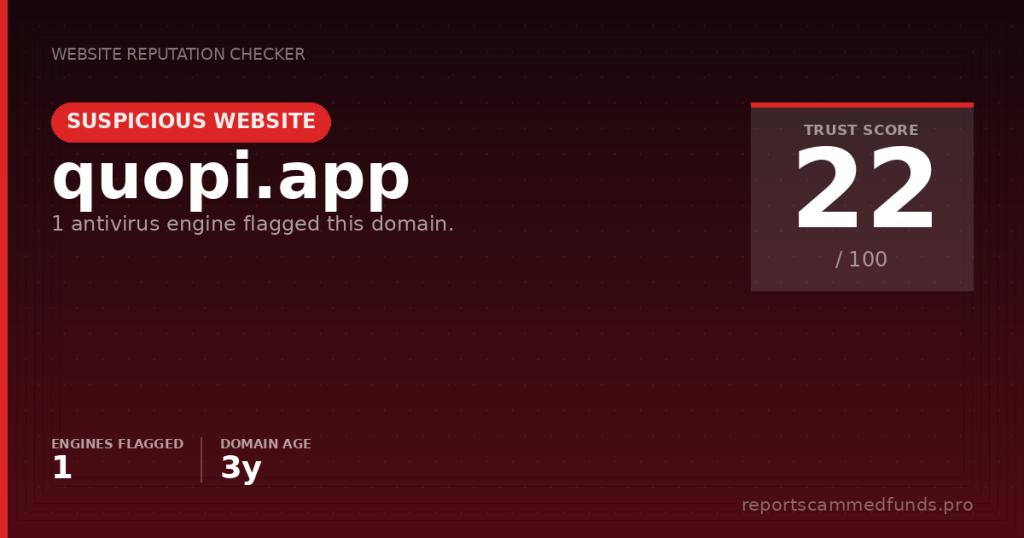
Quopi’s domain is young, its ownership is hidden, its site is cloaked by a challenge page, and no credible regulatory footprint is visible. Pair that with external chatter about AI-driven returns and familiar user-complaint themes, and the risk profile becomes unacceptable. Nothing here resembles the transparency or accountability you should demand before sending funds to an online investment platform.
Our recommendation is unambiguous: do not deposit, do not upload identity documents, and do not engage with upsells or requests for unlocking fees. If you are still tempted, at minimum insist on verifiable regulation (check the FCA, BaFin, ASIC, NFA registers yourself), audited financials, and a full set of public legal pages. Even then, the weight of present red flags would argue for walking away.
Safer alternatives exist with established, well-regulated brokers that publish license numbers, audited disclosures, clear fees, and dependable withdrawal processes. Until Quopi provides verifiable licensing, transparent ownership, and robust consumer protections, treat quopi.app as a high-risk destination. Your best defense is to keep your money and your identity out of its reach.