Trading platform & site functionality
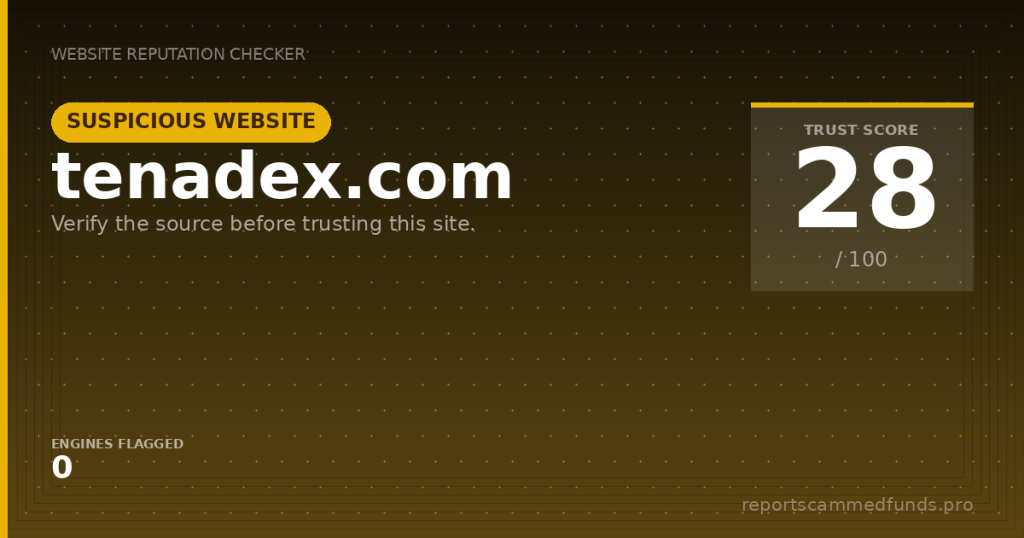
Tenadex presents as a trading or investment-oriented brand, suggested by its name ending in “-dex,” a suffix often associated with exchanges. However, during our review window the website did not load, leaving critical questions about what the platform actually offers. Without access to a live interface, we cannot evaluate whether Tenadex provides exchange services, brokerage accounts, portfolio management, or any form of wallet functionality. In practical terms, that means users have no way to examine the basics: account creation, dashboard design, pricing pages, or order execution features.
Because we could not reach the site directly, we looked for secondary traces: cached pages, archived snapshots, or referenced screenshots elsewhere online. No reliable cache or archive provided enough detail to reconstruct a product offering, user interface, or legal documentation. This absence is notable; legitimate platforms commonly leave a trail of mentions in comparison sites, developer documentation, or community FAQs. The vacuum here—with no verifiable platform documentation and no independent functional descriptions—makes it impossible to assess spreads, fees, asset coverage, or the presence of critical controls like two-factor authentication.
In a regulated financial environment, functionality transparency is not optional. Established trading platforms regularly display compliance badges, detailed fee tables, status pages for service uptime, and mobile app links if applicable, all of which can be cross-checked. None of that was available to confirm for Tenadex. While temporary outages can happen to any site, the combination of inaccessibility and the absence of corroborating materials elsewhere creates a usability and reliability concern that should give prospective users pause. Until Tenadex demonstrates consistent availability and publishes detailed, verifiable information about how it operates, users have no trustworthy basis on which to evaluate its service quality.
License & regulatory status
A credible financial platform must either be regulated where its services are offered or clearly state that it is a non-custodial tool that does not hold client funds. Our checks for Tenadex in major public registers—including the FCA in the United Kingdom, ASIC in Australia, BaFin in Germany, CONSOB in Italy, and the CFTC/NFA in the United States—did not return a listing for this brand. That gap does not automatically prove wrongdoing, but it does mean users do not benefit from investor protection regimes, statutory safeguards, or supervised conduct rules. Without a regulator, there is no capital adequacy oversight, no mandated segregation of client funds, and no formal redress mechanism.
Some offshore operators publish vague or misleading claims about regulation, often pointing to group companies or unrelated entities to suggest legitimacy. We found no clear licensing claims or registration numbers tied to Tenadex, and no independently verifiable corporate entity or address that would allow a reader to cross-check a license. If Tenadex is soliciting clients across borders, most jurisdictions would require authorization to market investment services, even if the core product involves digital assets. The absence of straightforward, checkable disclosures should be treated as a significant risk marker.
We also looked for regulator warnings or investor alerts that might explicitly name Tenadex. None were located at the time of writing among the leading agencies we monitor, but absence of a warning is not assurance—regulatory alerts are reactive and can lag months behind victim reports. In fact, many enforcement bulletins are published only after harm has occurred and investigations have matured. The safest course is to assume that any unregulated, identity-obscured financial brand poses elevated risk until it proves otherwise through verifiable corporate filings and live, consistent regulatory oversight.
User feedback
Public feedback is a crucial cross-check when platform transparency is thin. For Tenadex, we did not find a body of credible, longstanding user reviews that would typically exist for a functioning financial service. Sparse mentions here and there, especially on low-quality blogs or aggregator pages, do not constitute real social proof. The lack of substantive user discussion on reputable forums or consumer-protection platforms means there is little to corroborate claims about performance, support responsiveness, or withdrawal reliability.
In cases where unregulated services have disappointed users, common complaint themes recur: withdrawal blockages after profit, surprise identity-verification demands introduced only at cash-out, and escalating fee or “tax” requests that must be paid before funds are released. We cannot assert that Tenadex follows this pattern, but the combination of inaccessibility and missing disclosures fits the risk profile that often precedes such complaints. When users cannot pre-read the full terms—including the conditions for withdrawals and any fees—disputes are more likely, and the odds of successful recovery diminish.
We also caution readers about the ecosystem of fabricated testimonials and review-padding used by some operators. It is common to see short five-star blurbs with no transaction detail, cloned across multiple domains, sometimes accompanied by stock photos presented as “clients.” If Tenadex begins to surface in such venues without matching, detailed reviews from traceable, long-standing accounts, interpret that as marketing—not proof. Trustworthy feedback typically includes dates, instrument types, withdrawal timelines, ticket numbers, and balanced commentary, not only praise.
Deposits & withdrawals
Because the website was not accessible during our review, we could not confirm which deposit channels Tenadex accepts. Questionable platforms often steer users toward irreversible methods such as cryptocurrency transfers or international wires to opaque beneficiaries, both of which drastically reduce recovery options. Legitimate operators usually support mainstream credit/debit cards through well-known processors, publish exact fee tables, and identify the receiving entity in a manner that matches their corporate registration. None of that clarity is currently available to verify for Tenadex.
Withdrawal friction is where many disputes emerge. Tactics reported across similar cases include repeated “compliance holds,” late-stage KYC hurdles after accepting deposits without proper checks, and demands for advance payments labeled as taxes, security deposits, or liquidity unlock fees. These are classic red flags: legitimate brokers do not require prepayment to release client funds, and taxes are not paid to private platforms. If Tenadex uses ambiguous language around withdrawals or refuses to provide a written, publicly visible policy, that alone should be considered disqualifying for anyone considering a deposit.
A safe testing approach, if you still choose to explore despite the risks, is to avoid transferring any non-recoverable funds and to insist on the full withdrawal policy in writing before proceeding. Verify that the beneficiary name on any payment instruction exactly matches the verified company name and jurisdiction. Attempt small, card-based deposits only with a clear chargeback path and never exceed an amount you can afford to lose. Keep screenshots and correspondence from the very start—a thorough paper trail can make the difference if you later need to dispute a transaction.
Why unregulated brokers are risky
Unregulated platforms sit outside the consumer-protection frameworks that safeguard investors’ money. In the UK, the Financial Services Compensation Scheme (FSCS) does not apply to unregulated crypto brokers or offshore investment schemes. In the US, the Securities Investor Protection Corporation (SIPC) does not cover speculative platforms holding client funds without proper brokerage licenses. If Tenadex is unregulated, deposits could be co-mingled, frozen without explanation, or redirected with little recourse beyond civil action that is costly and jurisdictionally complex.
Jurisdictional opacity compounds these problems. When a platform does not disclose where it operates, which entity holds client funds, or what law governs the contract, consumers face a maze of uncertainty in any dispute. Many such terms include forced arbitration in remote venues, limitations of liability, and broad powers to alter or suspend services at the operator’s sole discretion. If Tenadex later asserts that users agreed to restrictive clauses buried in terms that were never easily accessible, recovery options narrow quickly.
Technical fragility is another risk. Outages, wallet maintenance notices, or “system upgrades” are sometimes cited just when users attempt withdrawals, and communication can go quiet or become circular. In a regulated environment, extended downtime prompts incident reports, status updates, and sometimes supervisor scrutiny. With an unregulated service, there is no external watchdog. The combination of operational opacity and legal non-accountability makes unverified platforms like Tenadex a poor place to park funds you cannot afford to lose.
How to get help if you’ve been scammed
If you have already transferred money to Tenadex or a related payment address, act quickly. Contact your bank or card issuer immediately and request a chargeback or dispute, citing unauthorized or misrepresented services if applicable. For bank transfers, ask your bank to initiate a recall or SWIFT investigation; speed matters, and success is higher the sooner you alert them. Document every interaction with the platform—emails, chats, payment confirmations, and any on-site messages—because this evidence will be essential for disputes and reports.
Report the incident to your local authorities and financial regulators. In the United States, file a complaint with the FBI’s Internet Crime Complaint Center (IC3). In the United Kingdom, report to Action Fraud and consider a notice to the FCA if there was investment solicitation. In the EU, notify your national regulator (such as BaFin in Germany or CONSOB in Italy) and your local police; similar pathways exist in Canada (through your provincial securities regulator) and Australia (ASIC’s reporting channels). These reports help build cases and may support future restitution efforts.
Beware of secondary “recovery” scams that often target recent victims. Fraudsters monitor forums and public reports, then approach victims promising to unlock funds for an upfront fee, sell “chargeback packages,” or claim they can hack wallets. No legitimate authority will demand payment to investigate, and reputable banks do not require a fee to start a chargeback. If Tenadex or any third party asks you to pay a tax or clearance fee to release your balance, treat that as a definitive red flag and do not pay.
For tailored guidance, you can reach our team at reportscammedfunds.pro. We review cases, help structure evidence, and advise on the correct sequence of notifications to banks, regulators, and law enforcement. While no outcome is guaranteed, timely and well-documented action improves your chances. Use the contact channels on reportscammedfunds.pro to share your timeline, proof of payments, correspondence, and any wallet or transaction identifiers so we can assess next steps with you.
Conclusion
Tenadex currently presents as an opaque, inaccessible brand with no verifiable regulatory status or corporate identity. The absence of live site access, corporate disclosures, and independent user feedback deprives prospective customers of the minimum information needed to assess risk. Legitimate financial services survive public scrutiny—unregulated, identity-obscured operations tend to avoid it. Until Tenadex demonstrates continuous availability, publishes full legal and pricing documents, and appears in recognized regulatory registers, we cannot recommend engaging with it.
If you are evaluating Tenadex because of a referral, advertisement, or unsolicited message, step back and insist on objective verification. Cross-check claimed registrations, confirm the legal entity and jurisdiction, and test a withdrawal policy on paper before any deposit. Compare alternatives with clear licensing under the FCA, ASIC, or other top-tier regulators, and read their client agreements before you fund an account. If a platform refuses to provide these details, your decision should be easy: walk away.
Your capital deserves the protection of transparency and accountability. In our judgment, Tenadex has not met that bar. Treat it as high risk and avoid depositing funds unless and until it provides verifiable proof of regulation, ownership, and operational reliability. If you have already engaged and are facing obstacles, follow the help steps above and contact reportscammedfunds.pro for assistance.