Trading platform & site functionality
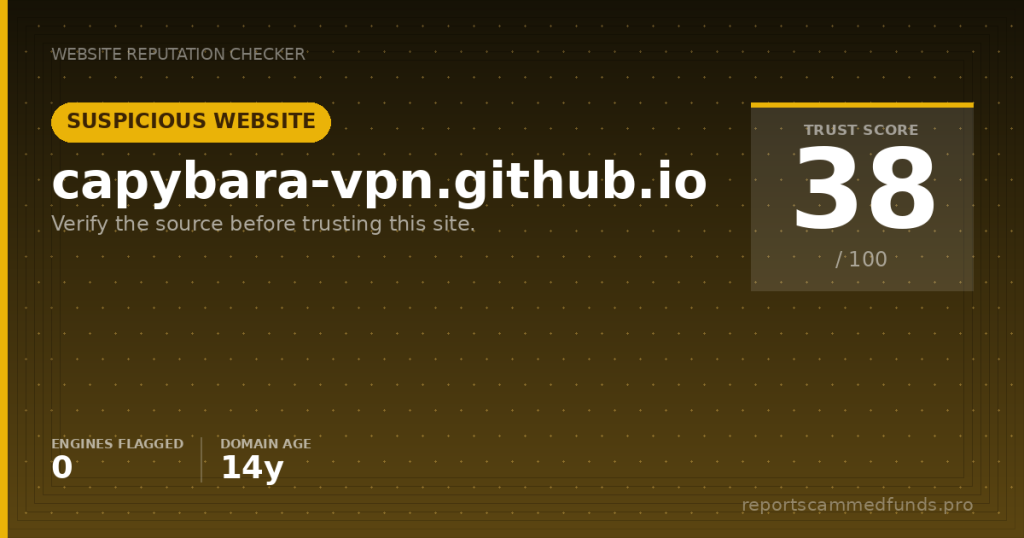
Capybara VPN’s site is a simple static landing hosted on capybara-vpn.github.io, presented predominantly in Russian. The page copy promotes VPN access “from 249 ₽” with “38 locations” and a “one-day free trial,” and references the VLESS protocol, which is commonly associated with modern proxy/VPN stacks. Technical fingerprints indicate the site uses a static site generator (Astro), which is typical for lightweight promotional pages but offers no built-in account portal or billing dashboard. The flow described suggests account delivery or configuration through Telegram or a browser link, rather than a traditional customer area tied to a proprietary domain. That can work for hobby projects, but for a paid VPN it leaves questions about persistence, service management, and continuity if a Telegram channel is removed or rebranded.
From a user‑experience standpoint, the pitch is straightforward: a low‑cost, quick‑to‑start VPN with multiple locations and modern protocols. However, beyond marketing lines, we do not see clear feature matrices, speed test results, or independent performance benchmarks that reputable VPNs often publish. There is no visible client software catalogue for major platforms, which suggests the service likely distributes configuration profiles rather than full‑fledged apps. Configuration‑only delivery is not inherently bad, especially for advanced VLESS/WireGuard/OpenVPN users, but it increases the burden on the customer to trust the configuration source and keep it updated. For less technical users, that often leads to support dependency on private chats or instructions delivered via messaging apps.
A commercial VPN offering typically includes a privacy policy, logging statement, and some articulation of security posture such as audits, warrants canaries, or infrastructure notes. On this GitHub‑hosted landing we did not see those staples documented or linked in a way we could verify independently. We also could not identify a status page, uptime metrics, or API endpoints for subscription management, which are increasingly standard for serious providers. Without those, it is difficult to anticipate maintenance windows, incident reporting, or service degradation communications. Users are left to rely on Telegram posts or one‑to‑one messages, which can be missed or selectively delivered.
Pricing and trials are attractive on paper, and the free day may help some users test connectivity from restrictive networks. Still, trials delivered over informal channels can become bait for upselling or pressure to prepay longer terms without a robust refund pathway. We have also seen cases across the broader VPN market where entry‑level plans throttle bandwidth or limit key locations, prompting users to pay more to unlock what was implied in the marketing. None of that is proven here, but the absence of a transparent, hosted plan comparison with clear limitations is a quality gap worth acknowledging. In short, the site promises convenience and low cost, but the supporting infrastructure for a durable, well‑supported privacy service is opaque.
License & regulatory status
Unlike brokers or exchanges, VPN providers are generally not subject to financial regulation by bodies like the FCA, BaFin, ASIC, or the CFTC. Accordingly, we found no license claims on the site, and none would be expected for offering encrypted tunneling or proxy services. That said, consumer protection and data protection laws still apply in many jurisdictions, including requirements to disclose a legal entity, address, and a privacy policy explaining data handling. The Capybara VPN landing does not clearly present these disclosures in a way we could independently verify, leaving users to accept opaque promises about logging and data retention. For a service that will carry your browsing traffic, anonymity claims without accountable ownership are a critical gap.
We did not find warnings about this specific domain from financial regulators such as the FCA, CONSOB, BaFin, ASIC, FINMA, or ESMA. Again, that is not surprising given the non‑financial nature of the product. However, in countries with stringent telecom or VPN oversight, operators sometimes require registration or must comply with specific data localization or interception laws. The site provides no indication of such compliance or exemptions, nor any jurisdictional statements that would clarify where the operator is based and which legal framework governs the service. Absent that, users cannot know which courts or regulators would even accept a complaint if a dispute occurs.
Another dimension is cross‑border compliance. VPN usage can intersect with content distribution rules, sanctions regimes, and local restrictions on encryption tools. Responsible services typically publish acceptable use policies and explain how they handle lawful requests, DMCA notices, and abuse. We did not see these details on the GitHub page, and if they exist only within Telegram or ephemeral channels, that is problematic—terms conveyed in private chats can be altered without leaving a discoverable record. For customers, a lack of published, versioned legal documents increases the risk of sudden enforcement or account termination with little recourse.
Finally, false affiliation is a known risk in this sector: some pages imply ties to open‑source projects or infrastructure vendors to borrow credibility. Our review found no explicit false claims of affiliation with major regulators or household brands on this page. The principal risk here is not an overtly fake license claim, but the absence of any corporate credentials at all. With no public corporate identity, users are effectively buying a privacy service from an anonymous operator, which undermines trust in any “no‑logs” or “secure” assertion those same operators make.
User feedback
We searched for independent user reviews and structured feedback tied to “Capybara VPN” and this exact subdomain but did not locate a robust, verifiable review trail. Telegram‑centric services sometimes show testimonials within channels, but those are not a substitute for third‑party platforms where dissatisfied users can also be heard. Without a stable footprint on impartial forums or consumer review sites, prospective buyers must evaluate the offer largely on marketing claims. That imbalance is a classic environment for buyer’s remorse if performance or support fails to meet expectations. It also means there is little historical signal to judge uptime, stability, or response to incidents.
Common complaints across similar small‑footprint VPNs include servers disappearing without notice, credentials expiring early, or throttling after initial speed tests. Users also report support “ghosting” once payment is sent—especially when payments occur through messaging apps or manual transfer. While we cannot attribute such issues to this site without direct evidence, the risk profile is comparable given the absence of a public ticketing system, SLA, or company details. If your access depends on one Telegram contact or bot, an account ban or channel deletion can instantly sever support lines. That fragility is a recurring theme in consumer complaints about ephemeral VPN brands.
Another frequent pain point is refunds. Customers may be promised “no questions asked” refunds in chat, only to face silence when requesting one, or be told to accept service credits instead of money back. Refund eligibility windows, if not written into a timestamped, hosted policy, become a moving target that favors the seller. In our review, the landing page does not provide a verified refund policy or dispute process, making it difficult to assess how disagreements would be resolved. A credible vendor usually posts those details prominently and uses a payment processor with clear chargeback provisions.
Some users of small VPNs also complain about configuration security: receiving profiles with hard‑coded DNS, expired certificates, or proxies that expose real IPs under certain conditions. When configurations are delivered over Telegram or one‑off downloads, there is no guarantee of integrity checks, signing, or changelogs. Again, we cannot say this happens with Capybara VPN, but the delivery model implied by the site increases the chance of misconfiguration. For privacy tools, configuration mistakes are not just inconveniences—they can expose browsing history, reveal locations, or break geo‑sensitive services in ways that are hard to diagnose. That risk is worth weighing against the low advertised price.
Deposits & withdrawals
As a VPN, this service would typically operate on subscriptions rather than deposits or trading balances. The site copy mentions pricing “from 249 ₽” and a “one‑day free” period, but it does not clearly describe payment methods on the landing page we reviewed. Where onboarding occurs through Telegram, payments often route through manual card transfers, vouchers, or crypto, each with very different consumer protections. Card payments through reputable processors offer the strongest chargeback rights, while crypto is effectively irreversible and attractive to bad actors. Before paying, confirm the exact processor, obtain an invoice with the legal entity’s name, and avoid opaque peer‑to‑peer transfers.
Withdrawal in the traditional sense does not apply, but refunds and cancellations do. Without a published, versioned refund policy, you risk being denied a refund even if you cancel within what you assumed was a trial. Always look for a timestamped refund policy and cancellation instructions hosted on a domain controlled by the vendor, not solely inside a chat. If such information is only available via Telegram messages, take screenshots and export chat logs so you have evidence of the terms at the time of purchase. That documentation becomes vital if you later need to dispute the charge with your bank.
If the operator requests payment in cryptocurrency or through a non‑traceable channel, that is a significant red flag for a consumer service of this nature. Even when crypto is accepted for privacy reasons, reputable vendors often provide parallel card options with proper receipts. If you proceed with a card, ensure the merchant descriptor visible on your bank statement matches the service name, and check whether recurring billing is enabled by default. Turning off automatic renewals immediately after initial purchase can prevent unwanted charges while you test performance during the trial.
Finally, consider whether you can self‑serve account changes or cancellations through a dashboard, or if you must rely on a Telegram admin to do it for you. Reliance on a single contact to cancel means you could be billed again if that contact is unreachable or uncooperative. A proper customer area should let you view your next billing date, modify plans, and terminate service without having to plead your case in a chat. The absence of such controls is not proof of wrongdoing, but it is a risk factor that increases the difficulty of recovering funds or ending the relationship cleanly.
Why unregulated brokers are risky
While a VPN is not a financial platform, trusting one places your internet traffic in the hands of the operator, who can technically see connection metadata and, if misconfigured, more. Without regulation, the only real safeguards are the provider’s transparency, technical competence, and accountability. Anonymous or minimally disclosed operators may promise “no logs,” but those statements lack weight if there is no legal entity to hold accountable. Audits by independent security firms, warrant canaries, and clear data minimization practices are the industry’s informal checks; we did not find evidence of such measures here. That means you are relying on trust rather than verifiable controls.
Another non‑financial but critical risk is service continuity. Free hosting and Telegram‑based management are inherently fragile—GitHub Pages can be taken down for policy reasons, and Telegram channels can be banned, hijacked, or abandoned. If that happens, your paid access could vanish overnight with no recourse beyond hoping the operator resurfaces under a new handle. Established providers mitigate this with multiple support channels, dedicated domains, and a history of handling incidents transparently. In the absence of these, customers shoulder more risk for outages and operational turnover.
Payment security is also at stake. If you are led into off‑platform or peer‑to‑peer payments, you lose the benefit of structured dispute resolution that comes with reputable payment gateways. Many small VPNs are honest but lack the infrastructure to manage payments properly; others intentionally avoid traceable processors to make refunds difficult. Either way, hidden or improvised payment flows complicate your ability to recover funds if the service underperforms. This dynamic can mimic patterns seen in advance‑fee frauds, where the barrier to getting your money back is the point.
Lastly, the privacy paradox deserves mention: using a VPN to increase privacy can reduce privacy if the VPN is untrustworthy. A poorly run or malicious operator can inject ads, tamper with DNS, or resell traffic patterns. Even if none of that is happening here, the lack of disclosed ownership and independent oversight increases the theoretical risk profile. In high‑risk environments or for sensitive work, it is often worth paying more for a provider with a public track record, clear legal entity, and third‑party validation of its no‑logs claims.
How to get help if you’ve been scammed
If you have already paid Capybara VPN and feel misled or cannot access what was promised, act quickly and document everything. Save invoices, payment confirmations, chat transcripts, and screenshots of the offer and any refund terms you were shown. If you paid by card, contact your bank or card issuer immediately to request a chargeback, citing “services not as described” or “non‑delivery.” Banks often ask for a timeline of events, so having clear records strengthens your case. Avoid further payments or negotiation over irreversible channels while your dispute is in progress.
Where payment was made by bank transfer and it is very recent, ask your bank about recalling the transfer; success depends on speed and the receiving bank’s cooperation. For cryptocurrency payments, recovery is difficult, but not entirely hopeless if law enforcement engages and the counterparty used traceable exchanges. File a report with your local consumer protection authority and, where applicable, with cybercrime reporting portals (for example, IC3 for the United States or Action Fraud for the United Kingdom). Include the domain, Telegram handles, wallet addresses, and any linked emails. Cross‑border services complicate jurisdiction, but documented complaints help establish patterns.
You should also alert the platform hosts if relevant. For a GitHub Pages site, you can report policy violations to GitHub support, especially if you suspect terms or billing abuses that contravene platform rules. If interactions occurred through Telegram, use the in‑app reporting tools to flag abusive bots or channels, though results vary. The goal is to reduce the operator’s ability to repeat the conduct with new victims, even if it does not immediately recover your money. Keeping a written log of your escalation steps and responses you receive creates a coherent record if the case later reaches mediation.
If you need structured help, contact our team at reportscammedfunds.pro for case assessment and next‑step guidance. We can help you triage payment options, prepare an evidence bundle for your bank, and route reports to the right authority. We also warn clients about “recovery scams,” where someone contacts you promising quick refunds for an upfront fee—do not pay anyone who cold‑contacts you with such offers. Instead, verify all outreach independently and use only trusted channels you initiate yourself. Our investigators can outline a safe escalation plan that avoids throwing good money after bad.
Conclusion
Capybara VPN’s proposition—low price, quick setup, and modern protocols—will appeal to users who simply want a fast way around restrictions. However, the use of a free GitHub Pages subdomain, reliance on Telegram for onboarding, and lack of visible corporate identity or legal documents materially increase risk. We did not detect malware or phishing, so this is not a clear-cut malicious operation. But as a commercial privacy tool, it falls short on transparency and accountability compared with industry norms.
If you are considering this service, slow down and verify the fundamentals before paying. Ask for the full legal name of the operator, registered address, and a timestamped privacy policy and terms of service hosted on a controlled domain. Confirm payment methods and refund procedures in writing and prefer card payments through reputable processors for the ability to dispute charges. Demand clarity on logging policies, supported platforms, and how support is delivered if Telegram goes offline.
In the absence of satisfactory answers, it is prudent to look for alternatives with established reputations, third‑party security audits, and a support model that does not hinge on a single messaging channel. The promise of a one‑day free trial and low monthly fee should not override the long‑term risks of entrusting your traffic to an anonymous operator. Our bottom line: Capybara VPN is not conclusively a scam, but it carries enough red flags to warrant caution. Do your due diligence, and do not pay unless you are fully comfortable with the identity, policies, and payment protections in place.