
Trading platform & site functionality
Weibo.com functions as a large-scale microblogging platform where users publish short posts augmented by images, video, and links. The experience centers on a home timeline, trending topics, and comment threads, with well-known public figures and brands operating verified accounts. Search is robust but can feel constrained to non-logged-in users, and certain topical results may be de-emphasized depending on locale and policy. The interface is primarily Chinese-language by default, with pockets of English in the help center and select corporate pages. Mobile apps provide the most complete experience, though the web interface remains fully capable for posting and account management.
Account creation typically requires a mobile number, and in many cases real-name verification is encouraged or required to unlock features, which aligns with Chinese internet regulations. Two-factor authentication is available via SMS, and login can be bound to email or phone for recovery. We observed Weibo’s proprietary short-link behavior on outbound URLs, which helps the platform manage spam but also obscures destination domains unless you preview carefully. Media hosting is integrated, and the network is optimized for high-volume content flow across hashtags and "Super Topics" communities. The platform supports verified badges for public figures, media outlets, and brands, giving audiences a surface-level signal to distinguish authentic voices from impersonators.
Weibo also incorporates an advertising stack for promoted posts, brand takeovers, and influencer collaborations. Businesses and creators can manage campaign budgets inside dedicated dashboards, subject to identity checks and compliance rules. Because adverts and promoted content blend into the feed, users should practice standard ad hygiene by expanding profiles, checking verification details, and avoiding external forms that ask for sensitive information. The ad system is an important part of Weibo’s business model, but third-party abuse can occur when scammers attempt to slip through policy filters or impersonate official customer service. As with all platforms that monetize at scale, enforcement is a continuous process rather than a solved problem.
In terms of reliability, the site is generally stable, though certain functions can be rate-limited or require login for full access, especially from overseas IP addresses. This can be mistaken for malfunction by new users who expect entirely open browsing, but Weibo has long required authentication for more advanced engagement. Link previews and media may load more slowly outside mainland China depending on network peering and CDN routing, which is typical for high-traffic Chinese platforms. We did not encounter predatory prompts or forced downloads in normal flows; requests for unusual plug-ins or payments almost always indicate an impostor or off-platform fraud. As with any social network, your risk profile depends as much on whom you follow and the links you click as on the platform’s core software.
License & regulatory status
Weibo.com is a social networking service rather than a financial platform, so it does not require trading or brokerage authorization from regulators like the FCA, BaFin, ASIC, the CFTC, or ESMA. It operates within the Chinese legal framework for internet services, including real-name registration rules and content-compliance obligations. As a major consumer platform, Weibo maintains user terms, community rules, and privacy statements, though the most precise and complete versions are typically in Chinese. These documents govern acceptable content, ad rules, and account enforcement and should be read closely by businesses planning to operate official accounts.
At the corporate level, Weibo Corporation has been publicly traded for years, which gives the brand a level of transparency not found in fly-by-night websites. While we did not independently verify every corporate filing for this review, the company’s reports and investor communications are accessible via its investor-relations channels. Public listing does not immunize a platform from abuse by users or advertisers, but it generally means the operator undergoes audits, discloses risk factors, and runs a more formal compliance program than unlisted entities. This aligns with the platform’s long-standing role in China’s media ecosystem.
In the global context, data-protection regimes like the EU’s GDPR or the UK’s Data Protection Act may interact with a user’s cross-border data flows, but Weibo’s core operations and principal user base are in China. English-language disclosures on data handling exist but are not as granular as the Chinese-language materials, which can complicate foreign users’ understanding of data usage and retention. There is no claim that Weibo is regulated by Western financial authorities, nor does it present itself as a trading or investment venue. Any site or message that claims "Weibo is licensed for crypto/FX investment" is misrepresenting the brand and should be treated as a red flag for impersonation.
We also caution readers about copycat domains and rogue apps that misuse Weibo’s name to harvest credentials or sell dubious investment products. The legitimate service operates on the weibo.com domain and its well-known subdomains; slight lookalikes or domains promising "Weibo Profit" or "Weibo Trade" are not affiliated with the platform. Official login takes place within the platform’s recognized flows and mobile apps, not through random landing pages embedded in unsolicited messages. If a third party pressures you to link your Weibo account to claim winnings or to remit payment for account upgrades, step back and verify through Weibo’s help center or by contacting the brand through a verified channel.
User feedback
User reports about Weibo, taken across forums and public commentary over time, center on two recurring themes: impersonation and spam. High-profile figures occasionally see fake accounts mimic their branding to solicit money for giveaways or charity drives, which are in reality classic advance-fee or phishing attempts. Some users describe receiving direct messages containing short links that redirect to credential-harvesting pages masquerading as official verification portals. These issues are not unique to Weibo—it is a pattern seen on most global social networks—but language barriers and localization can make it harder for non-Chinese speakers to distinguish legitimate prompts from fabricated ones. Users who slow down and cross-check account verification markers generally fare better at avoiding these traps.
Another frequently observed theme is the difficulty non-mainland users report when attempting account recovery after losing access to their phone number. Real-name and phone verification requirements can be an obstacle if your original SIM is no longer active or if you registered while traveling. People have complained of delays in receiving support responses in English and have had to resort to Chinese-language forms for faster resolution. While this speaks to the platform’s focus on its domestic core audience, it does pose practical challenges for foreign users who adopted Weibo to follow news or celebrities. Patience and careful documentation of identity details are essential when navigating recovery workflows.
We also found scattered complaints about advertisements or promoted posts that, once clicked, lead to third-party websites offering counterfeit goods, suspicious investment packages, or off-platform giveaways. This aligns with a broader internet trend in which paid placement is targeted by bad actors who constantly test the platform’s screening filters. Weibo does take down policy-violating content and accounts, but users should assume a non-zero rate of false negatives, especially for new or cloaked campaigns. The safest approach is to evaluate the advertiser’s profile, look up their domain reputation, and avoid entering payment details on unfamiliar sites. If an offer purports to be time-limited with extraordinary returns, it is almost certainly a bait tactic.
Finally, there are sporadic reports of accounts being frozen for "abnormal activity," particularly after sudden follower growth or mass messaging. These freezes often reflect automated anti-spam systems acting conservatively rather than a financial scam by the platform. That said, scammers sometimes exploit such events by contacting affected users pretending to be "Weibo Support" and demanding a fee to expedite reinstatement. This is a hallmark of the recovery scam genre and should be ignored; official support does not ask for payment via cryptocurrency or gift cards to resolve policy violations. Always navigate to help.weibo.com or the in-app help menu rather than trusting links from unsolicited messages.
Deposits & withdrawals
Weibo is a social network, not a broker or exchange, so it does not handle customer funds for investment or trading. Payments on the platform are typically limited to optional services such as VIP memberships, creator tools, and advertising credits for business accounts. In mainland China, common payment methods include Alipay, WeChat Pay, and bank cards, with transactions processed through standardized, well-known payment gateways. Overseas users may encounter fewer payment options, and some features may not be available outside the domestic market. Importantly, ad credits and memberships are service purchases, not deposit accounts, and are generally non-withdrawable once used or credited.
Refund policies vary by service and jurisdiction, and users should consult the specific terms presented at checkout. We have seen reports from overseas customers who struggled to secure refunds when ad campaigns were misconfigured or when their corporate accounts were not fully verified. These disputes are usually process-related rather than signs of a scam; however, cross-border refunds can be slow and documentation-intensive. If you plan to spend materially on advertising, test with small budgets, ensure your business documentation is aligned with the platform’s requirements, and consider using a payment method with strong dispute rights. Screenshot invoices and keep thorough records of each transaction ID and timestamp.
As with any popular platform, opportunistic fraudsters sometimes impersonate Weibo staff and attempt to collect "verification fees" or "account unlock fees" via chat. The legitimate platform does not handle such payments in direct messages and will not request cryptocurrency, gift cards, or off-platform transfers to personal accounts. If you encounter a payment request referencing Weibo but outside the official payment flow, treat it as a red flag and disengage. Verify any urgent-sounding notice by contacting support through the official help pages or by checking your account’s notifications log for matching tickets. Paying a third party who claims privileged access almost always results in unrecoverable loss.
For ordinary users worried about data rather than money, there are options to control or withdraw from the service. You can deactivate or delete your account after meeting identity checks, and you may request data export where supported. The timelines for data erasure can vary, and legal obligations or technical backups may mean some data persists for a defined period. If you cannot access your account, gather identity proofs and initiate a recovery request before attempting deletion so you can manage privacy settings more effectively. Never send sensitive documents to email addresses shared in random chats; use only the official case portals.
Why unregulated brokers are risky
Because Weibo is not a financial service, you do not benefit from investor protections that apply to regulated trading platforms. This means that any investment solicitation you see on Weibo is a third-party promotion, not an offering by the platform operator, and falls outside the jurisdiction of financial authorities relative to the platform itself. If a contact you meet through Weibo persuades you to move to a private chat and invest in crypto or forex, you are stepping into a zone with no deposit insurance, no guaranteed recourse, and often no verifiable identity of the counterparty. These are classic setups for pig butchering and related romance-investment hybrids. The platform may remove the post, but monetary losses will still be your responsibility to pursue through law enforcement and your bank.
Another layer of risk is jurisdictional. Cross-border enforcement is difficult even for sophisticated agencies, and scammers know this. If you are outside China and engage with a seller or promoter who is domestic to China, it can be challenging to assert consumer protections or secure chargebacks without precise transaction documentation. Conversely, if the promoter is also outside China and is merely using Weibo to reach you, they may cycle identities quickly and disappear once funds clear. This dynamic underscores the need to verify identities, avoid off-platform payments, and use purchasing methods that offer robust dispute mechanisms.
Data privacy is also a consideration. A social network of this scale collects substantial metadata and content, and policies reflect both corporate practices and local legal requirements. If you are sensitive to data sharing or state compliance obligations, read the privacy policy closely and tailor your settings for visibility, tag permissions, and ad personalization. Be aware that language localization can affect the clarity of these documents if you rely solely on English versions. Limiting the personal information you publish publicly reduces your exposure if an impersonator or spammer targets you.
Finally, remember that platform verification is an important but not infallible signal. Verified badges reduce casual impersonation but are not proof of trustworthiness for financial offers or giveaways. A common scam pattern involves building a plausible-looking account, running small legitimate promotions, and then abruptly steering followers into high-risk, off-platform transactions. Treat every investment or high-value purchase pitch as separate from the reputation of the social media account delivering it. Your best defense is independent verification and the disciplined refusal to act under time pressure.
How to get help if you’ve been scammed
If you have already sent money to an offer you encountered via Weibo, act quickly. Contact your bank or card issuer immediately and explain that you fear fraud, requesting a chargeback or dispute if the payment method allows it. If you transferred via a faster-payment rail, ask your bank about recall options and file a formal fraud report so there is a case number on record. For crypto transfers, gather the transaction hash and wallet addresses; these details are essential for any investigative effort even though reversals are rarely possible.
Next, report the incident to law enforcement in your jurisdiction. In the United States, file a complaint with the FBI’s Internet Crime Complaint Center (IC3). In the United Kingdom, report to Action Fraud. In the European Union, contact your national cybercrime unit; police portals typically provide online forms for internet-fraud submissions. If the counterparty appears to be in China, you may also record the event with the platform through its abuse/report tools, but expect cross-border follow-up to be limited without formal cooperation.
Preserve all evidence before it disappears. Take screenshots of profiles, DMs, posts, payment receipts, and emails. Save URLs and note the dates and times of communications, including any usernames and phone numbers. Do not delete your Weibo account until you have completed reporting and retrieval of evidence, as access to your message history can help investigators.
For personalized guidance, you can contact our team at reportscammedfunds.pro. We help victims evaluate recovery avenues, coordinate documentation for banks and authorities, and screen for secondary "recovery scam" attempts that often target recent victims. We do not ask for upfront payments to merely "unlock" funds and will always set realistic expectations about the prospects of recovery. Reach out through reportscammedfunds.pro to discuss your case; even if recovery is uncertain, a well-documented file improves your chances with financial institutions.
Conclusion
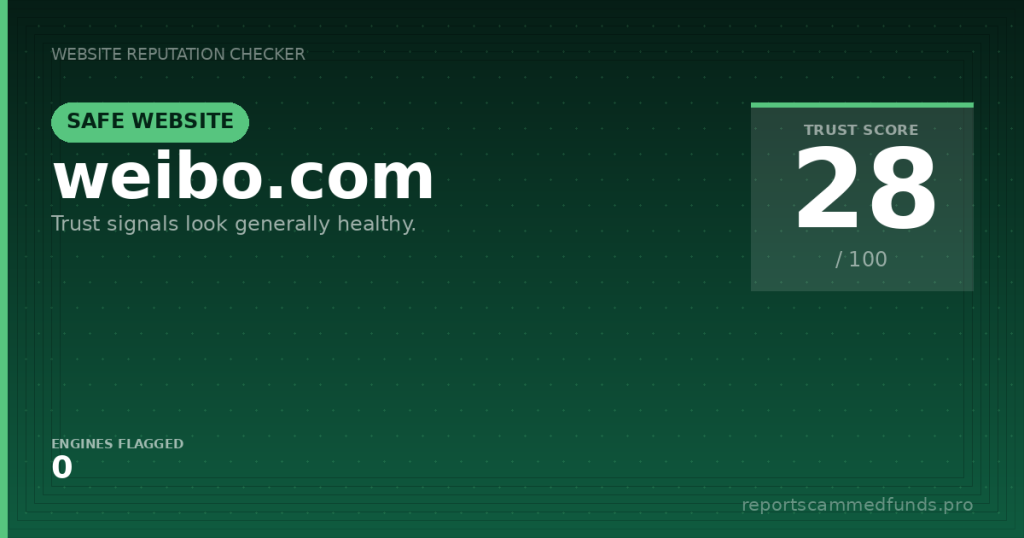
Our view is that weibo.com is a legitimate, mainstream social networking service with a long public track record. It is not a broker, exchange, or investment platform, and it does not solicit customer funds for trading. The risks users face are the same ones that come with any open publishing venue at scale: impersonation, spam, and third-party scams that piggyback on brand recognition and advertising tools. That requires vigilance from users rather than avoidance of the platform itself. If you limit trust to verified accounts, avoid rushed payment decisions, and keep interactions inside official channels, you can use Weibo without exposing yourself to undue financial risk.
For businesses and creators, the advertising and verification systems are developed and widely used, but you should approach spending in staged increments and understand the documentation requirements. Cross-border customers should plan for potential friction in support response times and refunds, and keep transactions prudent until you confirm operational reliability for your particular use case. Always verify any outreach claiming to be "Weibo Support," as real administrators will not ask for off-platform payments. Protect your account with strong passwords and multi-factor authentication to reduce the risk of takeover.
In short, treat weibo.com as you would any major social network: a powerful distribution channel that demands disciplined security habits. Verify domains, scrutinize links, and use payment methods with dispute protections if you decide to transact with third parties you discover on the platform. When in doubt, step back and seek verification through official help resources or independent sources. And if you do encounter fraud, move swiftly to freeze payments, report to authorities, and consult specialists such as the team at reportscammedfunds.pro for next steps.