
Trading platform & site functionality
WazirX presents itself as a mainstream, India-focused cryptocurrency exchange offering spot trading in a range of tokens with quote currencies typically centered around USDT and INR. The platform is available through a browser-based interface as well as mobile apps, with onboarding steps oriented toward local users who must complete know-your-customer checks. A notable feature historically has been a peer-to-peer mechanism that helps Indian users move between INR and USDT when formal banking rails were constrained. The site highlights ease of use, quick order placement, and a catalog of popular cryptocurrencies, though the exact list of supported assets and pairs can change over time. Taken together, the front-end experience aims to be familiar to anyone who has used a centralized exchange elsewhere, with dashboards for balances, open orders, and transaction history.
From a trading perspective, WazirX relies on a central limit order book for spot pairs and, for INR access, a P2P marketplace where counterparties settle via domestic transfers while the platform provides escrow for crypto legs. Market depth and spreads can be reasonable in calm periods but, as with many retail-heavy venues, slippage and wider spreads can emerge during volatility spikes or sudden news events. Users who are purely price-sensitive will want to compare effective execution costs—spread, taker fees, and occasional fiat off-ramp fees—against global benchmarks rather than just headline fee tables. The P2P system can be practical for local flows but demands vigilance: counterparties can be slow, perfunctory, or occasionally non-compliant, and WazirX’s dispute resolution timelines may vary with demand. If your goal is liquidity on large tickets or niche assets, testing small trades first is prudent.
Onboarding typically requires identity verification, and WazirX emphasizes compliance with Indian AML rules. Security features on the account side commonly include two-factor authentication, device management, and withdrawal confirmations, which are essential minimums for any exchange in this risk category. The platform’s UI highlights basic portfolio charts and logs, but it is not a professional-grade terminal—advanced order types, robust API rate limits, and institutional tooling may be limited or subject to change. For retail customers making periodic buys or sells, the functionality is largely sufficient, assuming underlying systems are stable. Experienced traders, however, will want to evaluate API responsiveness, order-type availability, and rate limits during high-traffic moments to ensure strategies remain executable.
In terms of reliability, WazirX has faced periods of heightened latency, scheduled maintenance during peak interest, and episodic interruptions of INR deposit or withdrawal channels. These are not unique in the Indian crypto context but are still operational risks that users should account for by keeping trading balances modest. The exchange’s communications cadence—via social channels and announcements—has helped during incidents, yet updates can feel belated when funds are locked mid-trade. Any centralized exchange can run into throughput constraints or vendor outages; what matters is how quickly the platform isolates problems, restores functionality, and explains what occurred. WazirX’s track record is mixed: core services generally return, but the path to normalcy has sometimes been bumpy.
License & regulatory status
India’s current framework for crypto exchanges centers on anti-money laundering obligations rather than full-scope consumer protection or prudential oversight. Registration with the Financial Intelligence Unit (FIU-IND) as a reporting entity—often cited in exchange marketing—does not equate to being regulated like a bank, a broker under SEBI, or a payment system overseen by the RBI. That means users do not have a statutory investor-compensation scheme or a regulatory guarantee on operational soundness. WazirX publicly emphasizes compliance and KYC/AML controls, but those claims are not substitutes for a license regime with resolution planning and capital rules. This gap is crucial: when something goes wrong at a crypto exchange in India, there is typically no regulator-mandated backstop for customers.
Regulatory and enforcement scrutiny has surrounded the brand in the past. In 2022, India’s Enforcement Directorate (ED) announced investigations that included freezing certain WazirX-related funds during probes into alleged illicit use of crypto channels; public statements later indicated cooperation and a path to normalizing operations. Whether or not an exchange is ultimately cleared, such events expose customers to access risk—accounts can become unavailable at precisely the moment markets turn volatile. Additionally, India’s tax treatment of crypto, including a 1% TDS at source on many transactions since 2022, complicates cash-flow for active traders and can make domestic venues less attractive than offshore alternatives. None of this makes WazirX fraudulent, but it does mean users must price in a unique set of local frictions.
Governance clarity has also been a recurring theme. In 2019, Binance announced an acquisition of WazirX; by 2022, the two firms publicly disagreed over the extent of control and responsibility, particularly in the wake of enforcement questions. Such disputes may seem remote to a day trader, yet they matter for custody, wallet management, and who is ultimately accountable in a failure scenario. Our review could not independently verify the current, definitive status of ownership and operational control beyond public statements. Until there is unambiguous, up-to-date disclosure with third-party validation, users should assume they are relying primarily on the local operator’s financial health, compliance posture, and security practices—not on any implied global parent.
User feedback
Public feedback on WazirX is mixed, with many satisfied retail users citing a clean interface, recognizably priced trading pairs, and a relatively straightforward KYC process. During quiet periods, some customers report quick INR rails, predictable P2P settlement, and responsive app performance for small orders. Users new to crypto frequently praise educational snippets and step-by-step flows for deposits and withdrawals. For those who primarily need to buy or sell mainstream tokens in modest amounts, the exchange can work as intended. However, positive reviews tend to reflect periods without market stress, and experiences can diverge significantly when volatility hits.
On the negative side, recurring complaint themes are familiar from many centralized exchanges but deserve attention. Customers have reported withdrawal blockages immediately after profitable trades, often framed as compliance reviews requiring additional documents that were not requested during onboarding. Others describe “surprise KYC” after deposit—accounts that traded for weeks are suddenly asked for more proofs, with funds inaccessible during the review window. P2P disputes emerge periodically when counterparties delay domestic transfers or claim non-receipt; in such cases, users say resolution times vary and communication can feel one-sided. Another frequent pain point is support responsiveness: ticket replies can take days during incident spikes, leaving customers in limbo.
The 2024 security incident amplified user frustration. Reports describe abrupt pauses to withdrawals, ambiguous messaging early on, and gradual restoration that did not satisfy everyone impacted by pending transactions. Even unaffected customers expressed concern about governance and wallet segregation, asking whether hot and warm wallets were adequately compartmentalized. While WazirX has communicated that the breach was limited and took steps to mitigate, trust tends to be brittle after any major outflow. Over time, some users return; others opt to keep only small, transitory balances, using the platform more as a fiat on-ramp/off-ramp than a long-term custodian.
Deposits & withdrawals
Funding and withdrawal on WazirX revolve around two tracks: domestic INR access and on-chain crypto movement. For INR, availability has historically depended on partner banks and payment processors, with UPI, IMPS, or standard bank transfers appearing or disappearing as relationships change. When banking rails are constrained, WazirX’s P2P market becomes the main bridge; buyers and sellers match, domestic fiat settles off-platform, and USDT or other supported tokens move under WazirX escrow. This model can work smoothly in normal times, but it introduces counterparty risk and timing uncertainty that novice users often underestimate. Multiple reports suggest that INR rails can be turned off with little notice, making it important to check current status before initiating larger transfers.
On the crypto side, deposits and withdrawals follow the usual centralized-exchange flow: the platform provides addresses per chain, and network fees apply on outbound transactions. Users must take care to select the correct network (for example, ERC-20 vs. other compatible chains) since misrouted funds are typically irrecoverable. After the 2024 breach, WazirX temporarily restricted certain withdrawals and later restored them; such risk-control levers are common, but they can trap users at inopportune times. Some customers have reported delays or manual reviews on crypto outflows when transactions trigger risk flags, such as interactions with mixers or previously tainted addresses. As always, testing with a small withdrawal before scaling up is a prudent habit.
Fee visibility is serviceable but not foolproof for effective-cost comparisons. Taker and maker fees, P2P escrow conditions, and INR deposit/withdrawal charges can change, and taxes like TDS reduce net proceeds for Indian residents. Users often underestimate P2P friction: while exchange fees may be low, real-world costs include delayed counterparties, reversal attempts, or the need to file disputes. Documentation is critical—screenshots, payment references, and chat logs increase the odds of a favorable resolution if something goes wrong. Finally, because banking relationships can shift quickly, serious users should maintain redundant off-ramps—another exchange account or a reputable OTC desk—rather than relying solely on a single venue.
Why unregulated brokers are risky
The most consequential risk with WazirX—and most centralized crypto exchanges in India—is the absence of a full-scope, consumer-protection regulatory framework. AML registration commitments, where applicable, are about surveillance and reporting, not about safeguarding client assets through mandated capital buffers or segregation audits. If an exchange fails, is hacked, or otherwise becomes insolvent, there is no investor-compensation scheme akin to the protections offered in traditional finance. Customers are effectively unsecured creditors, hoping that the operator’s internal controls are sound and that any incident response will prioritize restitution. That is a big ask in an industry where information asymmetry between operators and retail users remains stark.
Operational risks compound this picture. Hot wallets are tempting targets, and there is no zero-risk way to keep large balances on a trading platform that needs to process real-time withdrawals. While WazirX advertises security features at the account level, those help mostly against user-side compromise, not against an attack on the exchange’s internal systems or third-party vendor integrations. Proof-of-reserves disclosures, if any, can provide partial comfort but vary in rigor and are often unaudited or one-off snapshots. Until independent, recurring audits with clear liability become standard, the prudent assumption is that custody on any exchange carries non-trivial failure risk.
There is also the policy dimension: Indian authorities can change stances quickly, as seen with shifting bank guidance and tightening AML expectations. Even absent wrongdoing by the customer, compliance holds can immobilize funds if accounts are reviewed or if a partner bank abruptly rethinks its risk exposure. The tax regime—especially TDS on certain transactions—adds another layer of friction that can reduce liquidity and push activity into channels with their own hazards. Users who need predictable access to capital should factor in these uncertainties and consider whether a mix of self-custody and multiple on/off-ramps better suits their risk tolerance.
How to get help if you’ve been scammed
If you have funds stuck on WazirX, start by capturing and organizing every relevant record: transaction hashes, order IDs, bank transfer references, screenshots of chats and tickets, and timestamps of any error messages. Open a formal ticket through the support portal and keep replies in-thread to preserve continuity. If your account is under review, request a clear list of documents needed and the expected timeline; keep your messages factual and time-stamped. Avoid escalating to social media with private data, but do not hesitate to post a neutral status update asking for a case number if public attention seems to accelerate responses. Persistence and meticulous documentation frequently make the difference.
If you funded via bank transfer, card, or UPI as part of a P2P transaction and believe you were defrauded by a counterparty, contact your bank or card issuer immediately. Ask for a chargeback on card payments where applicable, or file a dispute for erroneous or fraudulent UPI transactions through your PSP/bank; speed matters because reversals become near-impossible as time passes. In India, lodge a complaint at the National Cyber Crime Reporting Portal at cybercrime.gov.in and record the acknowledgment. If a bank refused to act on a clear error, consider the RBI’s grievance redressal route against your bank under the Ombudsman Scheme. Outside India, report to your relevant authority—IC3.gov in the United States, actionfraud.police.uk in the United Kingdom, or your national consumer-protection body.
For on-chain crypto transfers, understand that blockchains generally do not support reversals, but investigative tracing may help if funds hit a known exchange. File a report with the receiving platform’s compliance team including transaction hashes and a concise narrative; if the destination is unknown, consider a police complaint referencing the wallet addresses involved. Preserve your device logs and any malware/compromise indicators if you suspect a personal security breach. Keep your communication professional and specific; vague accusations are less effective than a clear timeline, evidence links, and a defined request such as account freeze or KYC hold on the beneficiary address.
Finally, if you have lost money or face complex cross-border elements, contact our team at reportscammedfunds.pro for tailored guidance. We can help you structure your evidence, identify the right reporting channels, and coordinate with financial institutions or platforms as needed. We also warn readers to be alert for recovery scams—unsolicited operators who promise guaranteed retrievals for hefty upfront fees often compound the loss. Work only with parties you can verify, and insist on clear terms and written scopes before engaging any service provider. The sooner you move, the better your odds of containing damage and preserving recourse.
As you work through these steps, secure your remaining assets by rotating account passwords, enabling or re-securing two-factor authentication, and sweeping funds into self-custody wallets under your control. Maintain a case diary with dates, contacts, and action items; this will support consistency if multiple agencies or banks become involved. If you engage local counsel, share your organized dossier to minimize billable hours spent untangling facts. And continue pressing the platform’s support channels with concise, dated updates—steady follow-up often nudges cases out of the queue.
Conclusion
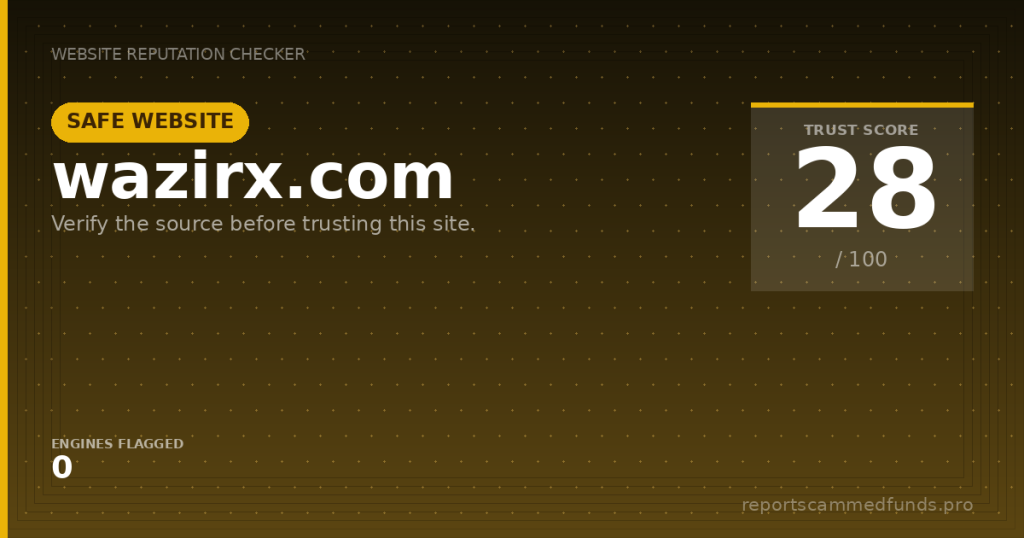
WazirX, accessible at wazirx.com, is a recognizable exchange in India with years of operation and a large retail footprint. Nothing in our review suggests it is a simple hit-and-run scam site; it has real infrastructure, a brand history, and observable user communities. At the same time, the venue carries the well-known hazards of centralized crypto trading in a jurisdiction without full-scope consumer protection, compounded by episodes of enforcement scrutiny and a high-profile security incident in 2024. These facts make it unsuitable for anyone seeking bank-like safeguards or instant, uninterrupted access to funds during crises. Users who proceed should do so with disciplined risk management.
If you decide to use WazirX, treat it primarily as a transactional bridge: move in, execute, and move out. Keep balances lean, test withdrawals before size-up, and diversify your on/off-ramps in case one partner bank or payment rail pauses without warning. Do not rely on marketing claims about compliance as a substitute for real, structural assurances; AML reporting is important, but it won’t make you whole if the platform fails. Ask hard questions of any exchange about wallet segregation, incident response, and the rigor of proof-of-reserves, and assume that sunny snapshots are not continuous guarantees.
Our bottom line is cautious: WazirX can be used, but only by users who understand the risks and maintain tight operational discipline. For long-term holdings, self-custody on well-audited wallets remains the safer standard. For those who have already run into trouble, move quickly on the remediation steps outlined above and engage reportscammedfunds.pro for assistance. Vigilance and preparation are your best defense in a market where the rules—and the rails—can change overnight.