Trading platform & site functionality
TronKing’s branding suggests a TRON-focused earning portal, which often translates into claims of staking, mining, or pooled-yield strategies. In this segment, legitimate providers usually publish technical documentation, auditor attestations, or at least a clear outline of revenue sources and risk controls. By contrast, the public information traceable to tronking.net is sparse, and we could not confirm the presence of a verifiable whitepaper, a named audit firm, or independently reviewed smart contracts. In short, the description of what exactly a user would buy, stake, or mine—and how payouts are derived—remains vague, which is a central concern when evaluating any investment-facing website.
Platforms in this niche vary from custom dashboards to simple web interfaces that assign a deposit address and list a running balance. Without transparent documentation, it is difficult to know if TronKing relies on smart contracts, centralized wallets, or an internal ledger that is opaque to users. We saw no reliable references to a mobile app, exchange integration, or open-source code repositories that would enable third-party scrutiny. As a result, users cannot easily evaluate platform reliability, dependency on third-party infrastructure, or protections against outages and withdrawal bottlenecks.
Traditional metrics like spreads or transaction fees do not directly apply to a staking/mining-style site, yet cost transparency is still essential. In higher-risk corners of crypto, we often see costs introduced indirectly—through maintenance fees, minimum-withdrawal thresholds, or sudden 'verification' charges that appear only when a user requests their funds. Vague or shifting fee policies can materially impact returns, particularly when payouts are small or infrequent. Investors should expect explicit schedules for any commissions, withdrawal fees, or lock-up periods, and avoid platforms that bury such terms or surface them only after a deposit has been made.
License & regulatory status
It is crucial to understand the regulatory context for sites that advertise yield on crypto. While mere token transfers are often unregulated, marketing an investment product—especially one promising returns—triggers oversight in many regions. In the UK, the FCA has taken action on unauthorized crypto promotions; in the EU, national regulators like BaFin and CONSOB, alongside ESMA guidance, have tightened expectations. In the U.S., yield-bearing crypto accounts have drawn the attention of the SEC and, depending on structure, may intersect with CFTC considerations when derivatives or leveraged products are involved.
Against that backdrop, we searched for credible disclosures that might indicate TronKing holds any form of authorization. We could not locate registrations or licenses for tronking.net with the FCA (UK), ASIC (Australia), BaFin (Germany), FINMA (Switzerland), CONSOB (Italy), or the CFTC/SEC (United States). We also did not see independently verified company identifiers or license numbers published by the operator. Absence of a listing is not definitive proof of illegitimacy, but any investment-facing crypto platform that cannot point to verifiable oversight should be approached with caution.
Another recurring problem in this space is the use of false or implied affiliations—such as placing exchange logos or mentioning reputable brands to evoke credibility. If TronKing makes any such claims, the safest course is to verify them directly with the named company or regulator via their official websites. Confirm that a claimed license number appears verbatim in the regulator’s registry and that the domain tronking.net is explicitly listed. Without direct confirmation, treat any 'regulated' or 'partnered' narrative as marketing at best, or misrepresentation at worst.
User feedback
Consumer feedback can be a revealing signal, particularly when a site has been operating for long enough to generate a track record. For tronking.net, we did not find a meaningful volume of consistent, credible reviews from long-standing forums like Bitcointalk, established subreddits, or detailed Trustpilot pages tied specifically to this domain. While absence of evidence is not evidence of absence, a near-silent footprint for a consumer-facing investment portal is unusual. Users should be wary when visibility is limited to short, anonymous comments or promotional posts that are difficult to verify.
In comparable cases, certain complaint patterns recur with troubling regularity. Users report smooth deposits followed by friction when attempting withdrawals, with reasons cited such as unexpected KYC demands, 'tax' prepayments, or sudden account reviews that freeze balances after profits are shown on-screen. Others recount 'managed-account' arrangements where an 'advisor' encourages larger stakes, leading to steep losses or inaccessible balances after a few superficial gains. These narratives—withdrawal blockages after profit, surprise KYC after deposit, and high-pressure upselling—are consistent with high-risk operations, and they merit heightened skepticism.
Another dynamic to consider is testimonial reliability. Screenshots of payouts or short social posts can be trivially fabricated, and newly created accounts that post glowing praise provide little evidentiary weight. If TronKing presents endorsements or success stories, vet their source, age, and reputation, and look for corroboration across neutral venues. In the absence of that, assume that promotional narratives are curated and may not reflect the typical user experience.
Deposits & withdrawals
Crypto-earning portals with a TRON theme often accept deposits in TRX or USDT (TRC-20), emphasizing speed and low fees. While these qualities are appealing, they come with a trade-off: blockchain transfers are essentially final once confirmed, so there is no natural consumer recourse. When a platform is unregulated and anonymous, sending crypto is akin to handing over cash with limited paper trail beyond the chain record. Users should therefore consider the irreversibility of deposits a core risk factor and decline to proceed without strong evidence of trustworthiness.
We have also documented a common withdrawal playbook in higher-risk sites: small early payouts to build confidence, followed by escalating barriers once larger withdrawals are requested. These barriers can include unexpected 'maintenance' or 'activation' fees, claims that a balance must reach an arbitrary threshold, or so-called 'taxes' that must be paid to unlock funds. None of these demands are legitimate in regulated finance, where fees and taxes are handled transparently and never required as prepayments to release your own money. Treat any request for additional funds to process a withdrawal as a major warning sign.
Before committing funds, attempt to map the entire transaction lifecycle: minimum deposit and withdrawal amounts, fee schedules, daily limits, identity requirements, and expected processing times. Try a micro-withdrawal test if possible and confirm it credits to your independent wallet without intervention or extra payments. Ensure you retain control of your private keys and enable two-factor authentication for account access where offered. Finally, review any terms and policies for clauses that allow unilateral changes, suspend withdrawals during 'volatility', or force arbitration in unknown jurisdictions—these are often used to sidestep user complaints.
Why unregulated brokers are risky
Operating outside recognized regulatory regimes leaves users without important safety nets. There is no deposit insurance like the UK’s FSCS or the US’s SIPC for crypto deposits sent to an offshore, anonymous platform. If the operator vanishes or refuses to process withdrawals, your options narrow to private recovery efforts and law enforcement reporting, neither of which guarantees restitution. That asymmetry—funds leave your control instantly, yet recourse is limited—defines the core risk of unregulated investment schemes.
Cross-border complexity further reduces accountability. Even when a victim identifies the operator, jurisdictional challenges can stall investigations and complicate any civil action. Regulated providers tend to publish a real address, corporate directors, audited financials, and membership in dispute-resolution schemes—elements that can be used to exert pressure or pursue claims. Anonymous, unregulated sites provide none of that leverage, which is why they are favored by boiler-room operations and pop-up HYIP projects that cycle through domains.
It is also vital to consider data privacy and follow-on scams. Documents uploaded for KYC on unvetted sites may be mishandled or sold, exposing victims to identity theft or future 'recovery scam' approaches in which impostors claim they can get your money back for a fee. Likewise, operators sometimes repurpose email lists for 'pig butchering' outreach—long-game social engineering efforts designed to extract larger sums. Minimizing exposure starts with avoiding unverified platforms and refusing to share identity documents unless absolutely necessary with a known, regulated entity.
How to get help if you’ve been scammed
If you have already sent money to tronking.net, act quickly. For card payments, contact your issuing bank immediately to request a chargeback under dispute categories such as services not received or misrepresentation; emphasize any deceptive claims and point to the operator’s refusal to refund. For wire transfers, ask your bank to initiate a recall if the funds have not yet been withdrawn on the receiving end. Preserve all evidence—emails, chat logs, wallet addresses, transaction IDs, and screenshots—and be mindful of scheme deadlines for filing disputes, which can be short.
For cryptocurrency payments, notify your exchange or wallet provider as soon as possible, supplying the transaction hash and the destination address to flag the flow. File a police or cybercrime report to create an official case number; some providers will only escalate with that documentation. Consider blockchain intelligence assistance to trace onward hops, but avoid anyone demanding upfront fees with guaranteed recovery claims—those are classic recovery scams. Never send additional funds to 'unlock' or 'verify' your withdrawal; legitimate platforms do not demand prepayments to release your own balance.
Report the incident to your national authority: in the UK use Action Fraud, in the US file with IC3, and elsewhere consult your financial regulator’s consumer-protection portal (FCA, BaFin, ASIC, CONSOB, FINMA). Parallel to official reporting, you can request help from our team at reportscammedfunds.pro; we offer structured intake, documentation guidance, and case coordination to improve your odds of a successful dispute. Early engagement increases the chance of freezing suspect accounts or alerting counterparties before funds disperse. Even if recovery is uncertain, timely reporting helps prevent further victimization.
Conclusion
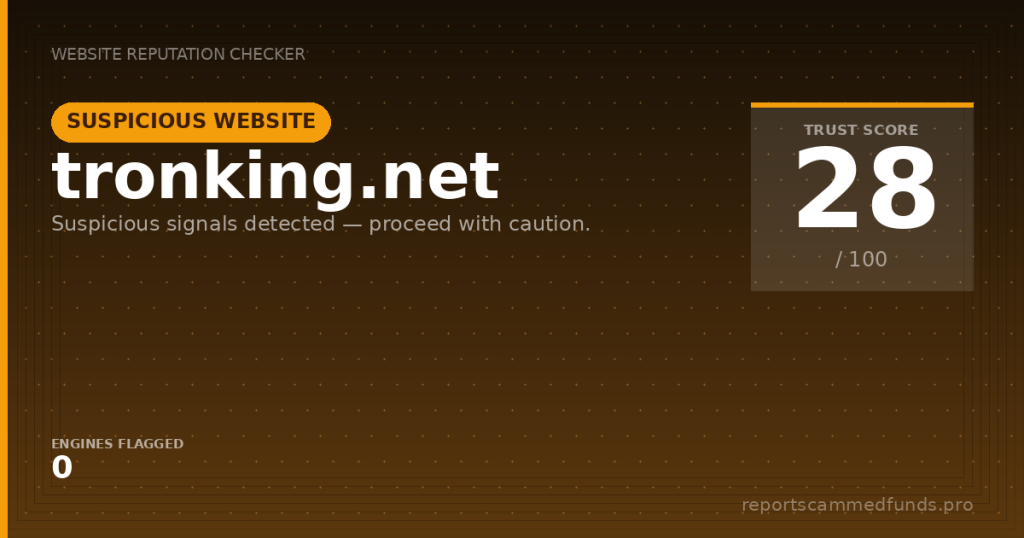
TronKing’s limited transparency, lack of evident regulatory status, and alignment with a historically high-risk niche lead us to a cautious but firm conclusion: tronking.net should be treated as suspicious. In a market crowded with TRON-themed mining and staking pitches, genuine businesses differentiate themselves with verifiable audits, clear leadership, and regulator-recognized compliance. We found none of those hallmarks here. Until the operator discloses traceable corporate details and independent oversight, the safest choice is to abstain.
If you intend to test the platform despite these warnings, confine any trial to capital you can afford to lose, and insist on proof through successful, repeated micro-withdrawals before scaling. Demand an explicit fee table, written withdrawal timelines, and confirmation that no 'unlock' or 'tax' prepayments will ever be required. Avoid handing over identity documents unless absolutely necessary and only after you have vetted the entity’s legitimacy. Skepticism is not cynicism in this context—it is standard due diligence.
We will continue to monitor for new regulator filings, consumer alerts, or credible audits tied directly to tronking.net. Readers who have interacted with the site can help the community by sharing verifiable experiences, both positive and negative, while redacting sensitive data. Keep meticulous records and act promptly if something feels wrong. In the absence of strong, independent evidence of legitimacy, our recommendation is to look elsewhere for crypto-earning opportunities.