
Trading platform & site functionality
City Traders Imperium positions itself within the growing proprietary trading space, where traders pay an evaluation fee to attempt qualifying for a funded account. Unlike a traditional broker that holds client deposits for live trading, a prop firm typically provides simulated or internalized capital access and pays out a profit share subject to rules. The website’s messaging centers on different account sizes, pathways to funding, and progression steps that may include scaling plans. While the overall proposition can appeal to disciplined traders, the fine print becomes the most important part of the experience. Fee structures, rule definitions, and platform partners are crucial elements that determine whether the program aligns with a trader’s strategy and risk tolerance.
Programs in this niche normally include multi-step evaluations, one-step challenges, and occasionally instant-access models with reduced risk budgets and higher joining costs. What matters is how the drawdown is calculated (daily vs. overall), whether it is static or trailing, and what counts as a violation that cancels eligibility for growth or payouts. These frameworks vary among prop firms, and small definitional changes—such as how equity versus balance drawdown is measured—can dramatically alter the difficulty of passing. City Traders Imperium appears to follow the typical market template, though the exact thresholds and definitions should be verified on the most current Terms & Conditions. Traders are well-advised to screenshot or save policy pages before paying any fee, in case mid-program rule changes occur.
Execution quality in a prop setting depends on the chosen platform and the underlying broker or trade simulator that routes orders. Spread widening during news, slippage around rollover, and occasional platform pauses are not unique to any one brand but are common stress points that surface in user forums across the industry. The critical question for any trader is whether the advertised conditions are actually achievable given the timing and style of trading they intend to use. For example, a scalper reliant on tight spreads may find an evaluation meaningfully tougher than a swing trader who holds positions for days. City Traders Imperium’s suitability will hinge on whether its real-world execution approximates the promotional descriptions, something only careful reading and a conservative first attempt can determine.
The site’s materials also stress education and discipline, which is consistent with prop firms that market risk management as a core value. Educational content can indeed help, though it is rarely a substitute for independent testing under live-like conditions. In this environment, any promise of easy funding should be met with skepticism; consistent profitability is hard, and passing a rules-based evaluation is often a narrower challenge than the broader task of long-term trading success. Before committing fees, traders should analyze whether the platform rules penalize their best setups, such as holding through weekends, trading around economic releases, or using particular order types. A mismatch between rules and strategy is a leading cause of frustration, fee churn, and accusations—across the industry—of unfair barriers to payouts.
License & regulatory status
A key point to understand is that City Traders Imperium is not a broker taking deposits for live market trading on behalf of customers, and therefore it generally does not fall under the same licensing regimes as an FCA or BaFin-authorized investment firm. This is common to the prop firm model worldwide: the firm funds traders (often on demo or internally risk-managed accounts) and pays out a share of profits subject to compliance with proprietary rules. Because of this structure, no protections like FSCS (UK) or SIPC (US) typically apply. For users, the absence of a formal regulatory umbrella means that any dispute becomes a matter of contract law and customer service rather than oversight by bodies such as the FCA, ASIC, or the CFTC/NFA.
We found no explicit claims of authorization by major financial regulators on publicly accessible pages. A search-based review did not surface an FCA Firm Reference Number tied to the brand, which aligns with the non-broker prop-firm categorization; that observation is not a negative by itself but limits outside recourse. Likewise, we did not encounter public warnings from regulators naming the brand at the time of writing; however, readers should understand that absence of a warning is not an endorsement. Regulators often caution that prop firm evaluations and profit splits are generally outside their remit, and some have signaled increased interest in related marketing practices, especially when a firm’s advertising could be mistaken for brokerage services or investment advice.
It is essential not to confuse a prop firm’s legitimacy with the formal regulatory standing required of deposit-taking brokers and asset managers. If you expect third-party adjudication of disputes, restitution schemes, or precise best-execution obligations, you will not find them here. Instead, your protection is the contract: the posted rules, the refund policy (if any), the clarity of KYC and payout procedures, and the firm’s willingness to resolve disagreements consistently. For City Traders Imperium, prospective users should read all policy pages, check for version dates, and keep copies. If any page claims affiliation with a regulated entity or shows a regulator’s logo, verify independently by searching the specific registry (FCA, BaFin, ASIC, CONSOB, FINMA, CFTC/NFA) to avoid falling for the broader industry problem of false-affiliation claims.
User feedback
Public commentary about prop firms tends to be polarized, and City Traders Imperium is no exception to that pattern. On one side are traders who report that they passed evaluations and received payouts without incident, often praising responsive support or straightforward processes. On the other side are complaints centered on rules enforcement—particularly daily drawdown, consistency requirements, or news-trading restrictions—where claimants say that minor or technical breaches voided months of effort. This split is not unique to one brand and reflects how sensitive outcomes are to definitions and platform performance around volatile periods.
A recurring theme in industry-wide feedback is the surprise KYC request right before a first payout. Many firms do this to comply with basic anti-money-laundering practices, yet some customers only discover the requirement late in the process, calling it ‘surprise KYC after profit.’ It is reasonable for a business to verify identity before sending funds, but it should be spelled out early and clearly. Where the friction arises is when identity checks take longer than expected, documents are rejected for formatting reasons, or additional proofs are requested multiple times. If City Traders Imperium follows a similar approach, it would reduce disputes by clearly highlighting KYC steps and timelines upfront.
Another set of user remarks across the prop space concerns execution quality during evaluations. Traders have alleged that spreads momentarily widen or stops are filled at worse levels than anticipated, particularly around news releases, rollover, or low-liquidity hours. Whether attributable to the partner broker’s liquidity, the platform, or normal market conditions is hard to prove after the fact. Still, it underscores why traders should align their strategy with the firm’s rules and market microstructure realities. To evaluate City Traders Imperium fairly, prospective users should test cautiously, avoid pushing limits near known volatility events, and document any anomalies with screenshots and timestamps for later reference.
Deposits & withdrawals
The financial relationship with a prop firm differs from a broker: you do not deposit trading capital but typically pay an evaluation or program fee. Firms in this niche commonly accept card payments via standard gateways and sometimes alternative methods like bank transfer or certain e-wallets; some accept crypto, though this varies. Because fees are often non-refundable (or refundable only under narrow conditions), users should be certain about the program they choose before paying. City Traders Imperium appears to follow the evaluation-fee model, but exact payment rails and refund triggers should be confirmed on the checkout page and in the Terms & Conditions.
Payouts—more accurately profit splits—are generally scheduled monthly or biweekly, contingent on meeting rules and any minimum payout thresholds. Know-your-customer verification is frequently required before a first disbursement, which is a standard step even for unregulated businesses to mitigate fraud and sanctions risk. Payment channels for prop firm payouts can include bank transfers, e-wallets, or contractor platforms; the exact mix varies by brand and region. Before engaging with City Traders Imperium, request confirmation of available payout methods in your country and expected timelines, so you are not surprised by delays or unsupported options.
Several complaint themes regularly appear with prop firms and deserve attention: withdrawal blockages after profit due to alleged rule violations, requests for additional documents, or changes to payout schedules. When these occur, traders often discover that Terms grant the firm wide discretion to interpret rules or conclude an agreement. This can create a power imbalance unfavorable to the user. If working with City Traders Imperium, treat all rule thresholds as hard limits and keep detailed logs of trades, equity curves, and communications to improve your position in any dispute over payout eligibility.
Why unregulated brokers are risky
Operating in an unregulated or lightly regulated segment does not automatically make a company fraudulent, but it does shift risk to the user. Without a license under bodies like the FCA, BaFin, or ASIC, there is no capital adequacy regime, no standardized complaints process overseen by an ombudsman, and no investor-compensation scheme to backstop losses or fee disputes. In the prop model, most conflicts revolve around contract interpretation—was a rule broken, was a news event improperly traded, did a trailing threshold apply at a given tick? Those questions typically end in customer-service channels, not regulator-run arbitration.
A second layer of risk stems from the dependency chain. Most prop firms rely on external technology providers, partner brokers, data vendors, and payment intermediaries. Disruptions at any point—such as platform licensing changes, connectivity failures, or payment processor restrictions—can cascade into account pauses, rule amendments, or slower payouts. Users have little visibility into these dependencies, which are rarely disclosed in detailed, plain-English terms. When evaluating City Traders Imperium, consider how resilient its operations appear and whether alternative payout or platform options are offered if one route fails.
Finally, funding promises in this sector can be misread as direct access to a pool of cash or live market exposure. In practice, many accounts are internally risk-managed or simulated, with performance mirrored to a firm’s risk book according to undisclosed logic. This structure can be legitimate but should be communicated transparently so traders understand what they are—and are not—receiving. No matter how the internal model works, remember there is no deposit-insurance backstop for evaluation fees or time invested. Plan assuming that rules will be enforced strictly and that you will need your own documentation if you challenge a decision.
How to get help if you’ve been scammed
If you have already paid fees to City Traders Imperium and believe you were treated unfairly, act quickly. Start by gathering all documents: invoices, email threads, chat transcripts, screenshots of rules at the time you joined, and a complete trade history. Contact the firm through its official support channels with a concise, factual summary of the issue and a specific remedy request—whether a fee refund under a stated condition or reconsideration of a denied payout. Maintain professionalism; detailed, well-documented tickets tend to fare better than emotional appeals.
If your payment was made by card, contact your bank or card issuer immediately to ask about a chargeback under the appropriate reason code (for example, services not provided as described). Many card networks impose time limits, so do not delay. For transfers via e-wallets or fintech platforms, open a dispute within the platform and provide your supporting evidence. Crypto payments are harder to reverse, but you should still notify the exchange you used, in case there are red flags attached to the recipient address. In parallel, consider filing a report with your national consumer authority—Action Fraud in the UK, the FTC or IC3 in the US, or your local equivalent—to establish a formal record.
For expert guidance, you can contact our team at reportscammedfunds.pro. We review documentation, map the payment path, and advise on realistic recovery and escalation options, including regulator referrals and civil-claims pathways when appropriate. We also warn victims about secondary risks, notably recovery scams that promise guaranteed refunds for upfront fees—an all-too-common follow-on fraud. Whether you proceed independently or with help, set clear deadlines in your correspondence and keep a paper trail. Persistence and precise records often make the difference in disputes over fees, rule interpretations, or delayed payouts.
Conclusion
City Traders Imperium appears to be a genuine participant in the proprietary trading space rather than a classic boiler-room or phishing operation. Its model—charging for evaluations and sharing in trader profits subject to rules—is consistent with the broader prop firm industry. That said, the risk to the user is not trivial. Without regulatory recourse, outcomes hinge on whether the firm enforces policies transparently and whether the trader operates comfortably within those limits.
If you are considering joining, the safest path is to proceed incrementally. Verify the exact rulebook for your chosen program, confirm payment and payout methods available in your country, and ask pointed questions about KYC timing, holiday trading, and handling of platform outages. Treat promotional claims as starting points, not guarantees, and assume strict interpretation of drawdowns and event restrictions. Start with the smallest program that lets you test your approach and the firm’s responsiveness without committing large fees.
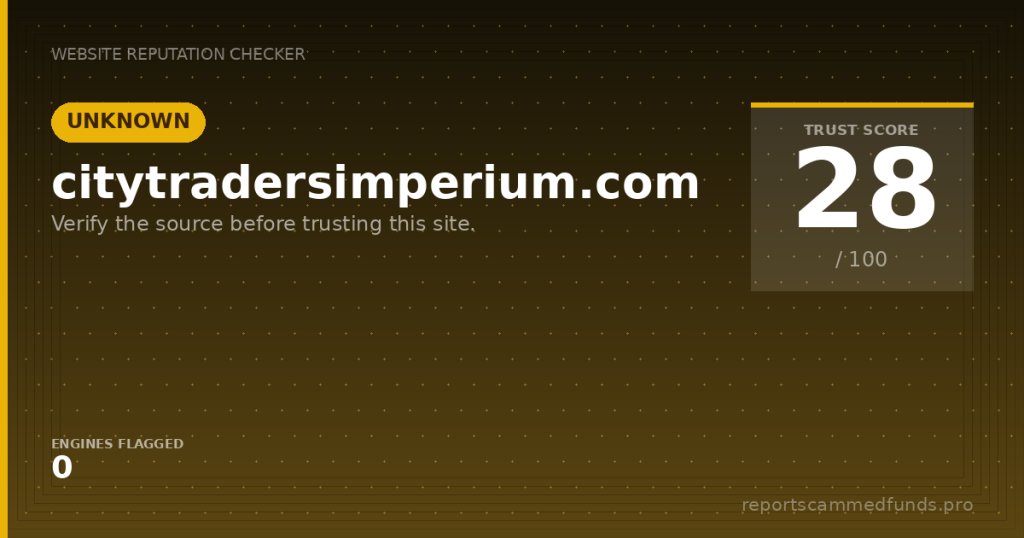
On balance, we do not label citytradersimperium.com as a scam, but we stop short of endorsing it unreservedly. The signals are mixed: multi-year presence and recognizable branding on one side; unregulated status, strict contractual levers, and dependency on third-party platforms on the other. If you move forward, do it with eyes open, documentation in hand, and clear expectations about the limitations of the prop-firm model. And if problems arise, escalate promptly and consider outside assistance from resources like reportscammedfunds.pro.