Trading platform & site functionality
At first glance, the name Invesbo suggests a blend of “invest” and possibly “bo,” a shorthand some brands use to hint at binary options. Without the live site available to review directly, we cannot confirm whether the service purports to offer CFDs, forex pairs, crypto trading, or binary options. That distinction matters: binary options are banned for retail customers in major jurisdictions like the EU and the UK, and retail leverage limits apply to CFDs under ESMA and FCA rules. A legitimate platform should make its product set, risk warnings, and regulator status wholly transparent on the homepage and in its legal pages. Invesbo.com offers none of that verifiable clarity at the time of this writing.
Quality brokerage sites routinely disclose their platform stack and operational details. Regulated brokers prominently list platform availability—MT4, MT5, cTrader, or a proprietary webtrader—along with spread ranges, financing costs, and any commissions per lot. In the absence of accessible pages, we could not verify whether Invesbo provides fixed or floating spreads, reliable charting tools, or essential order controls like guaranteed stop-losses. For traders, these details are not cosmetic: they determine execution safety and true trading cost. A lack of independently confirmed platform information is a material risk, not a minor omission.
Operational stability is equally important. Reputable providers explain latency expectations, server locations, and maintenance windows; they also post incident notices when something goes wrong. With Invesbo.com unreachable, we cannot attest to uptime history, chart accuracy, or trade reconciliation procedures. In past cases we have documented, opaque brokers used a thin web interface that looked polished but lacked reliable server-side execution or audit trails. Any platform where price feeds, margin calculations, or stop-outs cannot be independently verified tilts risk heavily against the customer.
Just as crucial is the on-boarding experience. Lawful brokers conduct know-your-customer checks, but they do so predictably—before deposits or immediately after account creation—with transparent data-handling policies. High-risk operations, by contrast, sometimes accept deposits quickly, then spring surprise KYC hurdles only when clients request withdrawals, creating delays or pretexts to deny payouts. Without transparent terms, we cannot determine which side Invesbo aligns with. Until the operator provides verifiable documentation and visible, professional account controls, the functional proposition remains speculative and the risk profile unacceptably high.
License & regulatory status
Licensing is not a bureaucratic nicety in retail trading—it is the core of investor protection. Authorizations from bodies like the FCA (UK), BaFin (Germany), ASIC (Australia), CySEC (Cyprus), FINMA (Switzerland), or the CFTC/NFA (United States) impose capital requirements, conduct rules, and complaint pathways. Operators must disclose their regulator, the legal entity name, and a license or firm reference number that can be independently verified on the regulator’s public register. In our assessment, we found no such verified disclosures for Invesbo.
We searched major registers for a match to the brand name Invesbo and plausible variations, and did not find a listing that unambiguously connects this website to a licensed firm. Absence of a listing does not automatically equal wrongdoing, but it does mean consumers lack the safety net that comes with regulated status. A licensed broker will proudly show its reference number and company entity information and will encourage you to verify it yourself on the official register. When a platform is quiet on this point, you should assume the strictest form of caveat emptor applies.
False-affiliation claims are a known tactic among questionable operators: they may reference generic regulatory frameworks, paste third-party logos, or cite the regulation of a different, similarly named company. If you encounter any such assertions on or around Invesbo.com, do not accept them at face value. Ask for the precise legal entity name and the jurisdiction of incorporation, and then confirm the details directly on the regulator’s website. If the information is hedged—“in process,” “applied,” or otherwise deferred—treat that as a red flag and step back.
Regulatory non-compliance can also surface indirectly through marketing claims. For example, EU and UK rules ban bonuses tied to trading or deposit behavior and limit leverage for retail traders, yet many unregulated brokers still dangle 1:200 or 1:500 leverage and bonus credits. If Invesbo markets outsized leverage, referral bonuses, or managed-account services without proper authorization, that would contravene standards enforced by ESMA and national regulators like the FCA and CONSOB. In short: without a clear, verifiable license and compliant terms, the safest assumption is that customers would have little to no formal recourse.
User feedback
We looked for substantive, verifiable client feedback and found very little with evidential weight. Established venues like Forex Peace Army, Trustpilot profiles with checked purchase histories, and extended forum threads on Reddit or specialized trading communities can surface patterns quickly—good or bad. In this case, there is either scant discussion of Invesbo.com or the commentary that exists lacks specifics and documentation. The absence of a proven track record does not prove misconduct, but it does remove a critical layer of social proof that helps separate enduring businesses from transient web presences.
In case after case with similar profiles, clients report hurdles that appear only after funds are at stake: withdrawal blockages after profit, surprise KYC demands following weeks of trading, sudden “bonus terms” cited to deny payouts, or account managers pushing larger deposits under the promise of expedited withdrawals. Some describe manipulated pricing or spreads that widen dramatically during news events, followed by margin calls that wipe out accounts. We cannot assert these events occurred with Invesbo, yet the patterns are so consistent across unregulated brokers that their mere plausibility should influence your risk calculus.
We also note the role of social channels and affiliates. Boiler-room style sales outreach via messaging apps, unsolicited calls, or aggressive lead-capture funnels is frequently paired with discretionary “assistance” or managed-account offers, which often culminate in concentrated risk-taking and rapid drawdowns. When these practices intersect with a firm that does not publish a regulator or a verifiable company line, the chances of dispute resolution drop considerably. In the absence of transparent, credible testimonials anchored by transaction proofs or regulator-supervised dispute outcomes, caution is the responsible default.
Finally, the lack of an identifiable, staffed support presence is telling. Reputable brokers maintain multi-channel support with audited response times, posted business addresses, and often a named management team. Where those markers are missing or unverified, everyday friction—like correcting an account detail—can escalate into a barrier to withdrawal. With Invesbo, we could not verify a service level, response times, or even the presence of a dedicated support desk. That information gap by itself is material for any consumer deliberation.
Deposits & withdrawals
Transparent funding and withdrawal procedures are a cornerstone of trust. Regulated brokers typically accept bank transfers and payment cards, keep client funds in segregated accounts, and provide clear timelines—often one to three business days for withdrawals—along with fee disclosures. In contrast, high-risk operations frequently rely on cryptocurrency deposits, offshore wires, and third-party processors with minimal disclosure, making reversals difficult. Because we could not access working pages on Invesbo.com, we have no verified list of accepted methods, processing times, or fees. That opacity means customers cannot reasonably estimate how easily they can retrieve their money.
In complaints we track across unregulated platforms, withdrawal attempts often trigger a gauntlet of obstacles: demands for additional documentary proofs, requests to pay unexpected “taxes” or “account verification fees,” or references to bonus terms that allegedly freeze funds until a near-impossible trading volume is reached. Some operators impose withdrawal minimums or per-transaction charges that are not disclosed upfront. If Invesbo follows any of these patterns—and we cannot confirm either way without reliable terms—the result would be predictable delays and potential losses for customers who assumed standard banking protections would apply.
For anyone still contemplating a trial, the only responsible approach is to test the exit before committing meaningful capital. That means requesting a small withdrawal immediately after the first deposit and before executing any trades, documenting all communications and retaining receipts. Never grant remote access software to “assist” with a withdrawal, and treat any request for additional upfront payments as a fraud signal. Until Invesbo publishes verifiable, regulator-compliant funding terms and demonstrates consistent, timely payouts, the withdrawal risk remains elevated.
Why unregulated brokers are risky
Engaging with an unregulated or unverified platform concentrates risk in ways that ordinary consumers do not anticipate. Without a recognized regulator, there is no mandated segregation of client assets, no prudential leverage limits, and no supervised complaints mechanism. If the operator disappears or refuses to honor a withdrawal, the path to restitution is murky at best. In contrast, with an FCA-regulated firm, for example, customers may have access to the Financial Ombudsman Service and certain protections like the FSCS for eligible categories—safety nets that simply do not exist with an offshore or unregulated counterparty.
Transparency gaps compound the danger. Investors are left guessing who controls the funds, where the accounts are held, and which laws apply. Irregular or missing disclosures about fees, slippage, and corporate governance translate directly into economic risk: hidden costs and discretionary decisions can drain balances quickly. If disputes escalate, an unregulated platform can invoke obscure terms or claim a foreign jurisdiction to complicate any legal recourse. For many victims we interview, the shock is realizing that the norms of their home market—chargebacks, regulated arbitration—do not seamlessly extend to offshore operators.
There is also the risk of data misuse. Copies of IDs and proofs of address sent to an unverified operation can be repurposed for identity theft or leveraged to intimidate complainants. A regulated institution will detail data handling under GDPR or equivalent rules and will have a published privacy officer and recourse channels. With unregulated actors, privacy policies are often generic and unenforceable. That asymmetry—your personal data exposed, their obligations undefined—tilts every dispute in their favor.
How to get help if you’ve been scammed
If you have already deposited with Invesbo.com or a similar platform and are facing resistance, act quickly. Contact your bank or card issuer to file a dispute or chargeback, describing the misrepresentation or non-delivery of services. If you funded via wire transfer, ask your bank to initiate a recall; speed is critical. For cryptocurrency transfers, preserve all transaction hashes and addresses in case law enforcement requests them. Document every interaction—emails, chat logs, phone calls—and store screenshots of the website, account dashboards, and any terms you were shown.
Report the incident to your national authority. In the UK, submit a complaint to Action Fraud and notify the FCA if financial services were promoted. In the EU, contact your national regulator (such as BaFin in Germany, CONSOB in Italy, or the AMF in France). In Australia, lodge a report with ASIC; in the United States, report to the FTC and file an IC3 complaint with the FBI if there is interstate or online fraud. These filings create a record that can support your chargeback and may assist investigators mapping the operation’s footprint.
For tailored assistance—including triage on evidence, escalation strategies, and avoiding common traps like recovery scams—reach out to our team at reportscammedfunds.pro. We review cases, help prioritize the strongest pathways, and warn clients away from “fund recovery” solicitations that demand upfront fees without legal authority. When you contact reportscammedfunds.pro, include your timeline, payment proofs, the exact merchant descriptors on your statements, and any correspondence. The more organized your dossier, the better your chances of a successful outcome.
Conclusion
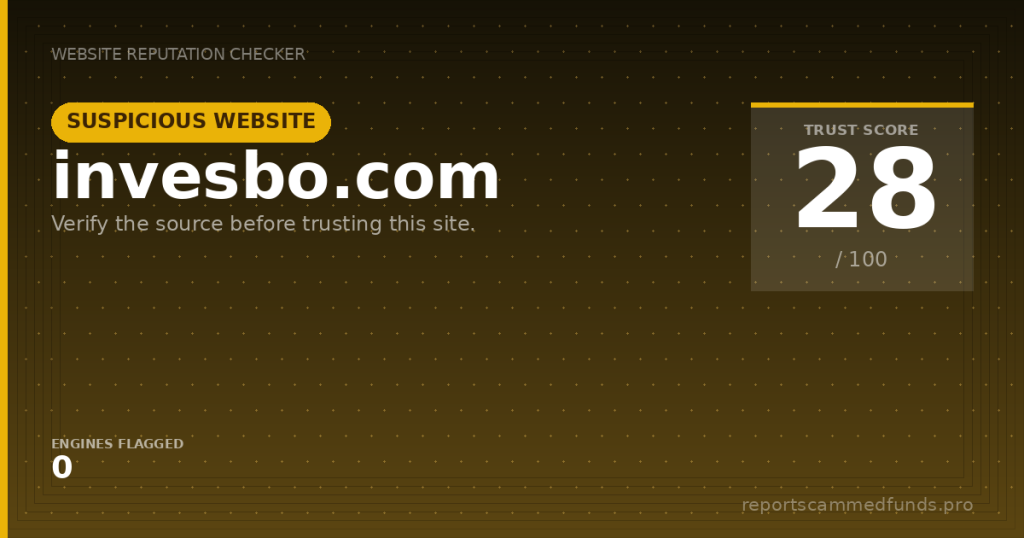
On balance, Invesbo.com presents more questions than answers. The website was not accessible for our review, there are no credible regulatory disclosures, and the public footprint is thin to nonexistent. That combination is typical of high-risk operations where the consumer bears all the downside and gains no institutional protection. Until verifiable information appears—specifically, a recognized license tied to a named legal entity—treat this platform as unproven and potentially dangerous.
What would change our view? Clear, regulator-verified authorization (FCA, ASIC, BaFin, CySEC, or equivalent), a published company name and registered office, transparent product and fee disclosures, and a demonstrable record of timely withdrawals to multiple clients. Platform transparency—independent confirmation of trading infrastructure and robust, well-documented terms—would also matter. Short of that, any glossy marketing or affiliate endorsements carry little weight.
Our recommendation is simple: do not deposit funds or share identity documents with Invesbo.com unless and until the operator proves its legitimacy through verifiable, regulator-grade evidence. If you insist on testing, do so with a trivially small amount and demand a successful withdrawal before taking any trading risk. Safer alternatives exist among well-known, properly supervised brokers; your capital and data deserve nothing less.