
Trading platform & site functionality
At first glance, dns.quad9.net can be confusing if you try to visit it in a standard web browser. That is because this hostname is not intended to be a normal website at all. Instead, it serves as a technical endpoint for DNS resolution over encrypted channels, such as DNS-over-HTTPS (DoH) and DNS-over-TLS (DoT). In practice, your device or application uses this endpoint to ask, for example, “What is the IP address of example.com?” while keeping the query encrypted in transit. A blank page or an error when navigating directly to this hostname is therefore not evidence of a scam but a sign you are knocking on a door meant for protocols, not people.
Quad9 is best known for its anycast resolver reachable at 9.9.9.9, but dns.quad9.net is the corresponding name-based target often used for encrypted DNS. With DoH, software points to a URL path such as /dns-query on this host and communicates over HTTPS, while with DoT it connects on a dedicated port with the server name indicating dns.quad9.net. The goal of these methods is to prevent intermediaries from snooping on or tampering with your DNS lookups. Quad9 layers a security filter on top, using reputational data from multiple sources to block domains known for malware, phishing, or command-and-control activity. If a domain is flagged, the resolver will return a block response rather than the real IP, which can stop a device from reaching harmful infrastructure.
Because dns.quad9.net is a service endpoint, there are no shopping carts, login boxes, or marketing pages to audit for typical consumer pitfalls. Instead, what matters is service reliability, certificate hygiene for encrypted connections, and transparency about data handling. Quad9 has cultivated a reputation for high availability and global reach, operating a distributed resolver network designed to provide low-latency answers. Users commonly report that performance is on par with other public resolvers, though network conditions and local peering can influence results. Importantly, your experience when using DoH/DoT depends on correct client configuration—pointing a browser without the proper path or a TLS client without the right parameters will not return a friendly landing page.
One recurring source of confusion stems from environments that intercept or block encrypted DNS. Some enterprises and ISPs explicitly disallow DoH or DoT, replacing or filtering connections for policy reasons. In those cases, attempting to use dns.quad9.net may time out or return certificate errors not because the Quad9 endpoint is malicious, but because the network between you and it is altering the traffic. A second source of confusion involves the security filtering itself: if the resolver declines to resolve a domain you believe to be safe, it can look like an outage. In reality, that is the service doing what it advertises—blocking domains it deems risky based on its threat intelligence inputs.
License & regulatory status
As a public DNS resolver, Quad9 is not a broker, exchange, or bank, and therefore does not fall under financial conduct regimes like the FCA, ASIC, BaFin, CONSOB, CFTC, or ESMA. We found no claims by the operator that it holds financial licenses, and none would be expected for a DNS service. The relevant oversight context instead touches telecommunications norms, data protection frameworks (such as GDPR for EU residents when applicable), and applicable Swiss law because the foundation is headquartered in Switzerland. Users should review Quad9’s published privacy and data-retention statements on its main site to understand what is logged, for how long, and for what purposes.
A particularly notable regulatory-adjacent issue for DNS providers is compliance with court orders that require blocking of specific domains. There have been public reports of litigation in Germany in which a rights holder sought injunctions to compel DNS blocking of an alleged piracy domain. Quad9 has stated in public posts that, when such orders target it in a given jurisdiction, it may geofence compliance while challenging the order through the courts. This context matters because it can explain why users in certain regions may see differing behavior, even when pointing at the same dns.quad9.net endpoint.
We did not observe any official warnings from financial regulators alleging misconduct by Quad9 or by dns.quad9.net, which aligns with the nature of the service. However, nonfinancial infrastructure does not enjoy a free pass from consumer protection principles. A DNS operator must be transparent about data handling, responsive to abuse reports, and truthful in describing its security filtering so that users can make informed trade-offs. On those points, Quad9’s public posture emphasizes a non-profit mission and minimization of personally identifiable logs, but each reader should independently verify current policy documents because practices can evolve over time.
It is also worth addressing false-affiliation claims: rogue actors sometimes misuse the names of reputable DNS providers in support scams or router-hijacking schemes. We have seen patterns across the industry where fraudsters claim to be from a “security DNS team” to pressure victims into paying fees or granting remote access. Nothing about dns.quad9.net suggests such behavior by the operator itself; nonetheless, users should treat any unsolicited call or message invoking Quad9 as likely impersonation. The correct usage pattern is self-service: you or your administrator configure devices to use the resolver, and there is no upsell, subscription payment, or one-on-one “fix” for a fee.
User feedback
Public commentary about Quad9 from network administrators and privacy-conscious users is generally positive. Many praise the service’s stability and the extra layer of safety that comes from refusing to resolve known malicious domains. In side-by-side comparisons with other major resolvers, dns.quad9.net often performs competitively, though the exact latency depends on peering and geographic distance to the nearest node. For privacy-minded users, the non-profit governance structure and stated limits on data collection are seen as differentiators.
On the critical side, we see recurring reports of confusion when trying to load dns.quad9.net directly in a browser. Users unfamiliar with DoH/DoT expect a landing page and, upon receiving a certificate mismatch due to incorrect client setup or a simple 404 when omitting the /dns-query path, wrongly conclude the domain is broken or unsafe. More experienced administrators frequently step in on forums to explain that the endpoint is working correctly but is not meant to be visited like a regular site. This mismatch between expectation and function is not a red flag; it is simply a peculiarity of how encrypted DNS endpoints are presented.
Another feedback theme is overblocking and delisting requests. Security-filtering resolvers walk a fine line between protecting users and avoiding false positives. Occasionally, a legitimate domain can be classified as risky by one or more of the threat sources feeding the filter, causing it not to resolve. Quad9 provides channels to review and correct such cases, but the remediation is not instantaneous. For organizations relying on frictionless access to newly launched domains, that delay can be frustrating.
We also note sporadic complaints that certain networks or countries appear to interfere with encrypted DNS. Whether due to corporate policy, national regulation, or middlebox misconfiguration, the result is that connections to dns.quad9.net fail or are reset, prompting speculation that the endpoint itself is at fault. In most documented cases, the root cause is the intervening network, not the Quad9 service. Users encountering this should test from an alternate network or use tools that verify DoH/DoT reachability with proper parameters before assuming the resolver is untrustworthy.
Deposits & withdrawals
There is no deposit, balance, or withdrawal functionality associated with dns.quad9.net. A DNS resolver is a utility, not a financial product, and Quad9 does not charge end users for standard resolution. Consequently, the risk patterns seen with online brokers or high-yield schemes—such as minimum deposits, bonus traps, or withdrawal blockages—do not apply here. If anyone approaches you requesting payment to “activate” or “unlock” Quad9 services, treat that outreach as fraudulent impersonation rather than a policy of the operator.
The relevant trust questions for a public resolver are data minimization and opt-out. Quad9 has stated that it seeks to reduce the amount of personally identifiable information in its logs, and that data is used to ensure service quality and security filtering rather than to build marketing profiles. Still, any resolver by definition sees the domains you look up, so even privacy-aware users should be comfortable with the trade-offs of sending that metadata to a third party. The simplest way to “withdraw” from the relationship is to change your device or router settings back to your ISP’s resolver or another provider; no account cancellation or RMA process is necessary.
If you have configured dns.quad9.net and want to confirm what, if anything, it retains, look for the operator’s most recent privacy policy on quad9.net and note the categories of data, retention periods, and the lawful bases cited for processing under GDPR when applicable. You can also choose different service variants—some DNS providers offer distinct endpoints with stricter logging minimization or alternative security profiles. If you administer a network and need to audit the traffic flows, capture a small sample of DoH/DoT transactions to ensure queries are heading where you expect and not being silently redirected by middleware. From a user-control perspective, this is as close as the DNS world gets to “withdrawal.”
Finally, remember that DNS configurations are reversible and decentralized. If a device converses with dns.quad9.net today, it can be set to converse with another resolver tomorrow with no fees, lock-ins, or waiting periods. That agility is an advantage because you can evaluate privacy claims over time and adjust without entanglement. If any third party claims your resolver choice is permanent unless you pay a fee, that claim is incompatible with how DNS works and should be disregarded.
Why unregulated brokers are risky
Although this is not a financial platform, there are general risks in trusting any unverified or little-known resolver. A malicious operator could log your queries in detail or manipulate answers to insert advertising, track behavior, or funnel you to phishing destinations. That is why reputation and governance matter in this corner of the internet. Quad9’s non-profit status and years of open engagement with the security community mitigate those risks, but users should still confirm that the endpoint in their settings truly belongs to the intended provider.
Lookalike domains are a recurring threat vector. Attackers might set up hostnames that visually resemble dns.quad9.net but belong to unrelated parties, then seed configuration guides or forum posts that trick users into adopting the rogue settings. If you are installing encrypted DNS, copy endpoints from the operator’s official documentation and verify the certificate presented by the server matches the expected hostname. Tools and modern browsers typically enforce these checks, but on embedded devices or custom clients that is not always guaranteed.
Intermediaries can also distort your risk picture. Some ISPs or corporate networks intercept and redirect DNS, causing your device to believe it is speaking to dns.quad9.net while traffic is funneled elsewhere. If your threat model includes such interception, use clients that implement strict DoH/DoT with certificate pinning or validation. Periodically test your resolver using independent verification services to confirm destination and policy. The unregulated aspect here is not about licenses but about the technical reality that, without vigilance, you might be trusting the wrong party with a sensitive part of your browsing.
How to get help if you’ve been scammed
If you have already interacted with a party claiming to represent Quad9 and paid money for “support,” “activation,” or “premium DNS,” assume you were targeted by an impersonation scam. Immediately contact your bank or card issuer to request a chargeback and block further charges. If you transferred funds via wire or cryptocurrency, notify your bank right away and file a report with your national cybercrime authority—IC3 for the United States or Action Fraud for the United Kingdom—to create a formal record. Preserve all emails, invoices, and chat logs to aid any investigation.
Those who suspect their router or computer was maliciously reconfigured to use a rogue resolver should reset network settings to defaults, update firmware, and change administrative passwords. Run a comprehensive endpoint security scan on affected devices and review browser proxy settings for unauthorized entries. If the incident was accompanied by credential theft or unauthorized purchases, rotate passwords and enable multi-factor authentication on critical accounts. Local consumer protection agencies and data protection authorities can also advise on next steps if personal data may have been exposed.
For personalized guidance on recovery and evidence preservation, you can reach our team at reportscammedfunds.pro. We handle cases involving payment disputes, crypto transfers, and cross-border recovery efforts, and we can help you structure an effective sequence: financial institution dispute, regulatory report, and, where appropriate, engagement with law enforcement. Even if no money changed hands, we can review logs and screenshots to help you determine whether you connected to the genuine dns.quad9.net endpoint or to a lookalike designed to harvest traffic. Early outreach improves outcomes, so contact reportscammedfunds.pro as soon as you recognize the issue.
Conclusion
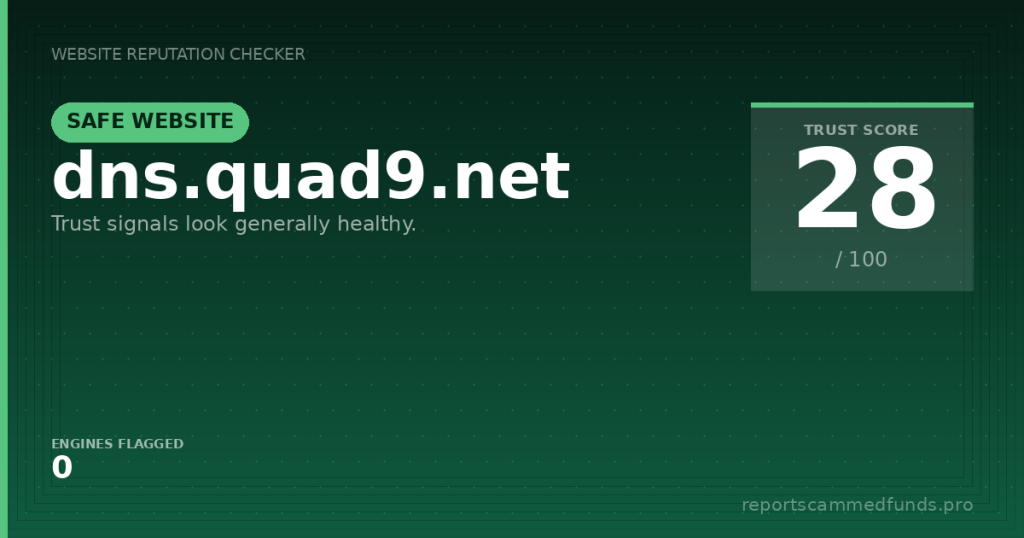
On balance, dns.quad9.net appears to be a legitimate infrastructure hostname operated by a widely recognized non-profit provider of DNS resolution and security filtering. The absence of a conventional webpage at this address is expected and reflects its purpose as an encrypted DNS endpoint. Users seeking a consumer-facing explanation or policy overview should consult the main site at quad9.net rather than judging safety by what appears when typing dns.quad9.net into a browser.
We advise a measured, verification-first approach to configuration. Obtain endpoints from official documentation, ensure your client uses the correct path for DoH or the correct TLS parameters for DoT, and verify that the presented certificate matches the hostname. If you encounter regional anomalies or blocked lookups, consider whether security filtering, court-ordered blocks, or network interception are at play before presuming foul intent by the operator.
There is no evidence that dns.quad9.net is a scam, phishing lure, or malicious asset. That said, the DNS space is not immune to impersonation or misconfiguration, and the stakes for privacy and connectivity are real. Proceed with appropriate due diligence, and if you discover you have interacted with a fraudulent lookalike, follow the recovery steps outlined above and contact reportscammedfunds.pro for further assistance.